Part I | Part II | Part III | Part IV | Part V
Part II: On the Nature and Origin of the Mind
Mind and body are the same thing expressed through different attributes (thought and extension).
Part 2 Important Concepts
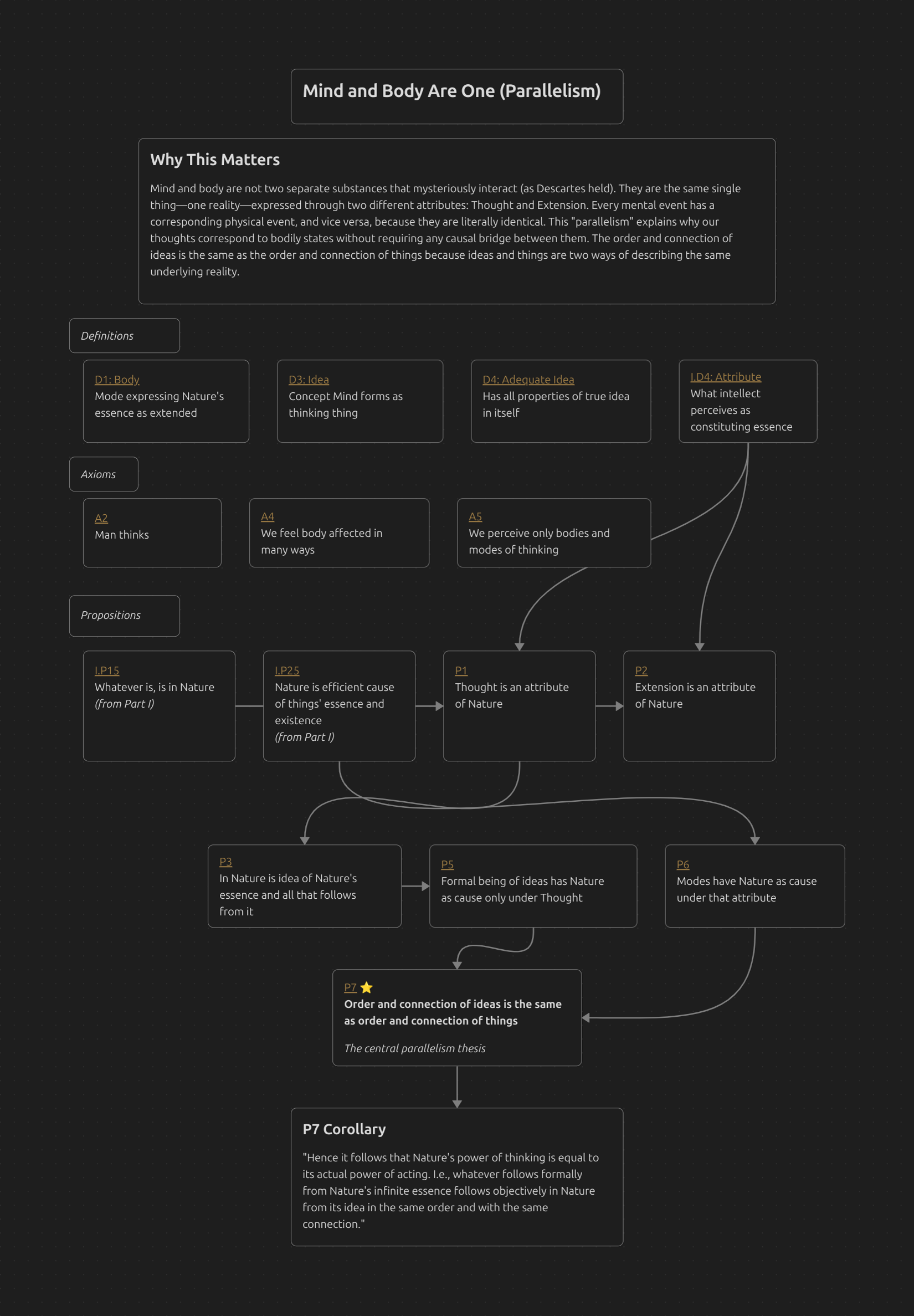
Mind and Body Are One (Parallelism)
Why This Matters
Mind and body are not two separate substances that mysteriously interact (as Descartes held). They are the same single thing—one reality—expressed through two different attributes: Thought and Extension. Every mental event has a corresponding physical event, and vice versa, because they are literally identical. This “parallelism” explains why our thoughts correspond to bodily states without requiring any causal bridge between them. The order and connection of ideas is the same as the order and connection of things because ideas and things are two ways of describing the same underlying reality.
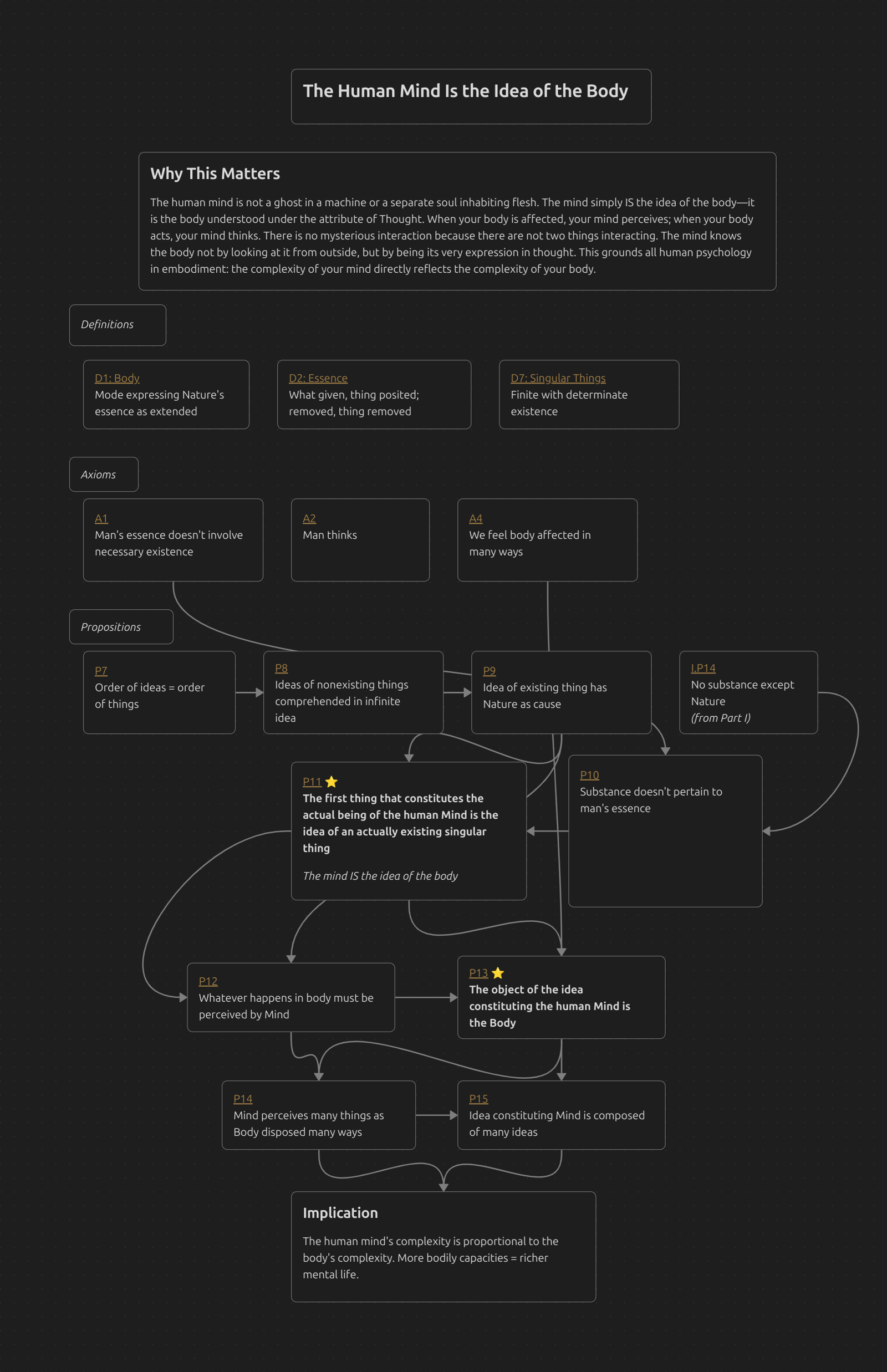
The Human Mind Is the Idea of the Body
Why This Matters
The human mind is not a ghost in a machine or a separate soul inhabiting flesh. The mind simply IS the idea of the body—it is the body understood under the attribute of Thought. When your body is affected, your mind perceives; when your body acts, your mind thinks. There is no mysterious interaction because there are not two things interacting. The mind knows the body not by looking at it from outside, but by being its very expression in thought. This grounds all human psychology in embodiment: the complexity of your mind directly reflects the complexity of your body.
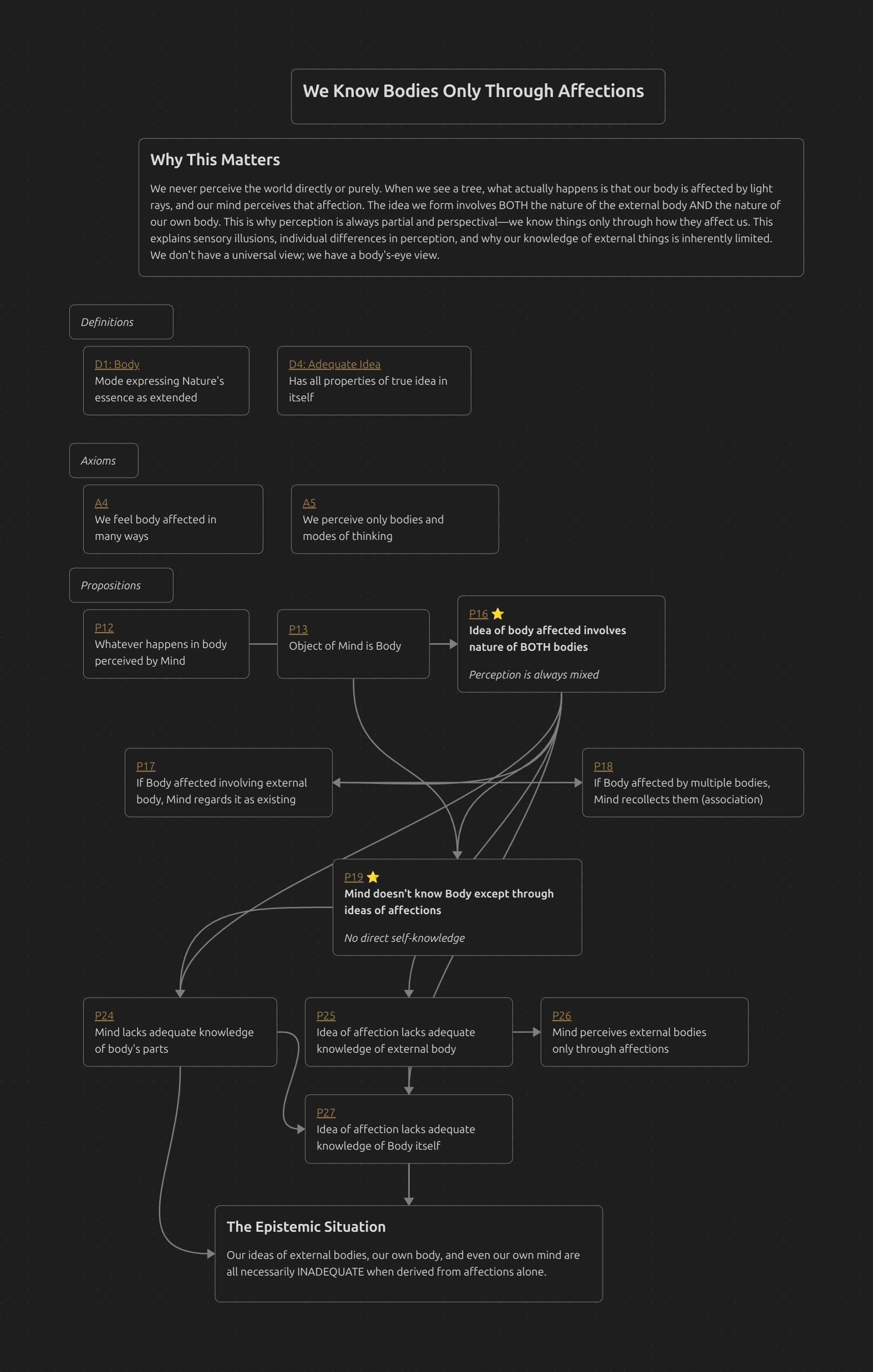
We Know Bodies Only Through Affections
Why This Matters
We never perceive the world directly or purely. When we see a tree, what actually happens is that our body is affected by light rays, and our mind perceives that affection. The idea we form involves BOTH the nature of the external body AND the nature of our own body. This is why perception is always partial and perspectival—we know things only through how they affect us. This explains sensory illusions, individual differences in perception, and why our knowledge of external things is inherently limited. We don’t have a divine view; we have a body’s-eye view.
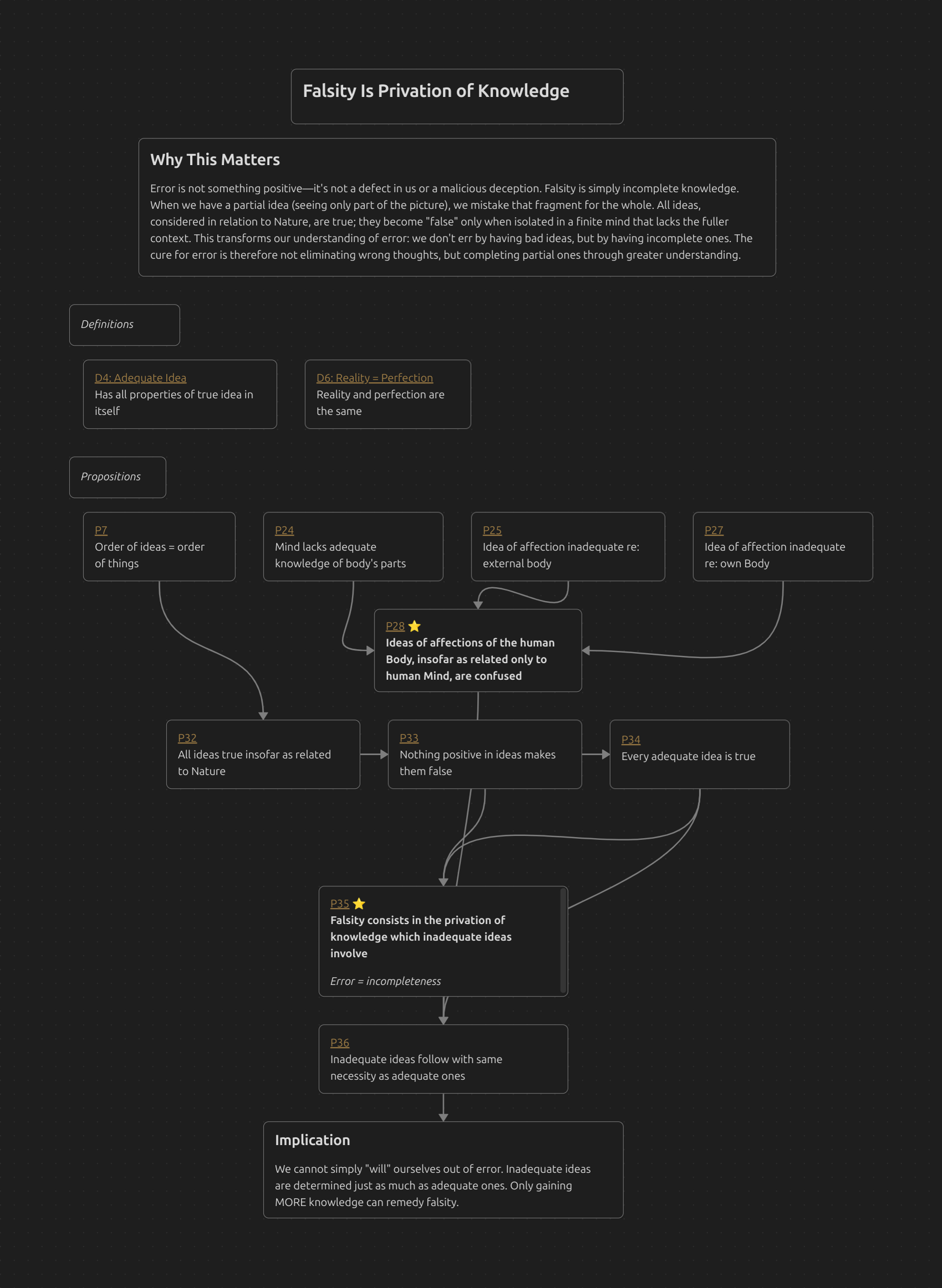
Falsity Is Privation of Knowledge
Why This Matters
Error is not something positive—it’s not a defect in us or a malicious deception. Falsity is simply incomplete knowledge. When we have a partial idea (seeing only part of the picture), we mistake that fragment for the whole. All ideas, considered in relation to Nature, are true; they become “false” only when isolated in a finite mind that lacks the fuller context. This transforms our understanding of error: we don’t err by having bad ideas, but by having incomplete ones. The cure for error is therefore not eliminating wrong thoughts, but completing partial ones through greater understanding.
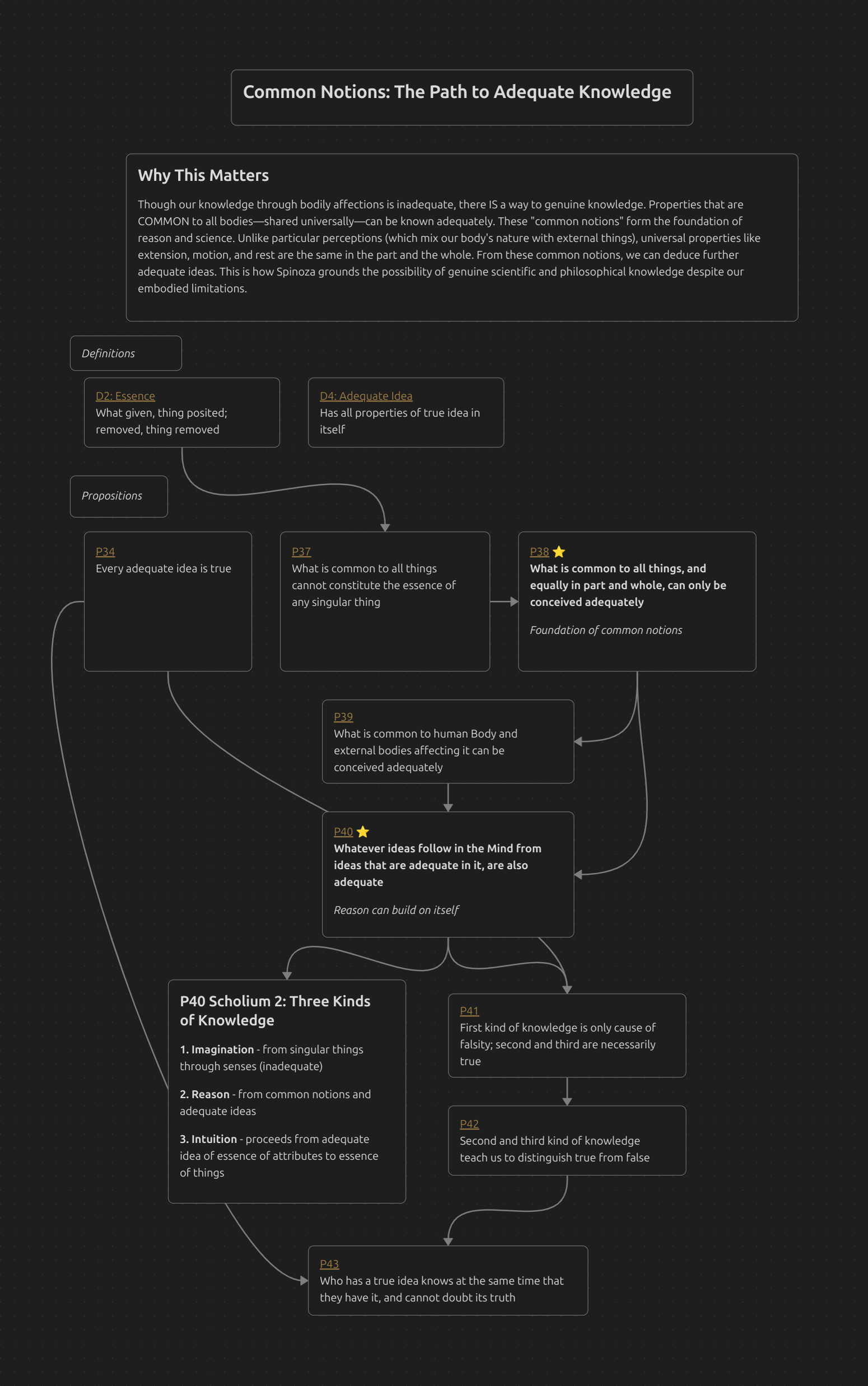
Common Notions: The Path to Adequate Knowledge
Why This Matters
Though our knowledge through bodily affections is inadequate, there IS a way to genuine knowledge. Properties that are COMMON to all bodies—shared universally—can be known adequately. These “common notions” form the foundation of reason and science. Unlike particular perceptions (which mix our body’s nature with external things), divine properties like extension, motion, and rest are the same in the part and the whole. From these common notions, we can deduce further adequate ideas. This is how Spinoza grounds the possibility of genuine scientific and philosophical knowledge despite our embodied limitations.
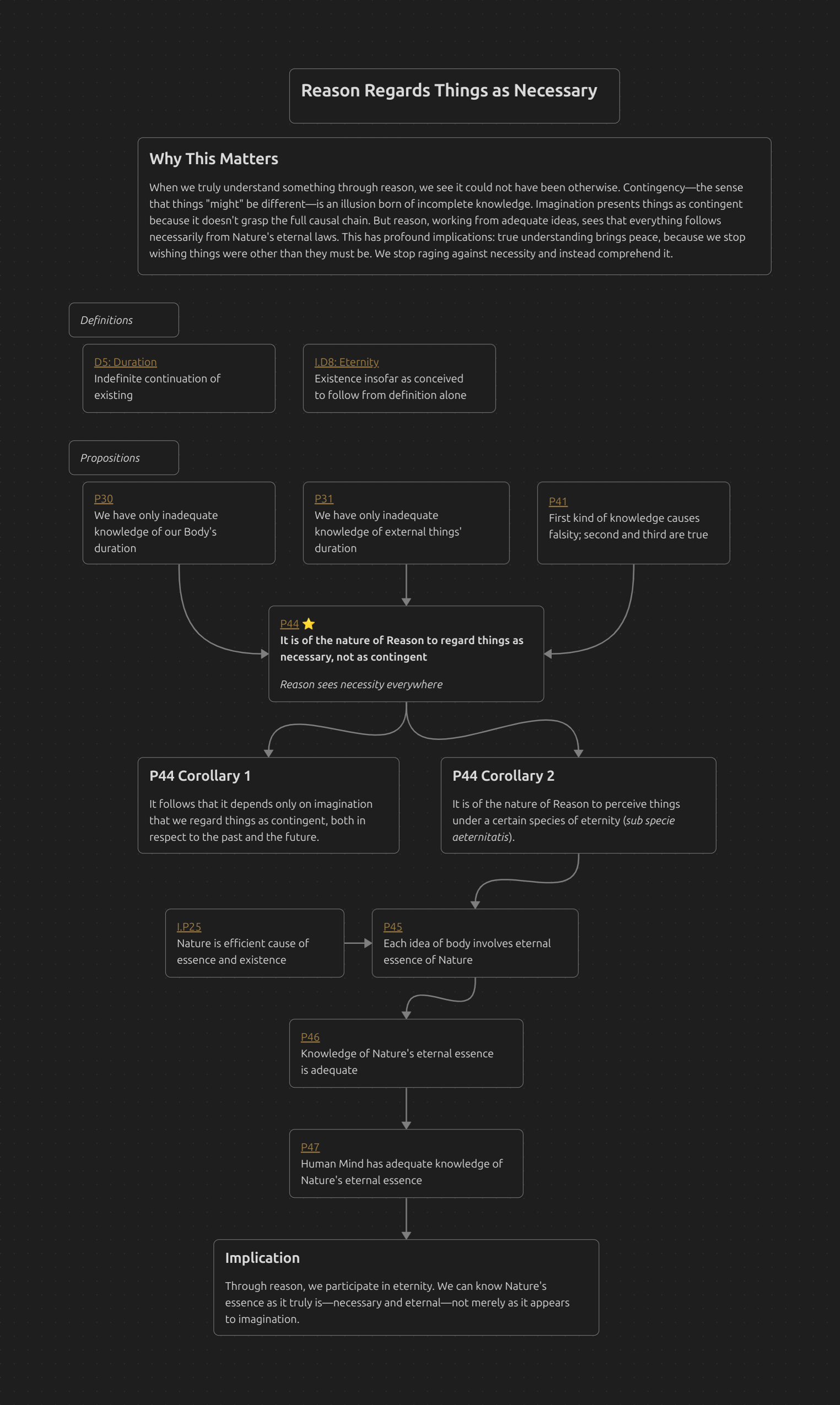
Reason Regards Things as Necessary
Why This Matters
When we truly understand something through reason, we see it could not have been otherwise. Contingency—the sense that things “might” be different—is an illusion born of incomplete knowledge. Imagination presents things as contingent because it doesn’t grasp the full causal chain. But reason, working from adequate ideas, sees that everything follows necessarily from Nature’s eternal laws. This has profound implications: true understanding brings peace, because we stop wishing things were other than they must be. We stop raging against necessity and instead comprehend it.
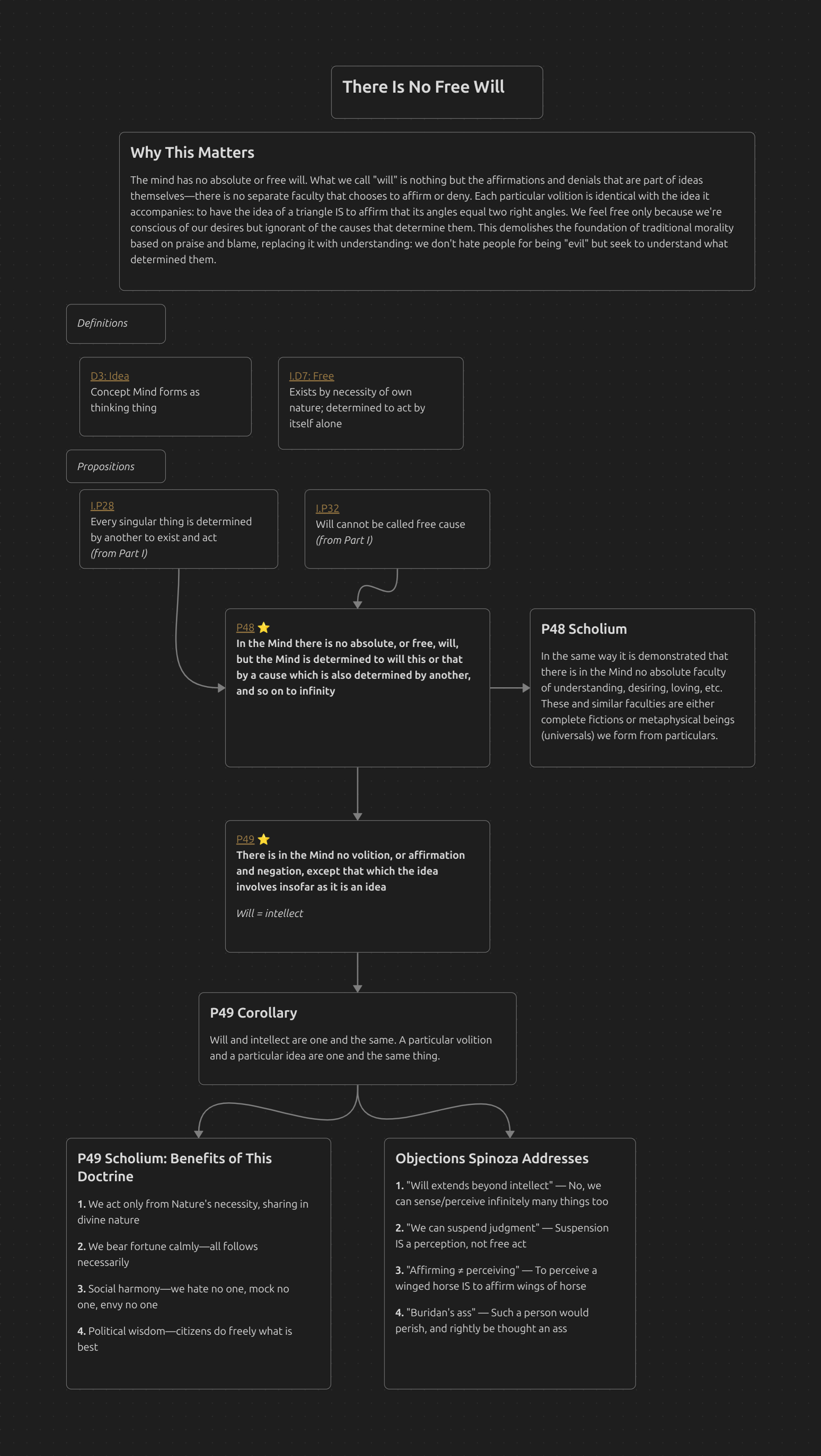
There Is No Free Will
Why This Matters
The mind has no absolute or free will. What we call “will” is nothing but the affirmations and denials that are part of ideas themselves—there is no separate faculty that chooses to affirm or deny. Each particular volition is identical with the idea it accompanies: to have the idea of a triangle IS to affirm that its angles equal two right angles. We feel free only because we’re conscious of our desires but ignorant of the causes that determine them. This demolishes the foundation of traditional morality based on praise and blame, replacing it with understanding: we don’t hate people for being “evil” but seek to understand what determined them.
Link to original
Definitions (7)
- Part II Definition 1 - Body: mode expressing Nature’s essence as extended
- Part II Definition 2 - Essence: what given, thing posited; removed, thing removed
- Part II Definition 3 - Idea: conception Mind forms as thinking thing
- Part II Definition 4 - Adequate idea: has all properties of true idea in itself
- Part II Definition 5 - Duration: indefinite continuance of existing
- Part II Definition 6 - Reality = perfection
- Part II Definition 7 - Individual things: finite with determinate existence
Axioms (5)
- Part II Axiom 1 - Man’s essence doesn’t involve necessary existence
- Part II Axiom 2 - Man thinks
- Part II Axiom 3 - Modes of thinking require idea of object
- Part II Axiom 4 - We feel body affected in many ways
- Part II Axiom 5 - We perceive bodies and modes of thinking only
Propositions (49)
- Part II Proposition 1 - Thought is attribute of Nature | Deps: I.P15, I.D4
- Part II Proposition 2 - Extension is attribute of Nature | Deps: I.P15, I.D4
- Part II Proposition 3 - In Nature is idea of Nature’s essence | Deps: I.P16, P1
- Part II Proposition 4 - Idea of Nature is one only | Deps: I.P14, P3
- Part II Proposition 5 - Formal being of ideas has Nature as cause under thought | Deps: P3
- Part II Proposition 6 - Modes have Nature as cause under that attribute | Deps: I.P25
- Part II Proposition 7 - Order of ideas = order of things ⭐ | Deps: P6
- Part II Proposition 8 - Ideas of nonexisting things comprehended in infinite idea | Deps: P3, P7
- Part II Proposition 9 - Idea of existing thing has Nature as cause | Deps: P7, P8
- Part II Proposition 10 - Substance doesn’t pertain to man’s essence | Deps: I.P14, A1
- Part II Proposition 11 - Mind is idea of actually existing body ⭐ | Deps: P9, P10
- Part II Proposition 12 - Whatever happens in body must be perceived by Mind | Deps: P9, P11
- Part II Proposition 13 - Object of Mind is Body ⭐ | Deps: P11, P12, A4
- Part II Proposition 14 - Mind perceives many things as Body disposed many ways | Deps: P12, P13
- Part II Proposition 15 - Idea constituting Mind is composed of many ideas | Deps: P13, P14
- Part II Proposition 16 - Idea of body affected involves nature of both bodies | Deps: P12, P13
- Part II Proposition 17 - If Body affected involving external body, Mind regards it as existing | Deps: P16
- Part II Proposition 18 - If Body affected by multiple bodies, Mind recollects them (association) | Deps: P17
- Part II Proposition 19 - Mind doesn’t know Body except through affection ideas | Deps: P13, P16
- Part II Proposition 20 - Idea of Mind exists in Nature | Deps: P11, P13
- Part II Proposition 21 - Idea of Mind united to Mind as Mind to Body | Deps: P7, P20
- Part II Proposition 22 - Mind perceives ideas of body’s affections | Deps: P20, P21
- Part II Proposition 23 - Mind knows itself through body affection ideas | Deps: P19, P22
- Part II Proposition 24 - Mind lacks adequate knowledge of body’s parts | Deps: P16, P19
- Part II Proposition 25 - Idea of body affection lacks adequate knowledge of external body | Deps: P16
- Part II Proposition 26 - Mind perceives external bodies only through affections | Deps: P25
- Part II Proposition 27 - Idea of affection lacks adequate knowledge of Body itself | Deps: P16, P24
- Part II Proposition 28 - Ideas of affections are confused | Deps: P24, P25, P27
- Part II Proposition 29 - Idea of idea of affection lacks adequate knowledge of Mind | Deps: P23, P28
- Part II Proposition 30 - We have inadequate knowledge of Body’s duration | Deps: P28
- Part II Proposition 31 - We have inadequate knowledge of external things’ duration | Deps: P28, P30
- Part II Proposition 32 - All ideas true insofar as related to Nature | Deps: P7
- Part II Proposition 33 - Nothing positive in ideas makes them false | Deps: P32
- Part II Proposition 34 - Every Adequate idea is true | Deps: P32, P33
- Part II Proposition 35 - Falsity is privation of knowledge | Deps: P33, P34
- Part II Proposition 36 - Inadequate ideas follow by same necessity as adequate | Deps: P28, P34
- Part II Proposition 37 - What’s common to all doesn’t constitute individual essence | Deps: D2
- Part II Proposition 38 - What’s common to all can only be conceived adequately ⭐ | Deps: P37
- Part II Proposition 39 - What’s common to body and external bodies, idea is adequate | Deps: P38
- Part II Proposition 40 - Ideas following from adequate ideas are adequate ⭐ | Deps: P38, P39
- Part II Proposition 41 - First kind of knowledge causes falsity; second and third are true | Deps: P35, P40
- Part II Proposition 42 - Second and third knowledge distinguish true from false | Deps: P41
- Part II Proposition 43 - Who has true idea knows it and can’t doubt | Deps: P34, P42
- Part II Proposition 44 - Reason regards things as necessary, not contingent ⭐ | Deps: P41
- Part II Proposition 45 - Each idea involves eternal essence of Nature | Deps: I.P25
- Part II Proposition 46 - Knowledge of Nature’s eternal essence is adequate | Deps: P45
- Part II Proposition 47 - Mind has adequate knowledge of Nature’s essence | Deps: P46
- Part II Proposition 48 - No absolute free will; Mind determined by causes | Deps: I.P28
- Part II Proposition 49 - No volition except what idea involves | Deps: P48