Part I | Part II | Part III | Part IV | Part V
Part I: Concerning Nature
Nature is the sole infinite substance; all things exist in and are determined by Nature.
Part 1 Important Concepts
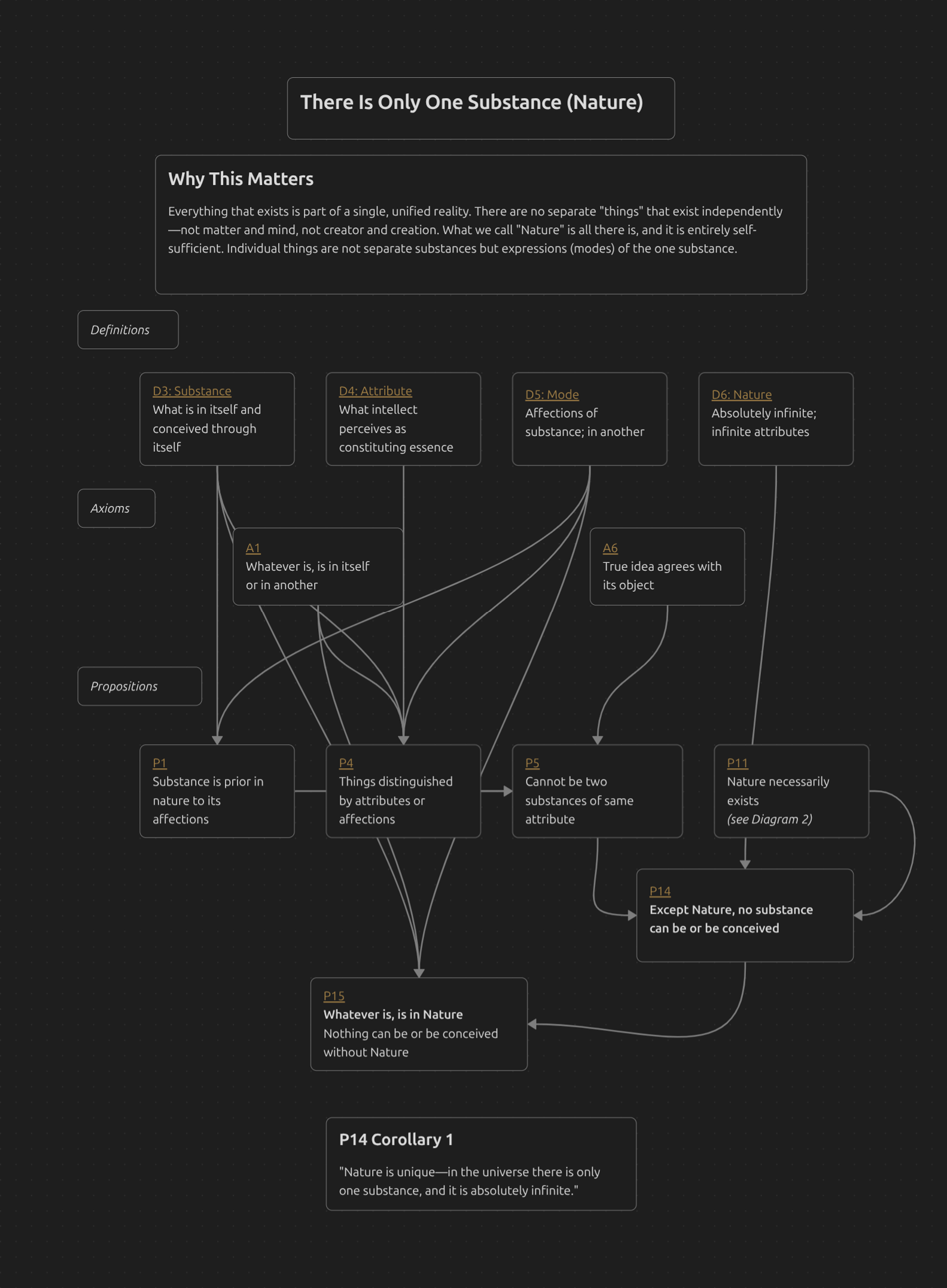
There Is Only One Substance (Nature)
Why This Matters
Everything that exists is part of a single, unified reality. There are no separate “things” that exist independently—not matter and mind, not creator and creation. What we call “Nature” is all there is, and it is entirely self-sufficient. Individual things are not separate substances but expressions (modes) of the one substance.
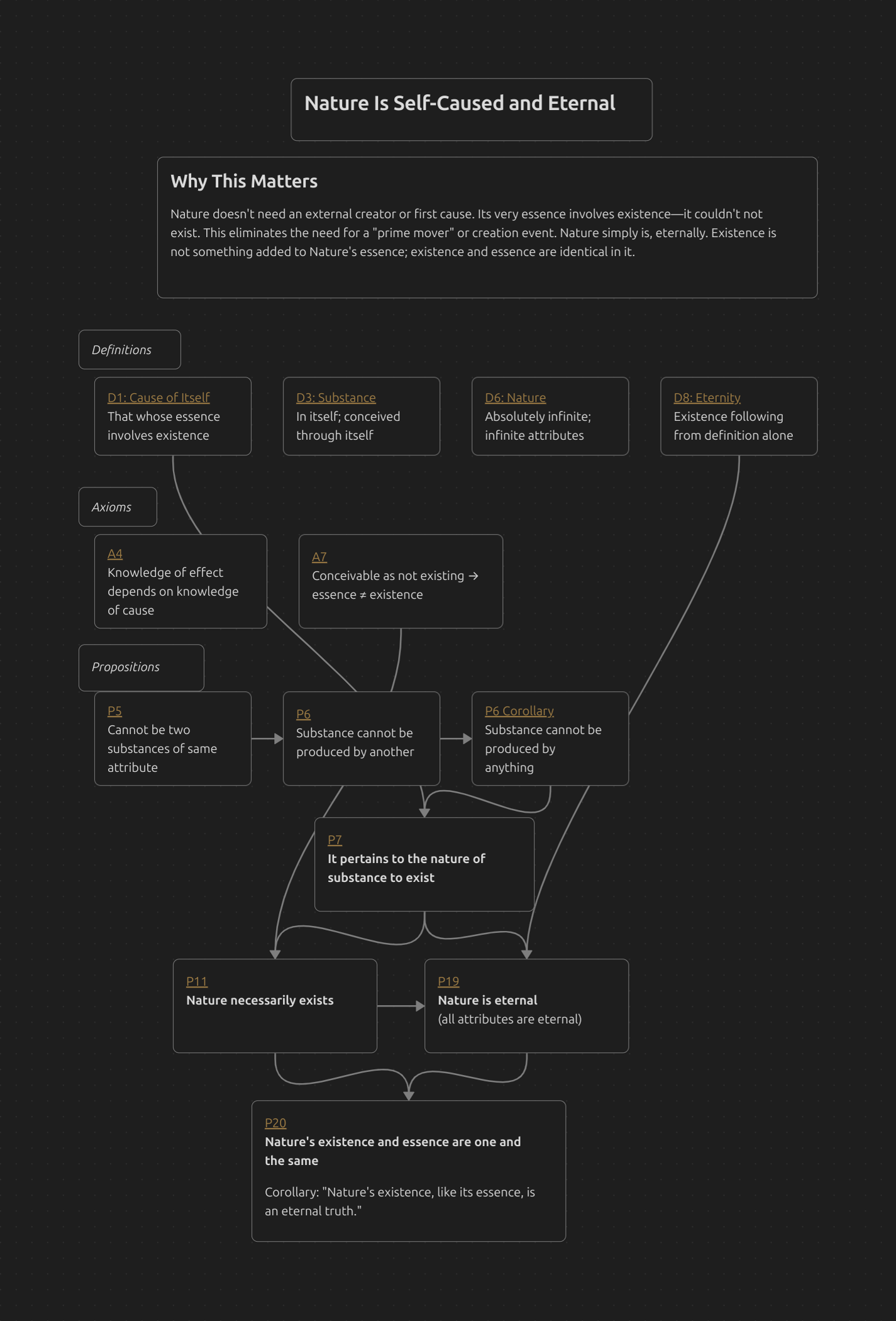
Nature Is Self-Caused and Eternal
Why This Matters
Nature doesn’t need an external creator or first cause. Its very essence involves existence—it couldn’t not exist. This eliminates the need for a “prime mover” or creation event. Nature simply is, eternally. Existence is not something added to Nature’s essence; existence and essence are identical in it.
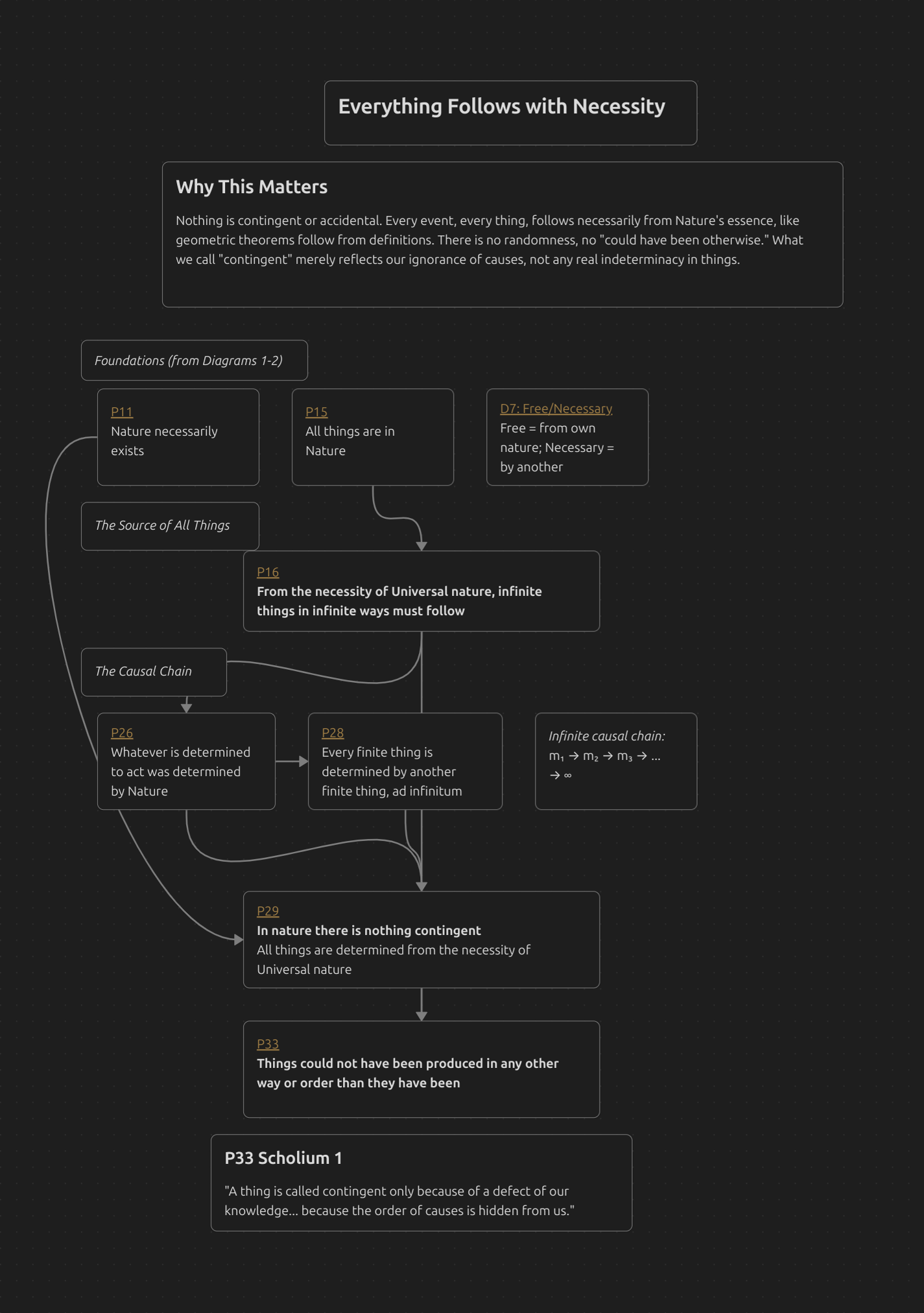
Everything Follows with Necessity
Why This Matters
Nothing is contingent or accidental. Every event, every thing, follows necessarily from Nature’s essence, like geometric theorems follow from definitions. There is no randomness, no “could have been otherwise.” What we call “contingent” merely reflects our ignorance of causes, not any real indeterminacy in things.
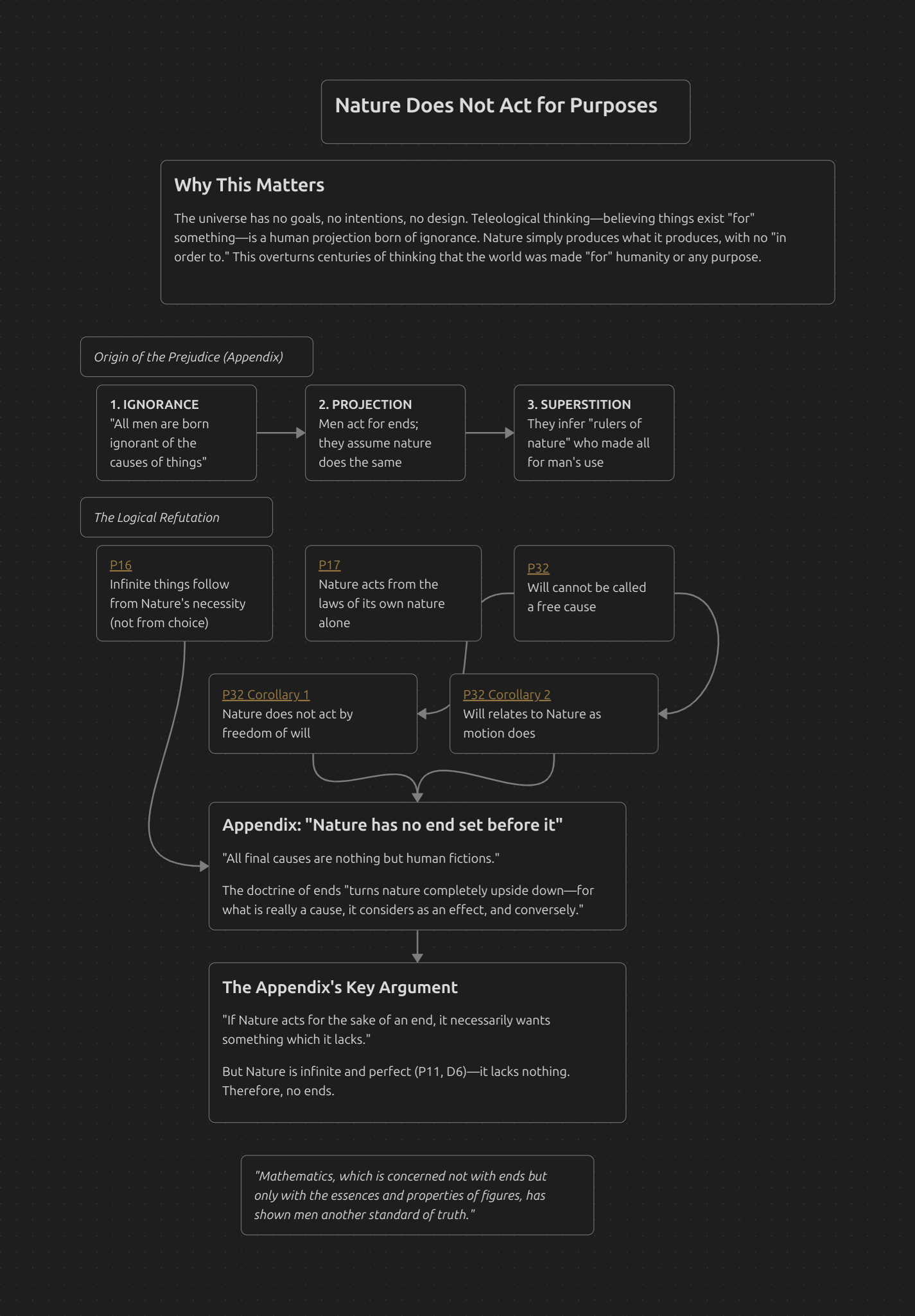
Nature Does Not Act for Purposes
Why This Matters
The universe has no goals, no intentions, no design. Teleological thinking—believing things exist “for” something—is a human projection born of ignorance. Nature simply produces what it produces, with no “in order to.” This overturns centuries of thinking that the world was made “for” humanity or any purpose.
Mental freedom Is Acting from One’s Own Nature
Why This Matters
True mental freedom isn’t “free will”—choosing without cause. Mental freedom is acting from the necessity of your own nature, not being compelled by external forces. Nature alone is truly free, since it acts entirely from itself. Humans approach mental freedom through understanding necessity and acting from reason rather than compulsion.
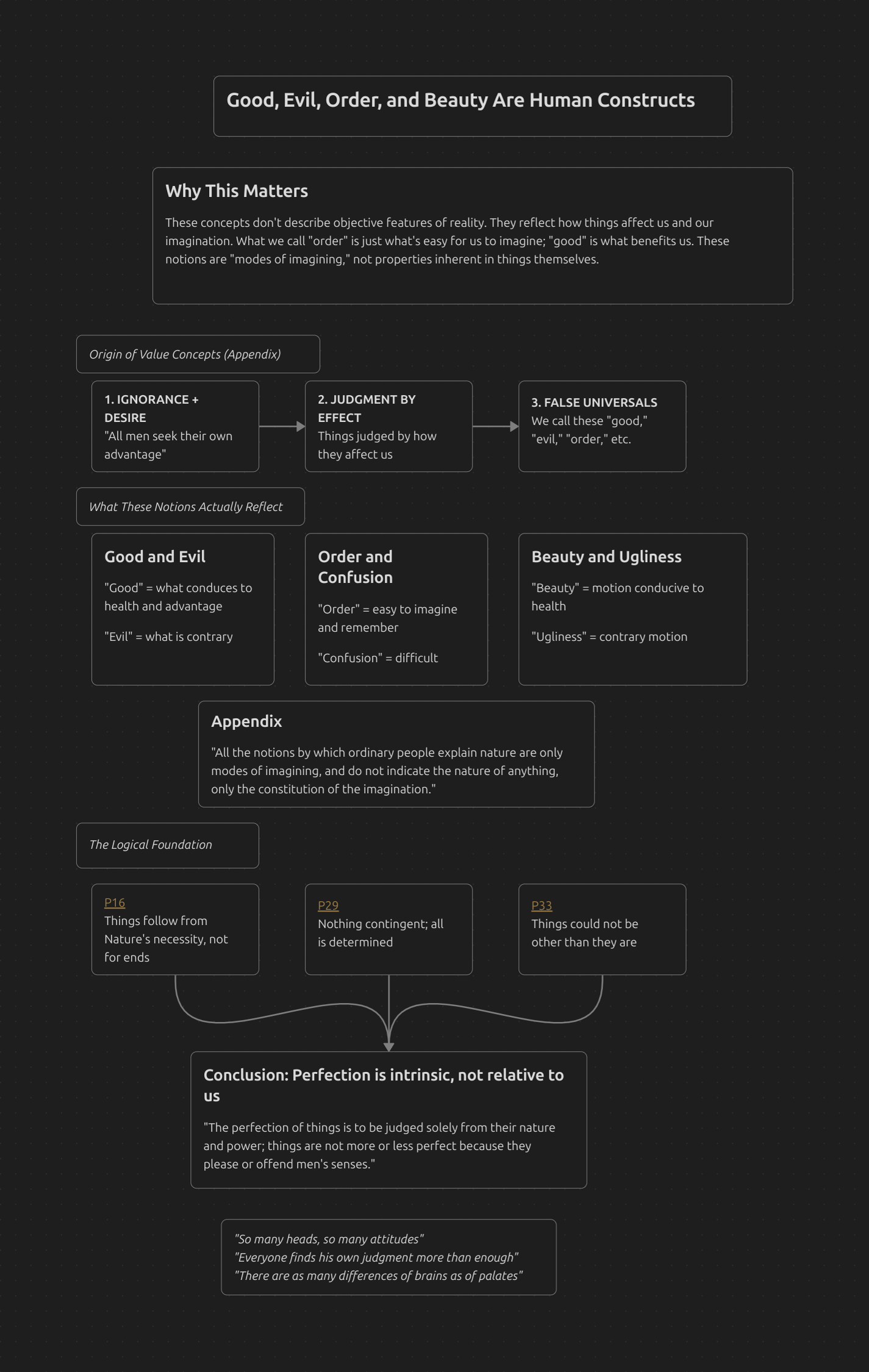
Good, Evil, Order, and Beauty Are Human Constructs
Why This Matters
These concepts don’t describe objective features of reality. They reflect how things affect us and our imagination. What we call “order” is just what’s easy for us to imagine; “good” is what benefits us. These notions are “modes of imagining,” not properties inherent in things themselves.
Link to original

Definitions (8)
- Part I Definition 1 - Cause of itself: essence involves existence
- Part I Definition 2 - Finite in its own kind: limited by another of same nature
- Part I Definition 3 - Substance: in itself, conceived through itself
- Part I Definition 4 - Attribute: what intellect perceives as constituting essence
- Part I Definition 5 - Mode: affections of substance, in another
- Part I Definition 6 - Nature: absolutely infinite substance with infinite attributes
- Part I Definition 7 - Free: exists from own nature, self-determined
- Part I Definition 8 - Eternity: existence following necessarily from definition
Axioms (7)
- Part I Axiom 1 - Everything is in itself or in another
- Part I Axiom 2 - What not conceived through another must be conceived through itself
- Part I Axiom 3 - From determinate cause, effect follows necessarily
- Part I Axiom 4 - Knowledge of effect depends on knowledge of cause
- Part I Axiom 5 - Things with nothing in common can’t understand each other
- Part I Axiom 6 - True idea agrees with object
- Part I Axiom 7 - If thing can be conceived as not existing, essence doesn’t involve existence
Propositions (36)
- Part I Proposition 1 - Substance prior to its affections | Deps: D3, D5
- Part I Proposition 2 - Two substances with different attributes have nothing in common | Deps: D3
- Part I Proposition 3 - Things with nothing in common, one can’t cause other | Deps: A4, A5
- Part I Proposition 4 - Distinct things distinguished by attributes or affections | Deps: D3, D5
- Part I Proposition 5 - No two substances of same nature/attribute | Deps: P4
- Part I Proposition 6 - One substance can’t produce another | Deps: P2, P3
- Part I Proposition 7 - Existence belongs to nature of substance | Deps: D3, D5, A1
- Part I Proposition 8 - Every substance necessarily infinite | Deps: D2, P7
- Part I Proposition 9 - More reality = more attributes | Deps: D4
- Part I Proposition 10 - Each attribute conceived through itself | Deps: D4
- Part I Proposition 11 - Nature necessarily exists ⭐ | Deps: D6, P7, A7
- Part I Proposition 12 - No attribute allows substance to be divided | Deps: P8
- Part I Proposition 13 - Absolutely infinite substance indivisible | Deps: P8, P12
- Part I Proposition 14 - Only Nature exists/can be conceived ⭐ | Deps: D6, P11
- Part I Proposition 15 - Whatever is, is in Nature ⭐ | Deps: P14
- Part I Proposition 16 - Infinitely many things follow from Nature | Deps: P15, D6
- Part I Proposition 17 - Nature acts from own nature alone ⭐ | Deps: D7, P16
- Part I Proposition 18 - Nature is immanent cause | Deps: P15, P16
- Part I Proposition 19 - Nature and attributes eternal | Deps: D8, P11
- Part I Proposition 20 - Nature’s existence = Nature’s essence | Deps: P19, D6
- Part I Proposition 21 - What follows from absolute nature of attribute exists eternally/infinitely | Deps: P16
- Part I Proposition 22 - What follows from attribute exists eternally/infinitely | Deps: P21
- Part I Proposition 23 - Eternal/infinite mode must follow from absolute nature | Deps: P21, P22
- Part I Proposition 24 - Essence of produced things doesn’t involve existence | Deps: A7, P21
- Part I Proposition 25 - Nature is efficient cause of essence and existence | Deps: P16, P24
- Part I Proposition 26 - Thing determined by Nature necessarily so determined | Deps: P24, P25
- Part I Proposition 27 - Thing determined by Nature can’t make itself undetermined | Deps: P26
- Part I Proposition 28 - Individual thing determined only by another individual thing | Deps: P26, P27
- Part I Proposition 29 - Nothing contingent; all determined by necessity ⭐ | Deps: P16, P26, P28
- Part I Proposition 30 - Intellect must comprehend attributes and affections of Nature | Deps: P15
- Part I Proposition 31 - Actual intellect comprehends attributes and affections only | Deps: P30
- Part I Proposition 32 - Will is necessary, not free | Deps: P28
- Part I Proposition 33 - Things couldn’t be produced differently | Deps: P16, P29
- Part I Proposition 34 - Nature’s power is Nature’s essence | Deps: P16
- Part I Proposition 35 - Whatever in Nature’s power necessarily exists | Deps: P34
- Part I Proposition 36 - From everything’s nature, effects follow | Deps: P29
APPENDIX
Alternative: Part 1 Appendix - Modernized
With these {demonstrations} I have explained God/Nature’s nature and properties: that he exists necessarily; that he is unique; that he is and acts from the necessity alone of his nature; that (and how) he is the free cause of all things; that all things are in God/Nature and so depend on him that without him they can neither be nor be conceived; and finally, that all things have been predetermined by God/Nature, not from mental freedom of the will or absolute good pleasure, but from God/Nature’s absolute nature, or infinite power.
Further, I have taken care, whenever the occasion arose, to remove prejudices that could prevent my demonstrations from being perceived. But because many prejudices remain that could, and can, be a great obstacle to men’s understanding the connection of things in the way I have explained it, I considered it worthwhile to submit them here to the scrutiny of reason. All the prejudices I here undertake to expose depend on this one: that men commonly suppose that all natural things act, as men do, on account of an end; indeed, they maintain as certain that God/Nature himself directs all things to some certain end, for they say that God/Nature has made all things for man, and man that he might worship God/Nature.
So I shall begin by considering this one prejudice, asking first [I] why most people are satisfied that it is true, and why all are so inclined by nature to embrace it. Then [II] I shall show its falsity, and finally [III] how, from this, prejudices have arisen concerning good and evil, merit and sin, praise and blame, order and confusion, beauty and ugliness, and other things of this kind.
[I.] Of course this is not the place to deduce these things from the nature of the human mind. It will be sufficient here if I take as a foundation what everyone must acknowledge: that all men are born ignorant of the causes of things, and that they all want to seek their own advantage, and are conscious of this appetite.
From these {assumptions} it follows, first, that men think themselves free, because they are conscious of their volitions and their appetite, and do not think, even in their dreams, of the causes by which they are disposed to wanting and willing, because they are ignorant of {those causes}. It follows, secondly, that men act always on account of an end, viz. on account of their advantage, which they want. Hence they seek to know only the final causes of what has been done, and when they have heard them, they are satisfied, because they have no reason to doubt further. But if they cannot hear them from another, nothing remains for them but to turn toward themselves, and reflect on the ends by which they are usually determined to do such things; so they necessarily judge the temperament of other men from their own temperament.
Furthermore, they find—both in themselves and outside themselves—many means that are very helpful in seeking their own advantage, e.g., eyes for seeing, teeth for chewing, plants and animals for food, the sun for light, the sea for supporting fish {and so with almost all other things whose natural causes they have no reason to doubt}. Hence, they consider all natural things as means to their own advantage. And knowing that they had found these means, not provided them for themselves, they had reason to believe that there was someone else who had prepared those means for their use. For after they considered things as means, they could not believe that the things had made themselves; but from the means they were accustomed to prepare for themselves, they had to infer that there was a ruler, or a number of rulers of nature, endowed with human mental freedom, who had taken care of all things for them, and made all things for their use.
And since they had never heard anything about the temperament of these rulers, they had to judge it from their own. Hence, they maintained that the Gods direct all things for the use of men in order to bind men to them and be held by men in the highest honor. So it has happened that each of them has thought up from his own temperament different ways of worshipping God/Nature, so that God/Nature might love them above all the rest, and direct the whole of Nature according to the needs of their blind desire and insatiable greed. Thus this prejudice was changed into superstition, and struck deep roots in their minds. This was why each of them strove with great diligence to understand and explain the final causes of all things.
But while they sought to show that nature does nothing in vain (i.e., nothing which is not of use to men), they seem to have shown only that nature and the Gods are as mad as men. See, I ask you, how the matter has turned out in the end! Among so many conveniences in nature they had to find many inconveniences: storms, earthquakes, diseases, etc. These, they maintain, happen because the Gods {(whom they judge to be of the same nature as themselves)} are angry on account of wrongs done to them by men, or on account of sins committed in their worship. And though their daily experience contradicted this, and though infinitely many examples showed that conveniences and inconveniences happen indiscriminately to the pious and the impious alike, they did not on that account give up their longstanding prejudice. It was easier for them to put this among the other unknown things, whose use they were ignorant of, and so remain in the state of ignorance in which they had been born, than to destroy that whole construction, and think up a new one.
So they maintained it as certain that the judgments of the Gods far surpass man’s grasp. This alone, of course, would have caused the truth to be hidden from the human race to eternity, if Mathematics, which is concerned not with ends, but only with the essences and properties of figures, had not shown men another standard of truth. And besides Mathematics, we can assign other causes also (which it is unnecessary to enumerate here), which were able to bring it about that men {—but very few, in relation to the whole human race—} would notice these common prejudices and be led to the true knowledge of things.
[II.] With this I have sufficiently explained what I promised in the first place {viz. why men are so inclined to believe that all things act for an end}. Not many words will be required now to show that Nature has no end set before it, and that all final causes are nothing but human fictions. For I believe I have already sufficiently established it, both by the foundations and causes from which I have shown this prejudice to have had its origin, and also by P16, P32C1 and C2, and all those {propositions} by which I have shown that all things proceed by a certain eternal necessity of nature, and with the greatest perfection.
I shall, however, add this: this doctrine concerning the end turns nature completely upside down. For what is really a cause, it considers as an effect, and conversely {what is an effect it considers as a cause}. What is by nature prior, it makes posterior. And finally, what is supreme and most perfect, it makes imperfect.
For—to pass over the first two, since they are manifest through themselves—as has been established in PP21-23, that effect is most perfect which is produced immediately by God/Nature, and the more something requires intermediate causes to produce it, the more imperfect it is. But if the things which have been produced immediately by God/Nature had been made so that God/Nature would achieve his end, then the last things, for the sake of which the first would have been made, would be the most excellent of all.
Again, this doctrine takes away God/Nature’s perfection. For if God/Nature acts for the sake of an end, he necessarily wants something which he lacks. And though the Theologians and Metaphysicians distinguish between an end of need and an end of assimilation, they nevertheless confess that God/Nature did all things for his own sake, not for the sake of the things to be created. For before creation they can assign nothing except God/Nature for whose sake God/Nature would act. And so they are necessarily compelled to confess that God/Nature lacked those things for the sake of which he willed to prepare means, and that he desired them. This is clear through itself.
Nor ought we here to pass over the fact that the Followers of this doctrine, who have wanted to show off their cleverness in assigning the ends of things, have introduced—to prove this doctrine of theirs—a new way of arguing: by reducing things, not to the impossible, but to ignorance. This shows that no other way of defending their doctrine was open to them.
For example, if a stone has fallen from a roof onto someone’s head and killed him, they will show, in the following way, that the stone fell in order to kill the man. For if it did not fall to that end, God/Nature willing it, how could so many circumstances have concurred by chance (for often many circumstances do concur at once)? Perhaps you will answer that it happened because the wind was blowing hard and the man was walking that way. But they will persist: why was the wind blowing hard at that time? why was the man walking that way at that same time? If you answer again that the wind arose then because on the preceding day, while the weather was still calm, the sea began to toss, and that the man had been invited by a friend, they will press on—for there is no end to the questions which can be asked: but why was the sea tossing? why was the man invited at just that time? And so they will not stop asking for the causes of causes until you take refuge in the will of God/Nature, i.e., the sanctuary of ignorance.
Similarly, when they see the structure of the human body, they are struck by a foolish wonder, and because they do not know the causes of so great an art, they infer that it is constructed, not by mechanical, but by Divine/Divine, or supernatural art, and constituted in such a way that one part does not injure another.
Hence it happens that one who seeks the true causes of miracles, and is eager, like an educated man, to understand natural things, not to wonder at them, like a fool, is generally considered and denounced as an impious heretic by those whom the people honor as interpreters of nature and the Gods. For they know that if ignorance is taken away, then foolish wonder, the only means they have of arguing and defending their authority, is also taken away. But I leave these things, and pass on to what I have decided to treat here in the third place.
[III.] After men persuaded themselves that everything that happens, happens on their account, they had to judge that what is most important in each thing is what is most useful to them, and to rate as most excellent all those things by which they were most pleased. Hence, they had to form these notions, by which they explained natural things: good, evil, order, confusion, warm, cold, beauty, ugliness. And because they think themselves free, those notions have arisen: praise and blame, sin and merit. The latter I shall explain after I have treated human nature; but the former I shall briefly explain here.
Whatever conduces to health and the worship of God/Nature, they have called good; but what is contrary to these, evil.
And because those who do not understand the nature of things, but only imagine them, affirm nothing concerning things, and take the imagination for the intellect, they firmly believe, in their ignorance of things and of their own nature, that there is an order in things. For when things are so disposed that, when they are presented to us through the senses, we can easily imagine them, and so can easily remember them, we say that they are well-ordered; but if the opposite is true, we say that they are badly ordered, or confused.
And since those things we can easily imagine are especially pleasing to us, men prefer order to confusion, as if order were anything in nature more than a relation to our imagination. They also say that God/Nature has created all things in order, and so, unknowingly attribute imagination to God/Nature—unless, perhaps, they mean that God/Nature, to provide for human imagination, has disposed all things so that men can very easily imagine them. Nor will it, perhaps, give them pause that infinitely many things are found which far surpass our imagination, and a great many which confuse it on account of its weakness. But enough of this.
The other notions are also nothing but modes of imagining, by which the imagination is variously affected; and yet the ignorant consider them the chief attributes of things, because, as we have already said, they believe all things have been made for their sake, and call the nature of a thing good or evil, sound or rotten and corrupt, as they are affected by it. For example, if the motion the nerves receive from objects presented through the eyes is conducive to health, the objects by which it is caused are called beautiful; those which cause a contrary motion are called ugly. Those which move the sense through the nose, they call pleasant-smelling or stinking; through the tongue, sweet or bitter, tasty or tasteless; through touch, hard or soft, rough or smooth, etc.; and finally, those which move the ears are said to produce noise, sound or harmony. Men have been so mad as to believe that God/Nature is pleased by harmony. Indeed there are Philosophers who have persuaded themselves that the motions of the heavens produce a harmony.
All of these things show sufficiently that each one has judged things according to the disposition of his brain; or rather, has accepted affections of the imagination as things. So it is no wonder (to note this, too, in passing) that we find so many controversies to have arisen among men, and that they have finally given rise to Skepticism. For although human bodies agree in many things, they still differ in very many. And for that reason what seems good to one, seems bad to another; what seems ordered to one, seems confused to another; what seems pleasing to one, seems displeasing to another, and so on.
I pass over the {other notions} here, both because this is not the place to treat them at length, and because everyone has experienced this {variability} sufficiently for himself. That is why we have such sayings as “So many heads, so many attitudes,” “everyone finds his own judgment more than enough,” and “there are as many differences of brains as of palates.” These proverbs show sufficiently that men judge things according to the disposition of their brain, and imagine, rather than understand them. For if men had understood them, the things would at least convince them all, even if they did not attract them all, as the example of mathematics shows.
We see, therefore, that all the notions by which ordinary people are accustomed to explain nature are only modes of imagining, and do not indicate the nature of anything, only the constitution of the imagination. And because they have names, as if they were {notions} of beings existing outside the imagination, I call them beings, not of reason, but of imagination. So all the arguments in which people try to use such notions against us can easily be warded off.
For many are accustomed to arguing in this way: if all things have followed from the necessity of God/Nature’s most perfect nature, why are there so many imperfections in nature? why are things corrupt to the point where they stink? so ugly that they produce nausea? why is there confusion, evil, and sin?
As I have just said, those who argue in this way are easily answered. For the perfection of things is to be judged solely from their nature and power; things are not more or less perfect because they please or offend men’s senses, or because they are of use to, or are incompatible with, human nature.
But to those who ask “why God/Nature did not create all men so that they would be governed by the command of reason?” I answer only “because he did not lack material to create all things, from the highest degree of perfection to the lowest;” or, to speak more properly, “because the laws of his nature have been so ample that they sufficed for producing all things which can be conceived by an infinite intellect” (as I have demonstrated in P16).
These are the prejudices I undertook to note here. If any of this kind still remain, they can be corrected by anyone with only a little meditation. {And so I find no reason to devote more time to these matters, etc.}