Part I | Part II | Part III | Part IV | Part V
Part III: On the Origin and Nature of the Affects
Human emotions arise from the body’s power of acting and the conatus (striving to persist).
Part 3 Important Concepts
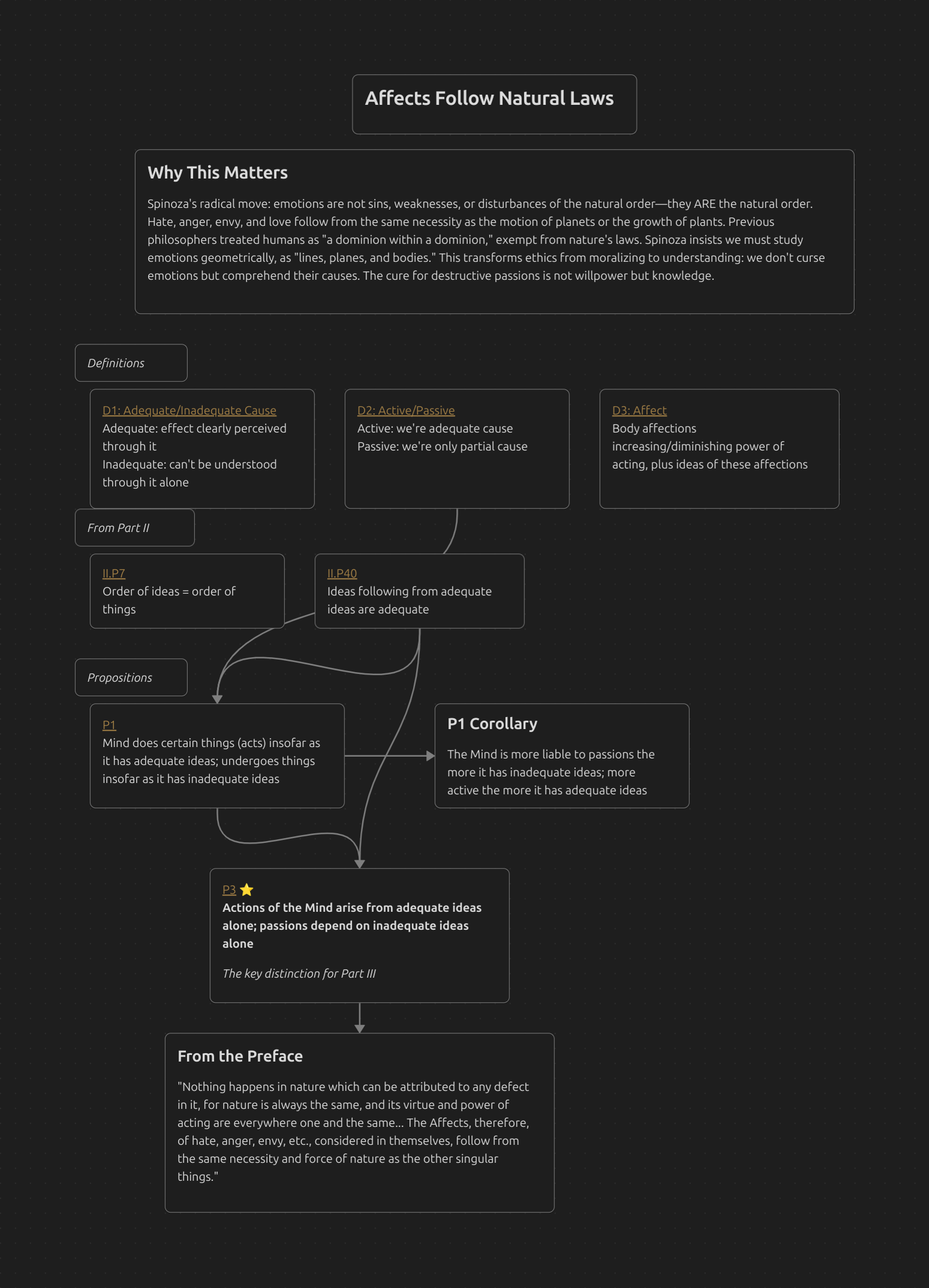
Affects Follow Natural Laws
Why This Matters
Spinoza’s radical move: emotions are not sins, weaknesses, or disturbances of the natural order—they ARE the natural order. Hate, anger, envy, and love follow from the same necessity as the motion of planets or the growth of plants. Previous philosophers treated humans as “a dominion within a dominion,” exempt from nature’s laws. Spinoza insists we must study emotions geometrically, as “lines, planes, and bodies.” This transforms ethics from moralizing to understanding: we don’t curse emotions but comprehend their causes. The cure for destructive passions is not willpower but knowledge.
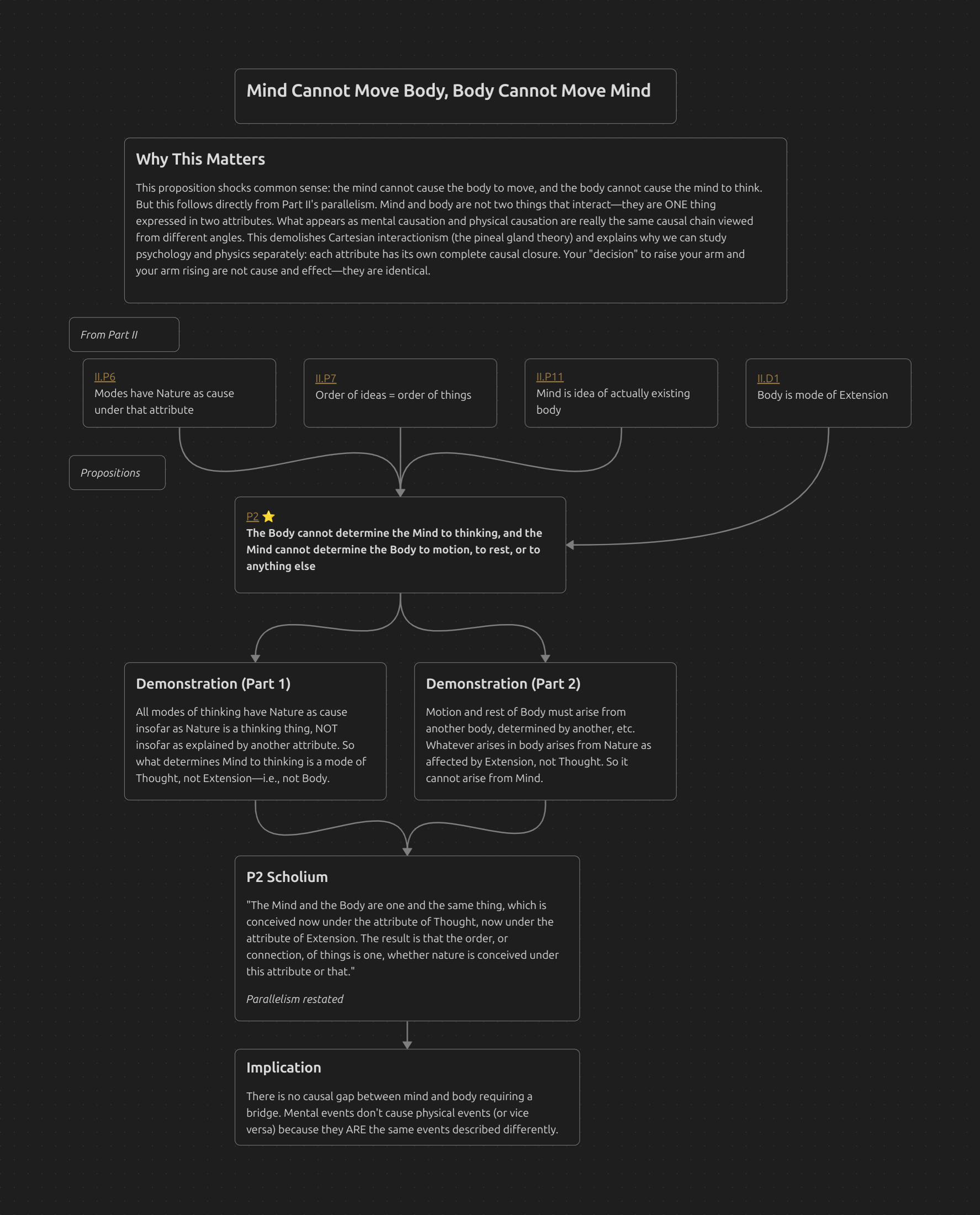
Mind Cannot Move Body, Body Cannot Move Mind
Why This Matters
This proposition shocks common sense: the mind cannot cause the body to move, and the body cannot cause the mind to think. But this follows directly from Part II’s parallelism. Mind and body are not two things that interact—they are ONE thing expressed in two attributes. What appears as mental causation and physical causation are really the same causal chain viewed from different angles. This demolishes Cartesian interactionism (the pineal gland theory) and explains why we can study psychology and physics separately: each attribute has its own complete causal closure. Your “decision” to raise your arm and your arm rising are not cause and effect—they are identical.
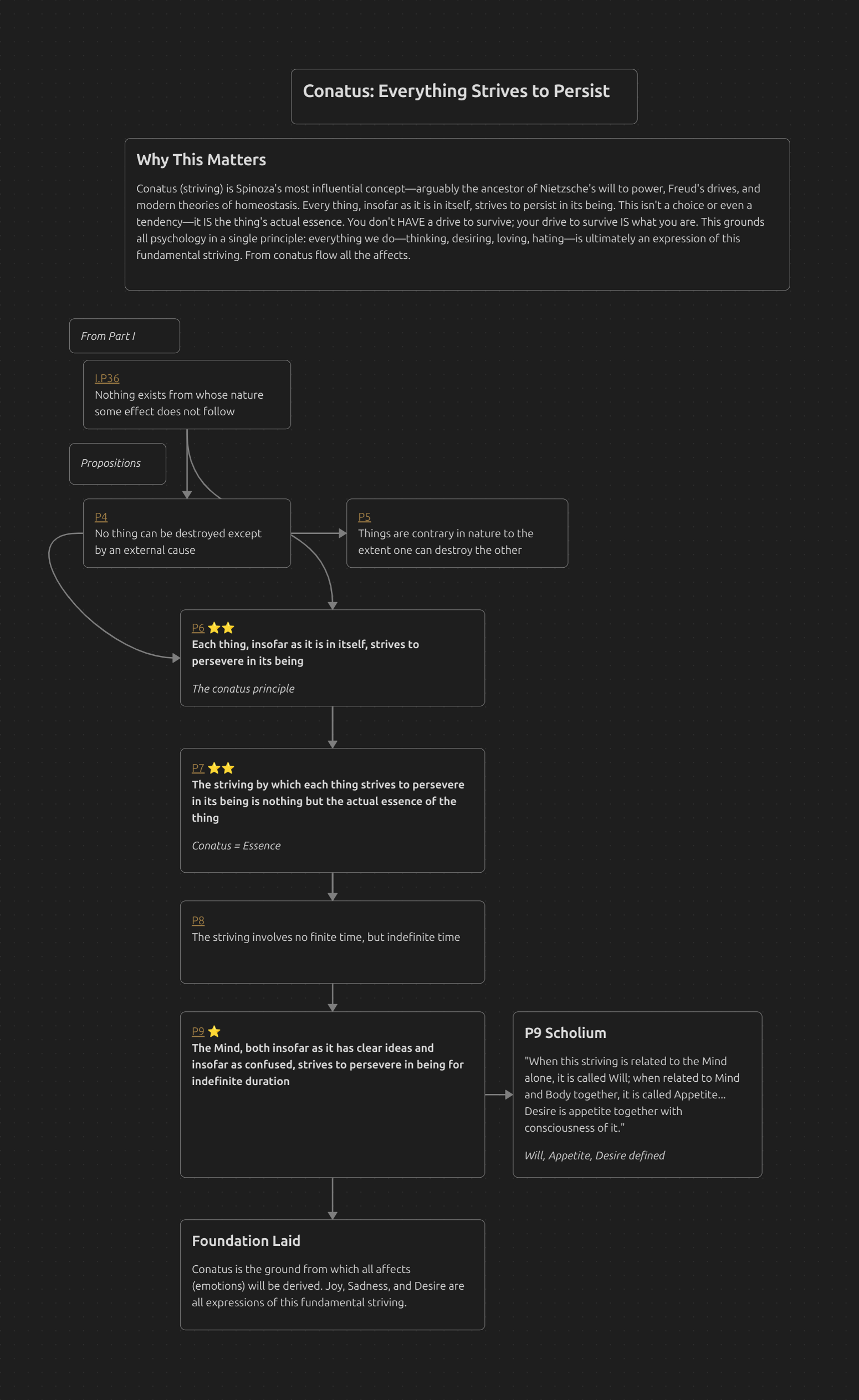
Conatus: Everything Strives to Persist
Why This Matters
Conatus (striving) is Spinoza’s most influential concept—arguably the ancestor of Nietzsche’s will to power, Freud’s drives, and modern theories of homeostasis. Every thing, insofar as it is in itself, strives to persist in its being. This isn’t a choice or even a tendency—it IS the thing’s actual essence. You don’t HAVE a drive to survive; your drive to survive IS what you are. This grounds all psychology in a single principle: everything we do—thinking, desiring, loving, hating—is ultimately an expression of this fundamental striving. From conatus flow all the affects.
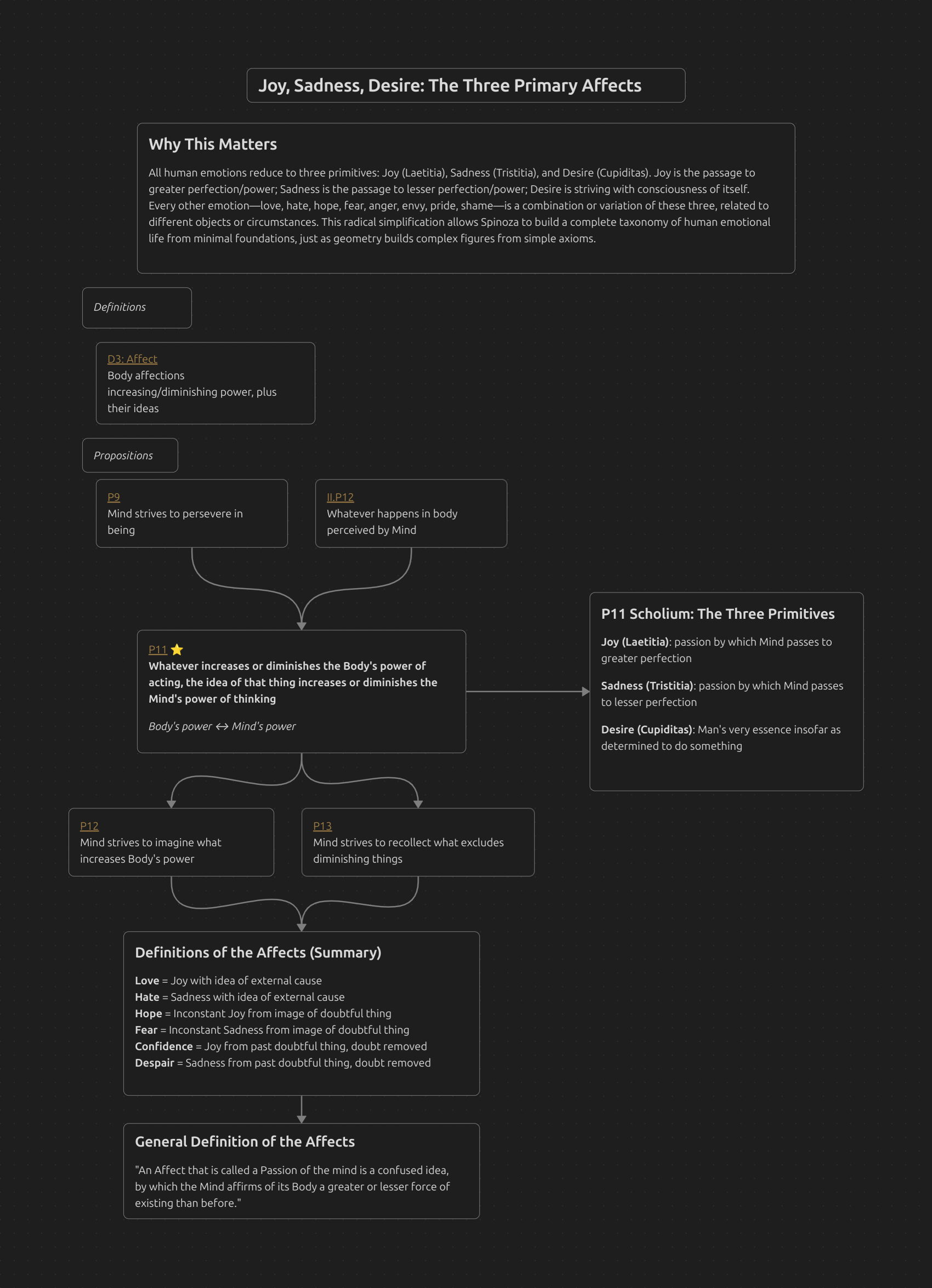
Joy, Sadness, Desire: The Three Primary Affects
Why This Matters
All human emotions reduce to three primitives: Joy (Laetitia), Sadness (Tristitia), and Desire (Cupiditas). Joy is the passage to greater perfection/power; Sadness is the passage to lesser perfection/power; Desire is striving with consciousness of itself. Every other emotion—love, hate, hope, fear, anger, envy, pride, shame—is a combination or variation of these three, related to different objects or circumstances. This radical simplification allows Spinoza to build a complete taxonomy of human emotional life from minimal foundations, just as geometry builds complex figures from simple axioms.
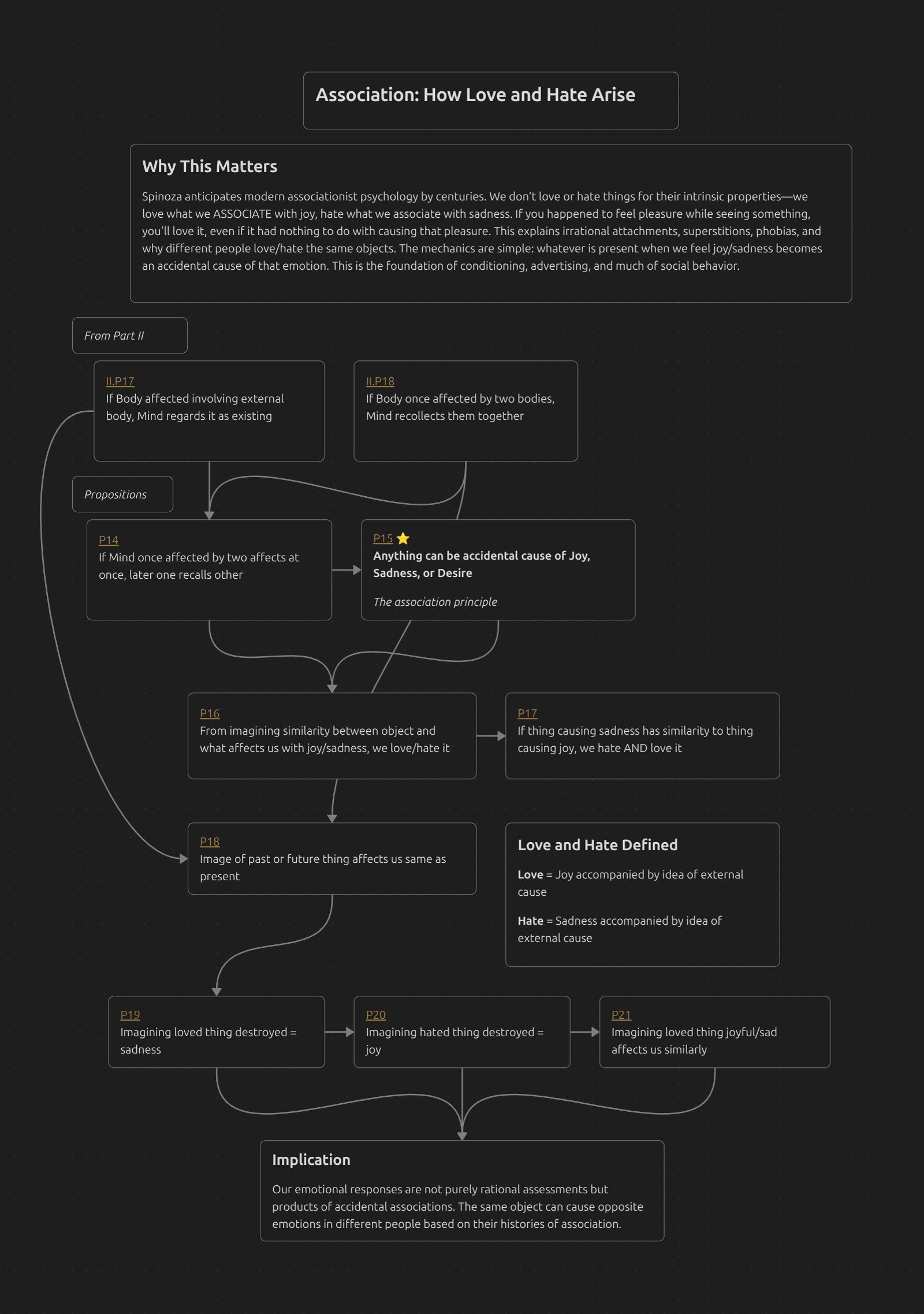
Association: How Love and Hate Arise
Why This Matters
Spinoza anticipates modern associationist psychology by centuries. We don’t love or hate things for their intrinsic properties—we love what we ASSOCIATE with joy, hate what we associate with sadness. If you happened to feel pleasure while seeing something, you’ll love it, even if it had nothing to do with causing that pleasure. This explains irrational attachments, superstitions, phobias, and why different people love/hate the same objects. The mechanics are simple: whatever is present when we feel joy/sadness becomes an accidental cause of that emotion. This is the foundation of conditioning, advertising, and much of social behavior.
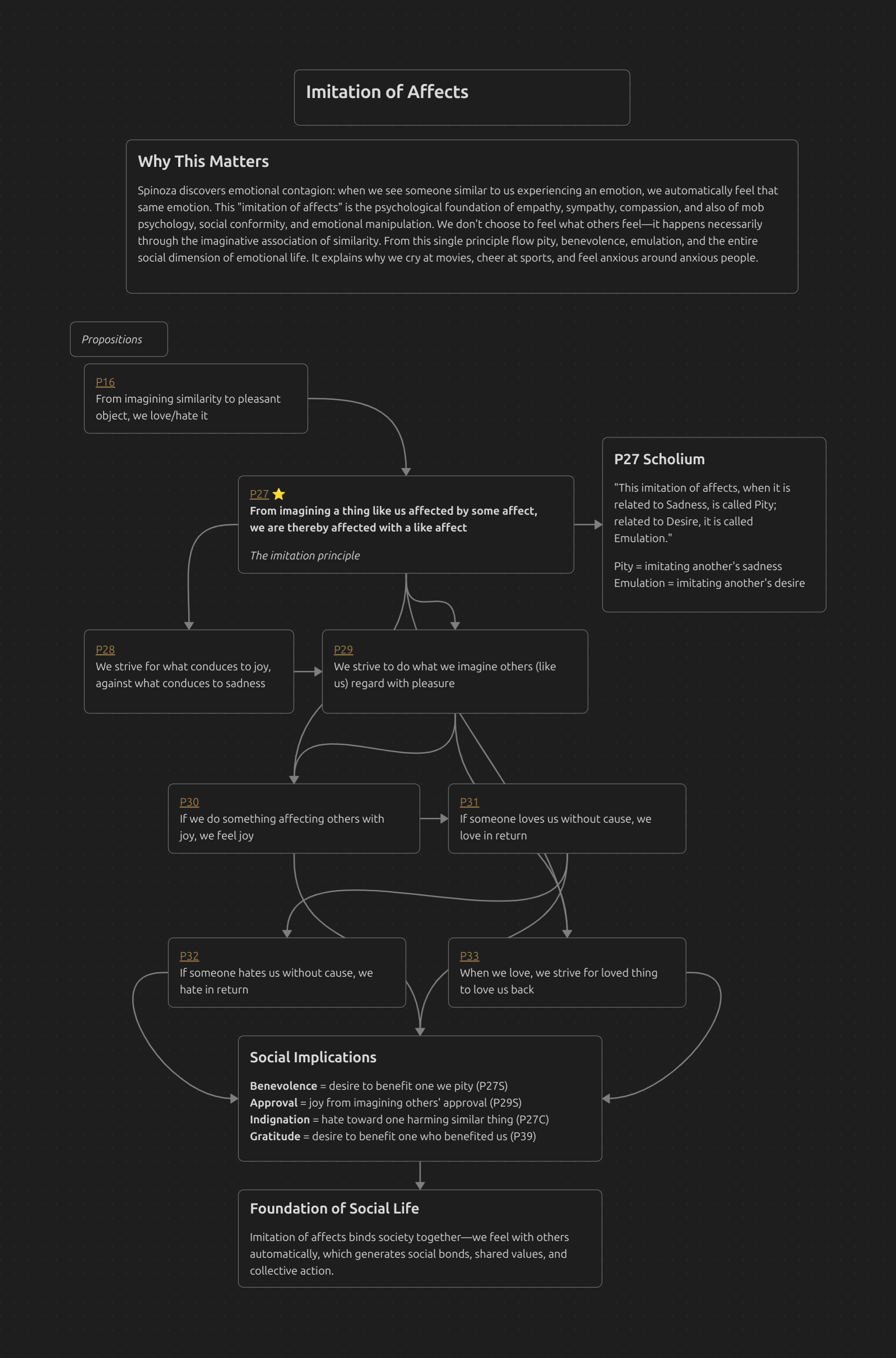
Imitation of Affects
Why This Matters
Spinoza discovers emotional contagion: when we see someone similar to us experiencing an emotion, we automatically feel that same emotion. This “imitation of affects” is the psychological foundation of empathy, sympathy, compassion, and also of mob psychology, social conformity, and emotional manipulation. We don’t choose to feel what others feel—it happens necessarily through the imaginative association of similarity. From this single principle flow pity, benevolence, emulation, and the entire social dimension of emotional life. It explains why we cry at movies, cheer at sports, and feel anxious around anxious people.
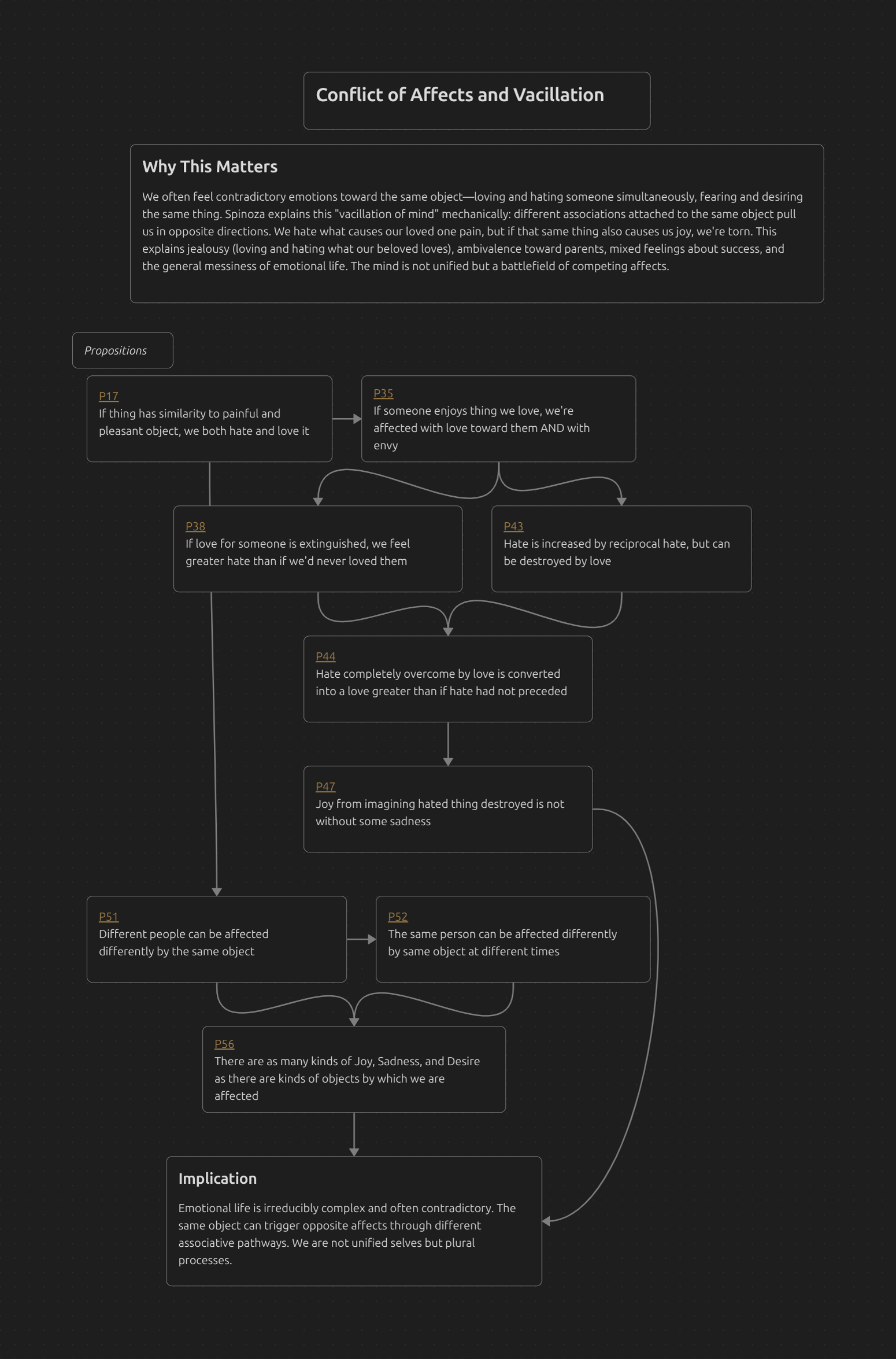
Conflict of Affects and Vacillation
Why This Matters
We often feel contradictory emotions toward the same object—loving and hating someone simultaneously, fearing and desiring the same thing. Spinoza explains this “vacillation of mind” mechanically: different associations attached to the same object pull us in opposite directions. We hate what causes our loved one pain, but if that same thing also causes us joy, we’re torn. This explains jealousy (loving and hating what our beloved loves), ambivalence toward parents, mixed feelings about success, and the general messiness of emotional life. The mind is not unified but a battlefield of competing affects.
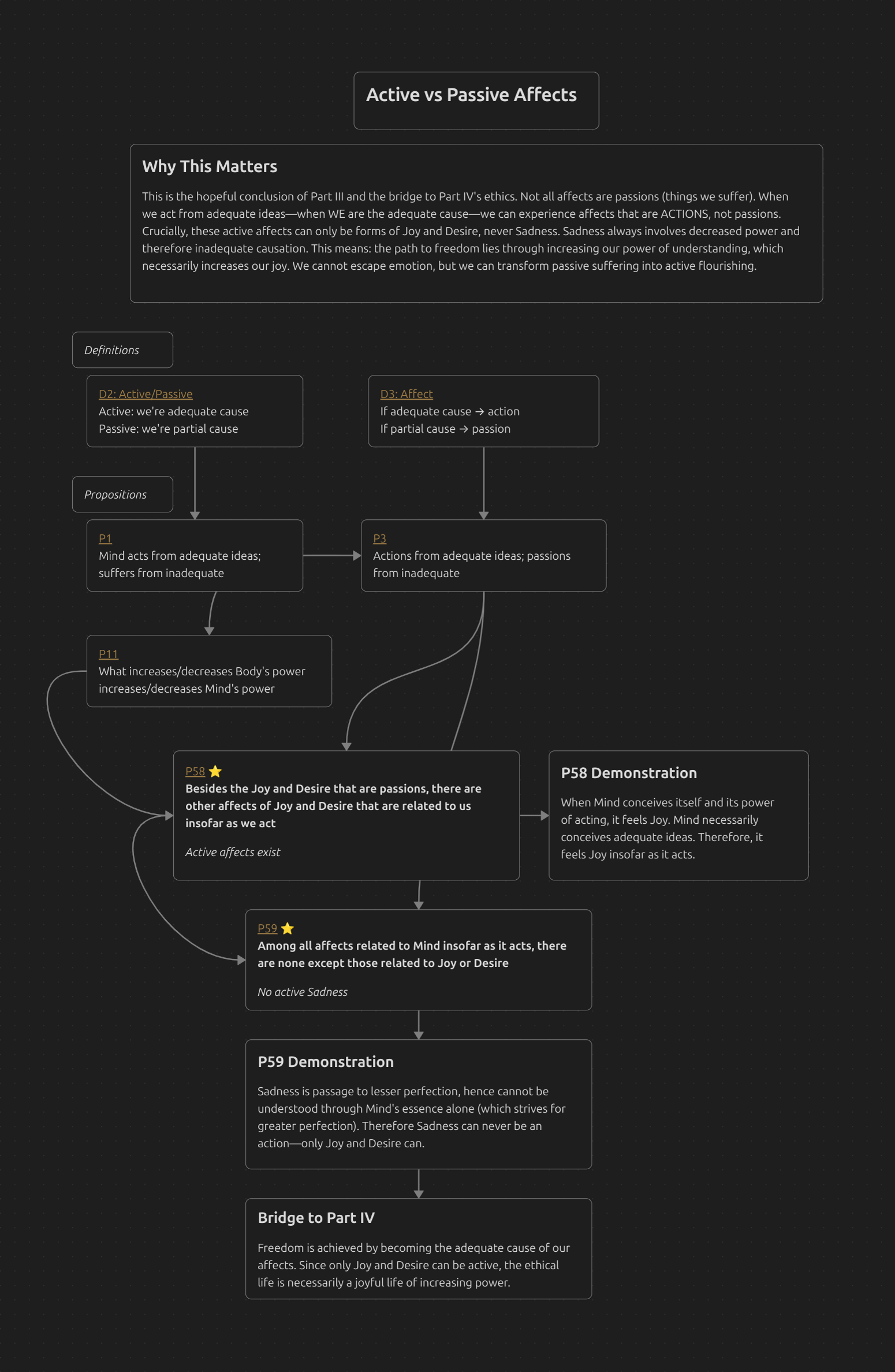
Active vs Passive Affects
Why This Matters
This is the hopeful conclusion of Part III and the bridge to Part IV’s ethics. Not all affects are passions (things we suffer). When we act from adequate ideas—when WE are the adequate cause—we can experience affects that are ACTIONS, not passions. Crucially, these active affects can only be forms of Joy and Desire, never Sadness. Sadness always involves decreased power and therefore inadequate causation. This means: the path to mental freedom lies through increasing our power of understanding, which necessarily increases our joy. We cannot escape emotion, but we can transform passive suffering into active intellectual joy.
Link to original
Preface
Most of those who have written about the Affects, and men’s way of living, seem to treat, not of natural things, which follow the common laws of nature, but of things which are outside nature. Indeed they seem to conceive man in nature as a dominion within a dominion. For they believe that man disturbs, rather than follows, the order of nature, that he has absolute power over his actions, and that he is determined only by himself. And they attribute the cause of human impotence, not to the common power of nature, but to I know not what vice of human nature, which they therefore bewail, or laugh at, or disdain, or (as usually happens) curse. And he who knows how to censure more eloquently and cunningly the weakness of the human Mind is held to be God/Naturely.
It is true that there have been some very distinguished men (to whose work and diligence we confess that we owe much), who have written many admirable things about the right way of living, and given men advice full of prudence. But no one, to my knowledge, has determined the nature and powers of the Affects, nor what, on the other hand, the Mind can do to moderate them. I know, of course, that the celebrated Descartes, although he too believed that the Mind has absolute power over its own actions, nevertheless sought to explain human Affects through their first causes, and at the same time to show the way by which the Mind can have absolute dominion over its Affects. But in my opinion, he showed nothing but the cleverness of his understanding, as I shall show in the proper place. For now I wish to return to those who prefer to curse or laugh at the Affects and actions of men, rather than understand them. To them it will doubtless seem strange that I should undertake to treat men’s vices and absurdities in the Geometric style, and that I should wish to demonstrate by certain reasoning things which are contrary to reason, and which they proclaim to be empty, absurd, and horrible. But my reason is this: nothing happens in nature which can be attributed to any defect in it, for nature is always the same, and its virtue and power of acting are everywhere one and the same, i.e., the laws and rules of nature, according to which all things happen, and change from one form to another, are always and everywhere the same. So the way of understanding the nature of anything, of whatever kind, must also be the same, viz. through the divine laws and rules of nature.
The Affects, therefore, of hate, anger, envy, etc., considered in themselves, follow from the same necessity and force of nature as the other singular things. And therefore they acknowledge certain causes, through which they are understood, and have certain properties, as worthy of our knowledge as the properties of any other thing, by the mere contemplation of which we are pleased. Therefore, I shall treat the nature and powers of the Affects, and the power of the Mind over them, by the same Method by which, in the preceding parts, I treated God/Nature and the Mind, and I shall consider human actions and appetites just as if it were a Question of lines, planes, and bodies.
Definitions (3)
- Part III Definition 1 - Adequate cause: effect clearly perceived through it; Inadequate: can’t be understood through it alone
- Part III Definition 2 - Active: we’re adequate cause; Passive: we’re partial cause
- Part III Definition 3 - Affect: body affections increasing/decreasing power, plus ideas
POSTULATES
Post. 1: The human Body can be affected in many ways in which its power of acting is increased or diminished, and also in others which render its power of acting neither greater nor less. This Postulate, or Axiom, rests on Post. 1, L5, and L7 (after IIP13).
Post. 2: The human Body can undergo many changes, and nevertheless {II/140} retain impressions, or traces, of the objects (on this see IIPost. 5), and consequently, the same images of things. (For the definition of images, see IIP17 S.)
Propositions (59)
- Part III Proposition 1 - Mind sometimes active, sometimes passive | Deps: II.P40, D2
- Part III Proposition 2 - Body can’t determine Mind; Mind can’t determine Body | Deps: II.P7, II.P21
- Part III Proposition 3 - Actions from adequate ideas; passions from inadequate ⭐ | Deps: P1, II.P40
- Part III Proposition 4 - Nothing destroyed except by external cause | Deps: I.P36
- Part III Proposition 5 - Things contrary to extent one can destroy other | Deps: P4
- Part III Proposition 6 - Each thing strives to persist in being (Conatus) ⭐⭐ | Deps: I.P36, P4
- Part III Proposition 7 - Conatus IS the thing’s essence ⭐⭐ | Deps: P6
- Part III Proposition 8 - Conatus involves indefinite time | Deps: P6, P7
- Part III Proposition 9 - Mind strives to persist ⭐ | Deps: P7
- Part III Proposition 10 - Idea excluding Body’s existence can’t be in Mind | Deps: II.P17, P5
- Part III Proposition 11 - Ideas affecting Body’s power affect Mind’s power ⭐ | Deps: II.P12, P9
- Part III Proposition 12 - Mind strives to imagine what increases Body’s power | Deps: P11
- Part III Proposition 13 - Mind strives to recollect what excludes what diminishes power | Deps: P12
- Part III Proposition 14 - If affected by two affects, later one recalls other | Deps: II.P18
- Part III Proposition 15 - Anything can be accidental cause of pleasure/pain/desire | Deps: P14
- Part III Proposition 16 - From imagining similarity to pleasant object, we love/hate it | Deps: P14, P15
- Part III Proposition 17 - If thing has similarity to painful/pleasant object, we hate and love it | Deps: P16
- Part III Proposition 18 - From image of past/future, same affect as present | Deps: II.P17, II.P18
- Part III Proposition 19 - Imagining loved thing destroyed = pain; preserved = pleasure | Deps: P18
- Part III Proposition 20 - Imagining hated thing destroyed = pleasure | Deps: P19
- Part III Proposition 21 - Imagining loved thing with pleasure/pain affects us similarly | Deps: P19
- Part III Proposition 22 - If someone affects loved thing with pleasure, we love them | Deps: P21
- Part III Proposition 23 - If someone affects loved thing with pain, we hate them | Deps: P22
- Part III Proposition 24 - If someone affects hated thing with pleasure, we hate them | Deps: P22, P23
- Part III Proposition 25 - We affirm of ourselves what affects us with pleasure | Deps: P12
- Part III Proposition 26 - We affirm of hated thing what affects it with pain | Deps: P13, P25
- Part III Proposition 27 - Imagining similar thing affected by affect affects us similarly (imitation) ⭐ | Deps: P16
- Part III Proposition 28 - We strive for what conduces to pleasure, remove what conduces to pain | Deps: P12, P13
- Part III Proposition 29 - We strive to do what we imagine others regard with pleasure | Deps: P27, P28
- Part III Proposition 30 - If we’ve done something affecting others with pleasure, we feel pleasure | Deps: P27, P29
- Part III Proposition 31 - If loved without having given cause, we love in return | Deps: P30
- Part III Proposition 32 - If hated without having given cause, we hate in return | Deps: P31
- Part III Proposition 33 - We strive for loved thing to love us | Deps: P27, P29
- Part III Proposition 34 - Greater affect toward us, greater our exultation | Deps: P30, P33
- Part III Proposition 35 - If another draws loved thing, we hate thing and envy other (jealousy) | Deps: P31, P34
- Part III Proposition 36 - Recollecting pleasant thing, we desire it in same circumstances | Deps: P14, P18
- Part III Proposition 37 - Desire from pain/pleasure proportional to affect | Deps: P36
- Part III Proposition 38 - If love extinguished, greater hatred than if never loved | Deps: P35, P37
- Part III Proposition 39 - Who hates will injure unless fears greater injury | Deps: P28
- Part III Proposition 40 - If hated and believes gave no cause, will hate in return | Deps: P32, P39
- Part III Proposition 41 - If loved and believes gave no cause, will love in return | Deps: P31
- Part III Proposition 42 - Who conferred benefit feels pain if ungratefully received | Deps: P30, P40
- Part III Proposition 43 - Hate increased by reciprocal hate, destroyed by love | Deps: P39, P40
- Part III Proposition 44 - Hate overcome by love becomes greater love | Deps: P38, P43
- Part III Proposition 45 - If similar person hates similar thing, we hate them | Deps: P27, P35
- Part III Proposition 46 - If affected by someone of different class, love/hate whole class | Deps: P16, P27
- Part III Proposition 47 - Pleasure from hated thing’s destruction mixed with pain | Deps: P20, P27
- Part III Proposition 48 - Love/hate toward free thing greater than toward necessary | Deps: P37
- Part III Proposition 49 - Love/hate toward free thing greater (repeated) | Deps: P48
- Part III Proposition 50 - Anything can be accidental cause of hope/fear | Deps: P15
- Part III Proposition 51 - Different people affected differently by same object | Deps: P16
- Part III Proposition 52 - Same person affected differently at different times | Deps: P51
- Part III Proposition 53 - Regarding itself and its power, Mind feels pleasure | Deps: II.P23, P11
- Part III Proposition 54 - Mind strives to imagine only what affirms its power | Deps: P12, P53
- Part III Proposition 55 - Imagining its lack of power, Mind feels pain | Deps: P53
- Part III Proposition 56 - As many kinds of affects as kinds of objects | Deps: P51, P52
- Part III Proposition 57 - Any affect differs as essences differ | Deps: P56
- Part III Proposition 58 - Besides passive pleasure/desire, there are active affects ⭐ | Deps: P3, P11
- Part III Proposition 59 - All affects related to active Mind are pleasure/desire only ⭐ | Deps: P3, P58