Part I | Part II | Part III | Part IV | Part V
Part IV: Of Human Bondage, or the Strength of the Affects
Human bondage comes from inadequate knowledge; virtue is acting from reason toward what preserves us.
Part 4 Important Concepts
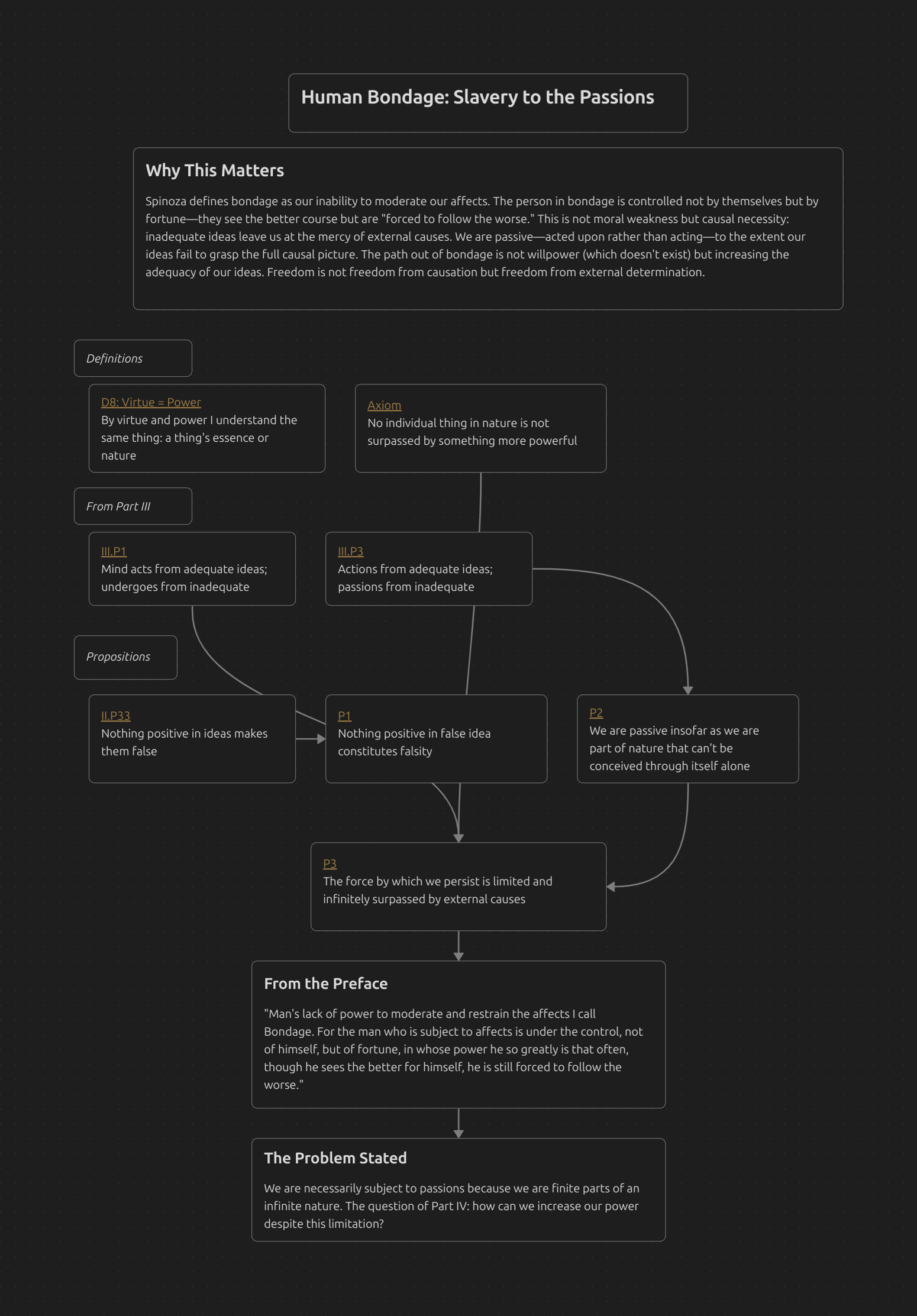
Human Bondage: Slavery to the Passions
Why This Matters
Spinoza defines bondage as our inability to moderate our affects. The person in bondage is controlled not by themselves but by fortune—they see the better course but are “forced to follow the worse.” This is not moral weakness but causal necessity: inadequate ideas leave us at the mercy of external causes. We are passive—acted upon rather than acting—to the extent our ideas fail to grasp the full causal picture. The path out of bondage is not willpower (which doesn’t exist) but increasing the adequacy of our ideas. Mental freedom is not mental freedom from causation but mental freedom from external determination.
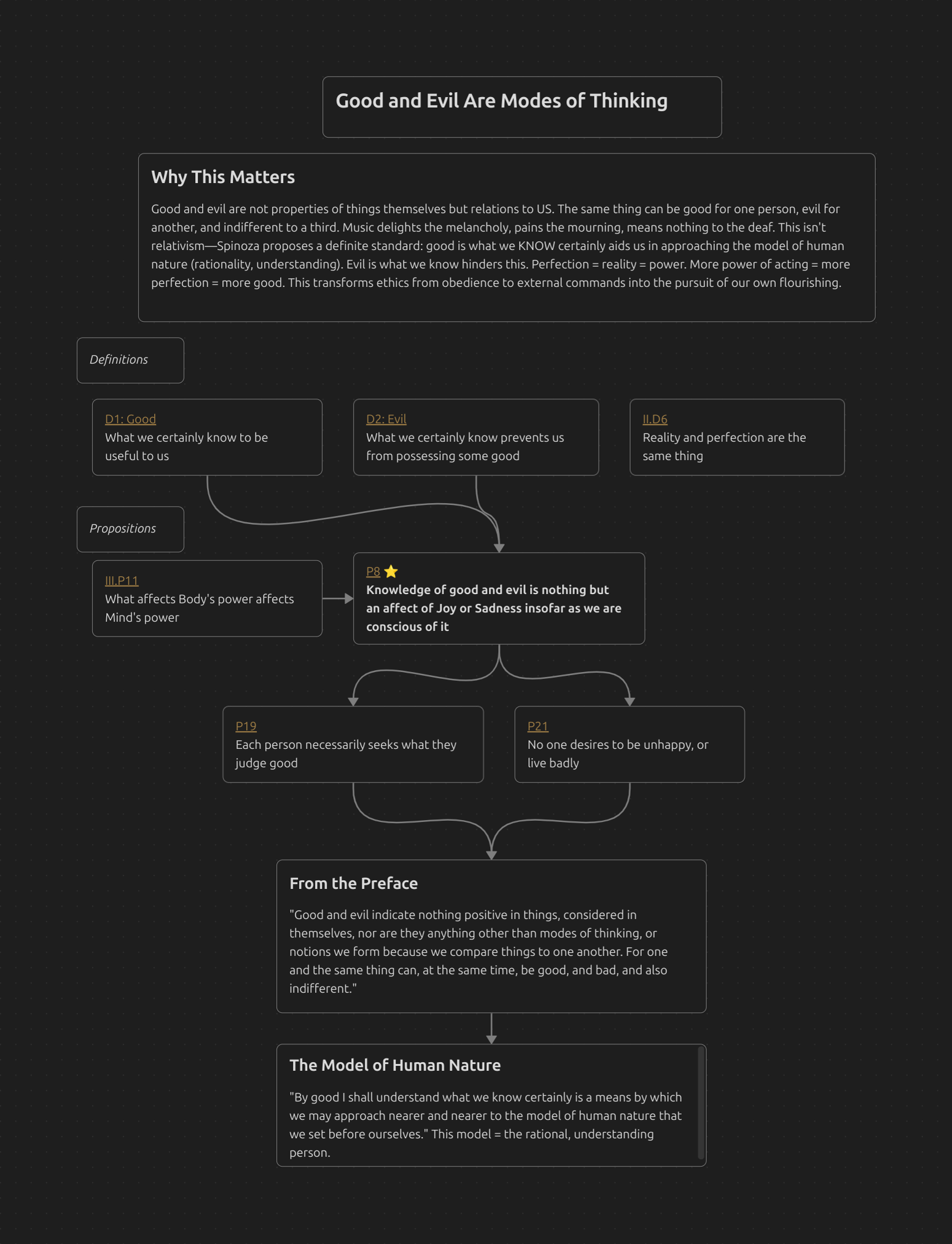
Good and Evil Are Modes of Thinking
Why This Matters
Good and evil are not properties of things themselves but relations to US. The same thing can be good for one person, evil for another, and indifferent to a third. Music delights the melancholy, pains the mourning, means nothing to the deaf. This isn’t relativism—Spinoza proposes a definite standard: good is what we KNOW certainly aids us in approaching the model of human nature (rationality, understanding). Evil is what we know hinders this. Perfection = reality = power. More power of acting = more perfection = more good. This transforms ethics from obedience to external commands into the pursuit of our own intellectual joy.
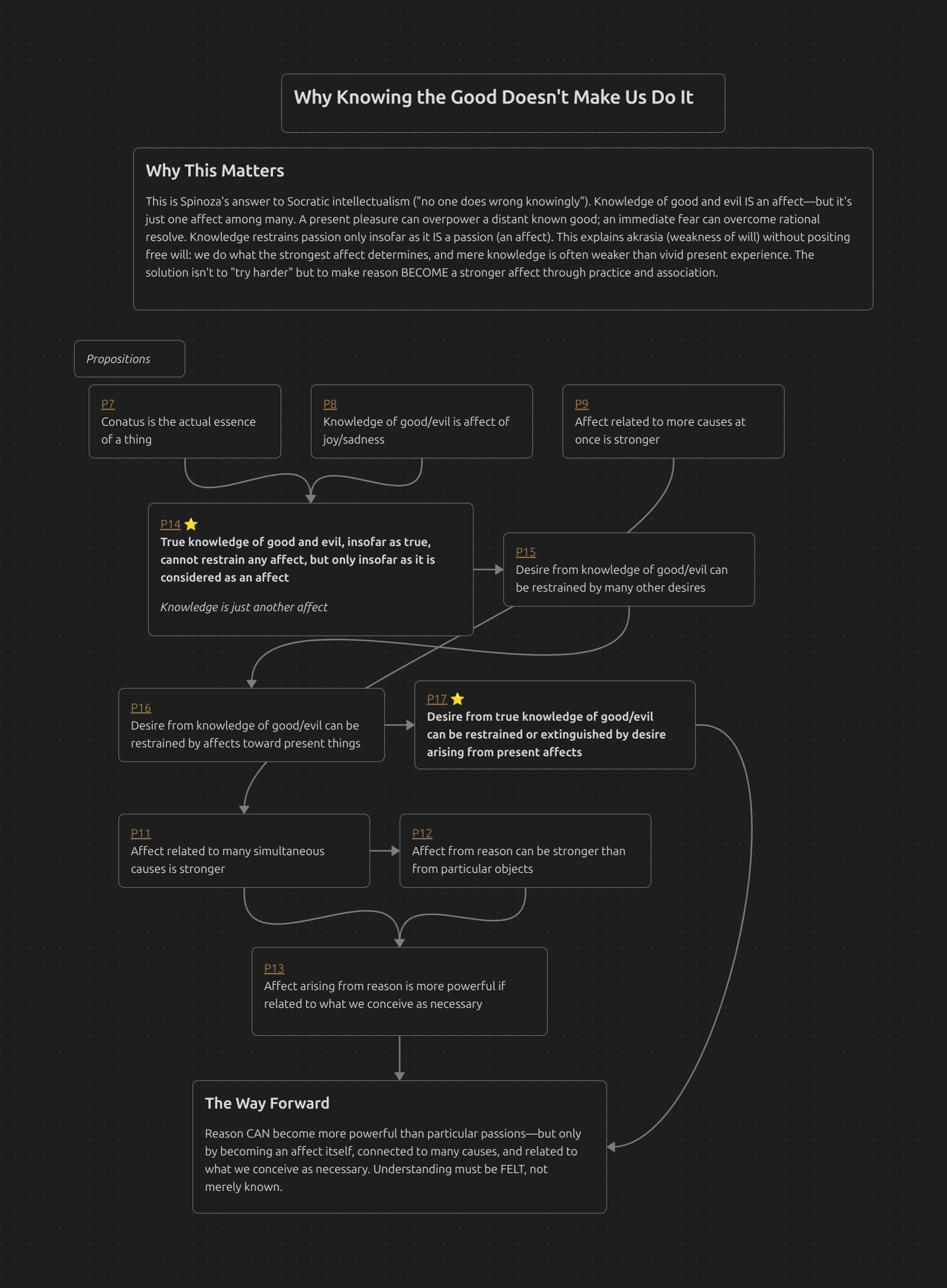
Why Knowing the Good Doesn’t Make Us Do It
Why This Matters
This is Spinoza’s answer to Socratic intellectualism (“no one does wrong knowingly”). Knowledge of good and evil IS an affect—but it’s just one affect among many. A present pleasure can overpower a distant known good; an immediate fear can overcome rational resolve. Knowledge restrains passion only insofar as it IS a passion (an affect). This explains akrasia (weakness of will) without positing free will: we do what the strongest affect determines, and mere knowledge is often weaker than vivid present experience. The solution isn’t to “try harder” but to make reason BECOME a stronger affect through practice and association.
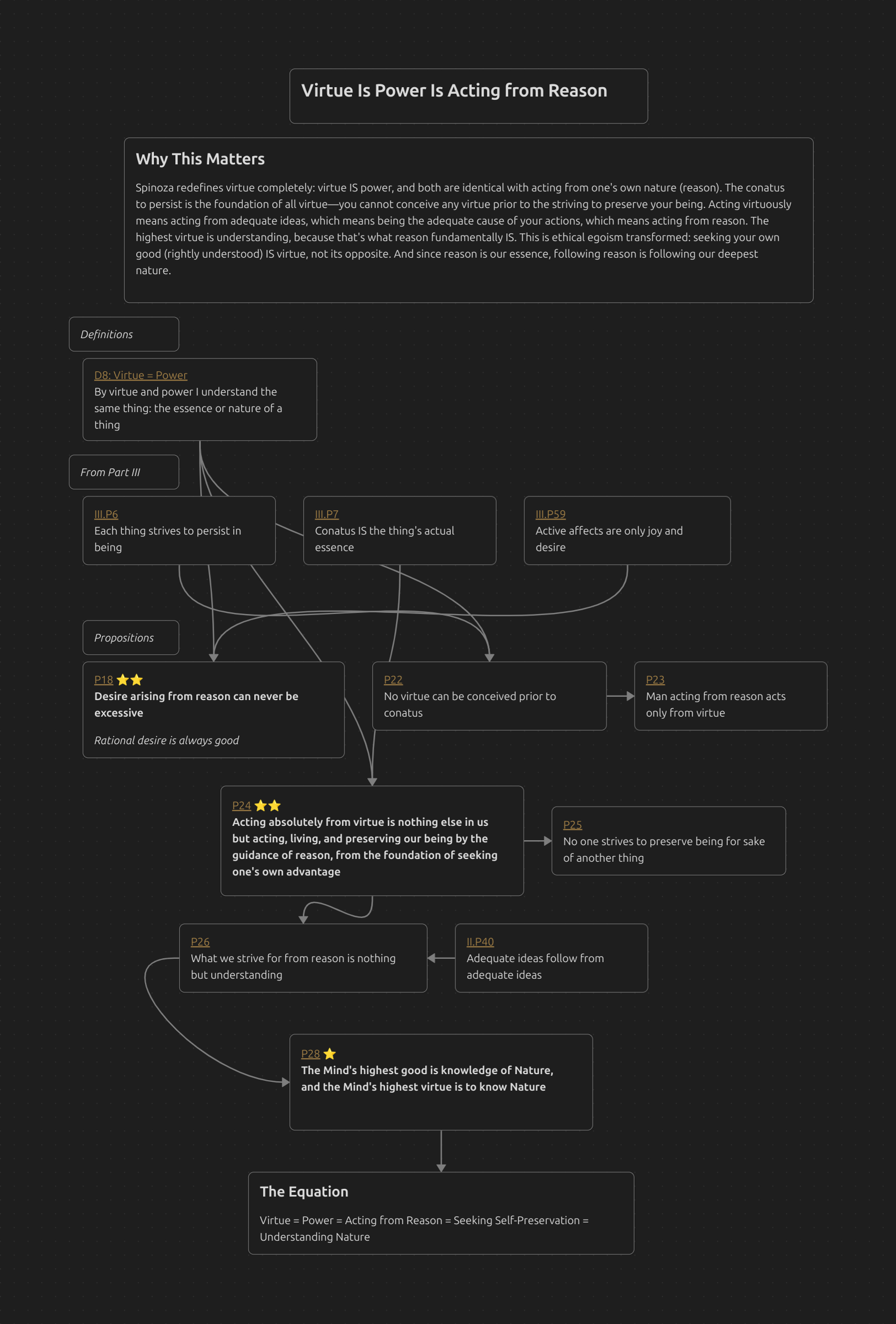
Virtue Is Power Is Acting from Reason
Why This Matters
Spinoza redefines virtue completely: virtue IS power, and both are identical with acting from one’s own nature (reason). The conatus to persist is the foundation of all virtue—you cannot conceive any virtue prior to the striving to preserve your being. Acting virtuously means acting from adequate ideas, which means being the adequate cause of your actions, which means acting from reason. The highest virtue is understanding, because that’s what reason fundamentally IS. This is ethical egoism transformed: seeking your own good (rightly understood) IS virtue, not its opposite. And since reason is our essence, following reason is following our deepest nature.
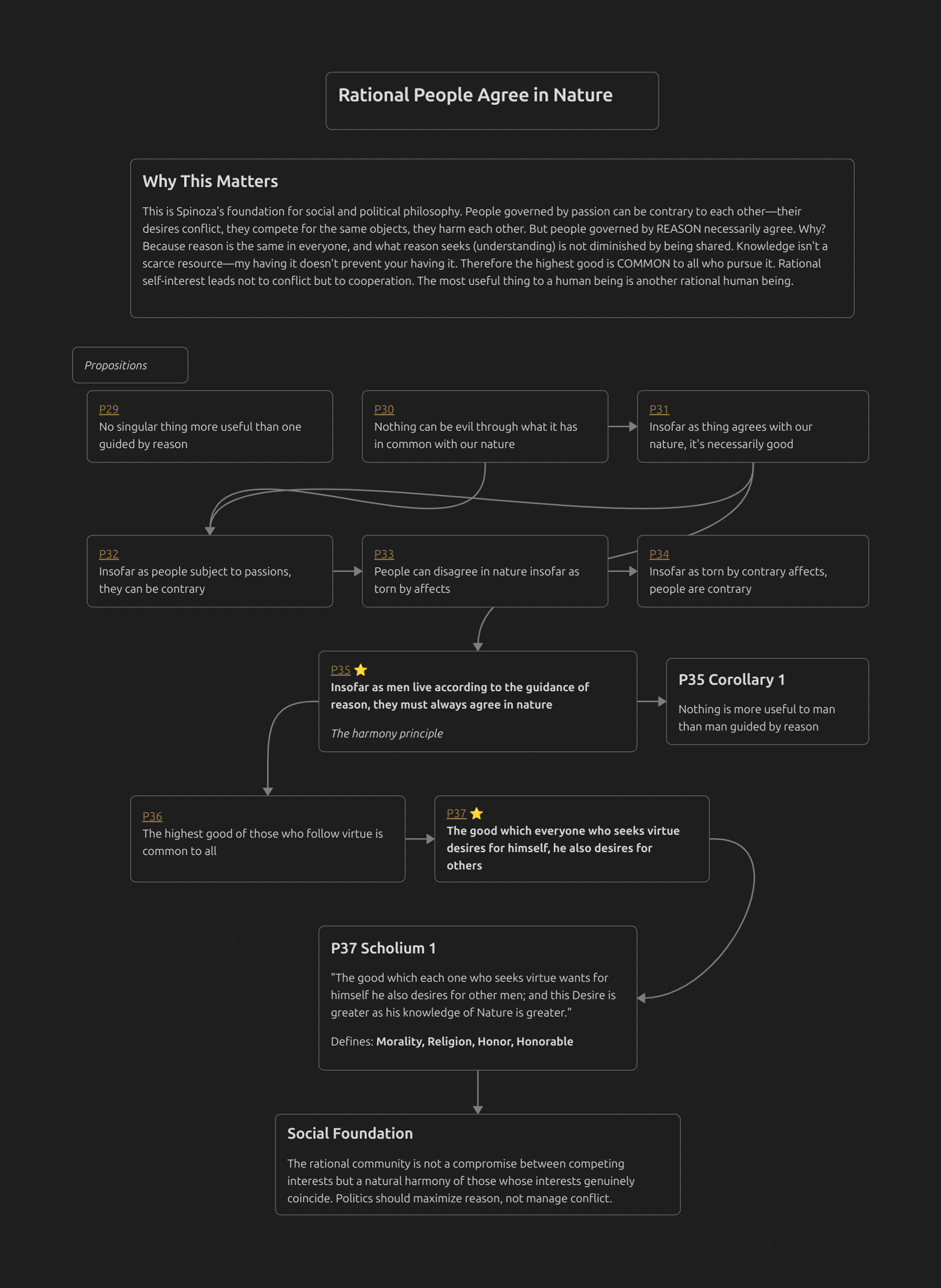
Rational People Agree in Nature
Why This Matters
This is Spinoza’s foundation for social and political philosophy. People governed by passion can be contrary to each other—their desires conflict, they compete for the same objects, they harm each other. But people governed by REASON necessarily agree. Why? Because reason is the same in everyone, and what reason seeks (understanding) is not diminished by being shared. Knowledge isn’t a scarce resource—my having it doesn’t prevent your having it. Therefore the highest good is COMMON to all who pursue it. Rational self-interest leads not to conflict but to cooperation. The most useful thing to a human being is another rational human being.
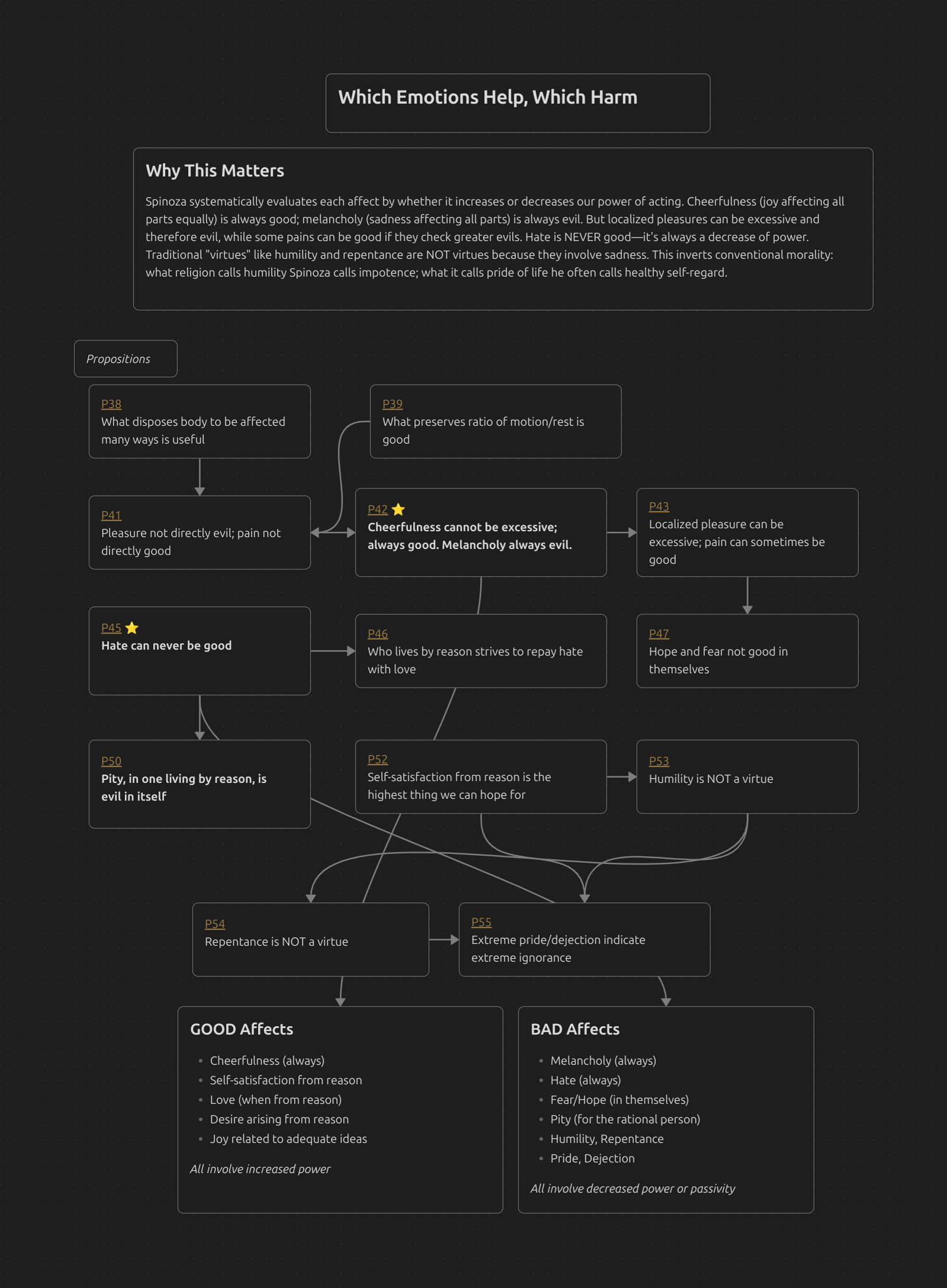
Which Emotions Help, Which Harm
Why This Matters
Spinoza systematically evaluates each affect by whether it increases or decreases our power of acting. Cheerfulness (joy affecting all parts equally) is always good; melancholy (sadness affecting all parts) is always evil. But localized pleasures can be excessive and therefore evil, while some pains can be good if they check greater evils. Hate is NEVER good—it’s always a decrease of power. Traditional “virtues” like humility and repentance are NOT virtues because they involve sadness. This inverts conventional morality: what religion calls humility Spinoza calls impotence; what it calls pride of life he often calls healthy self-regard.
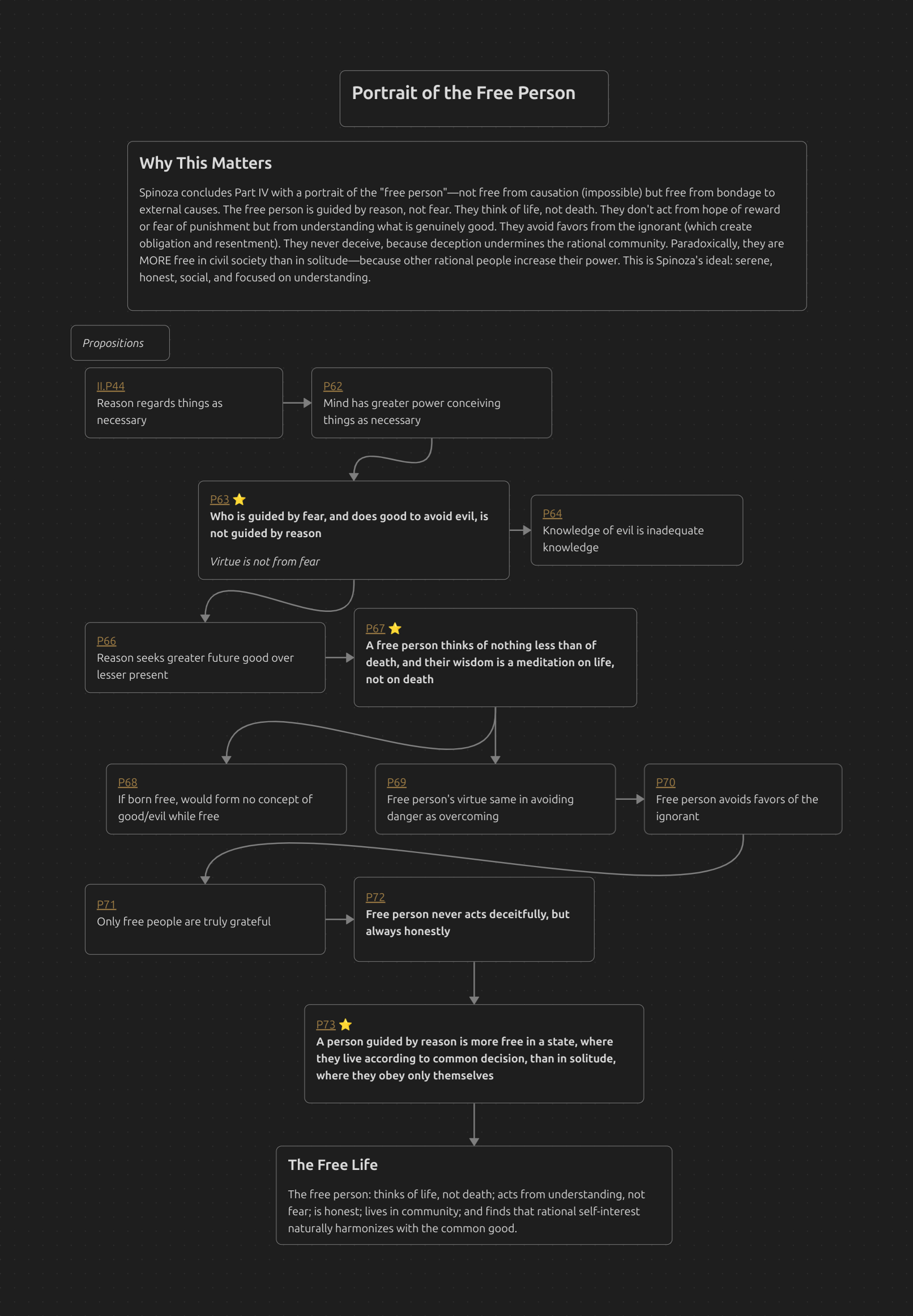
Portrait of the Free Person
Why This Matters
Spinoza concludes Part IV with a portrait of the “free person”—not free from causation (impossible) but free from bondage to external causes. The free person is guided by reason, not fear. They think of life, not death. They don’t act from hope of reward or fear of punishment but from understanding what is genuinely good. They avoid favors from the ignorant (which create obligation and resentment). They never deceive, because deception undermines the rational community. Paradoxically, they are MORE free in civil society than in solitude—because other rational people increase their power. This is Spinoza’s ideal: serene, honest, social, and focused on understanding.
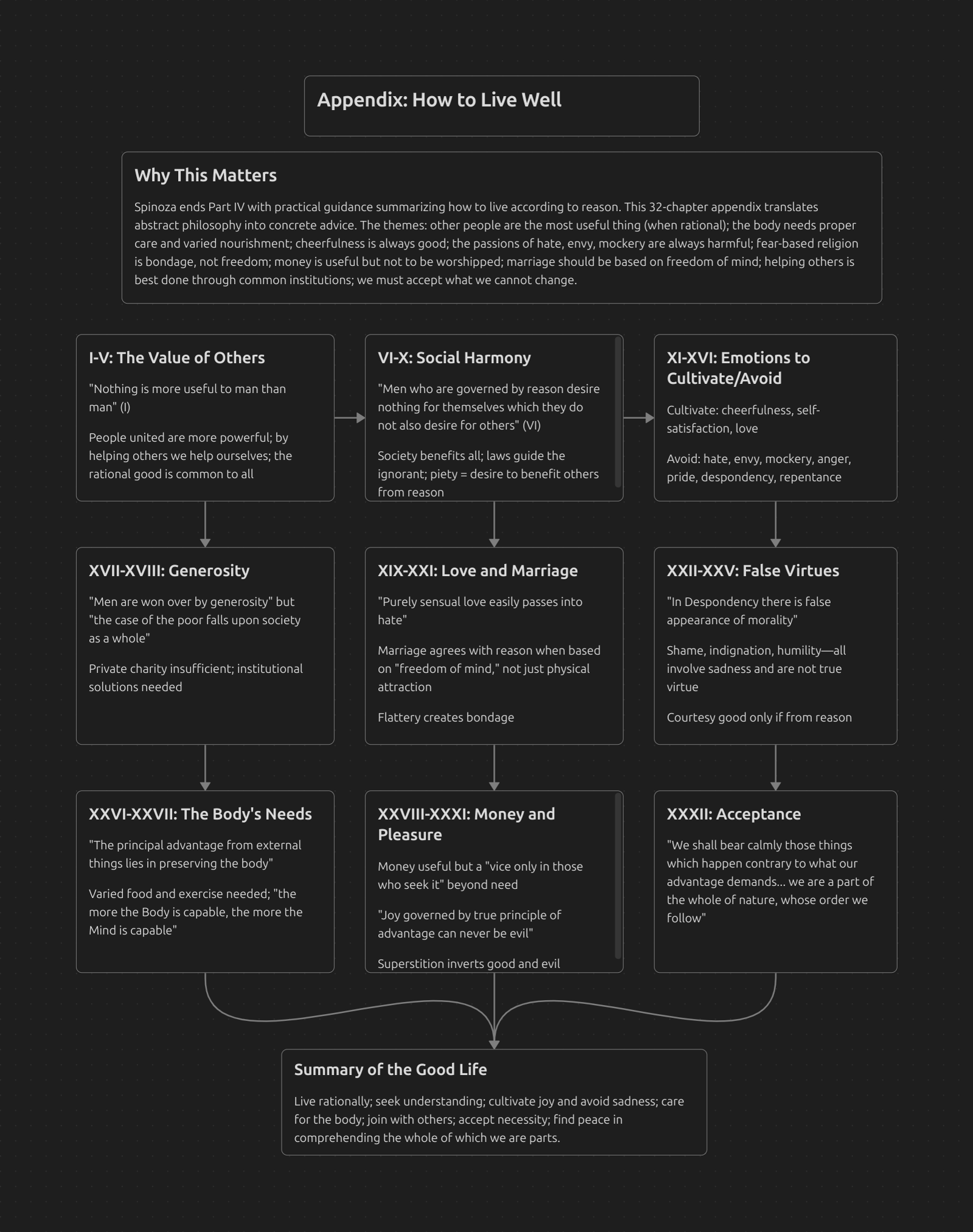
Appendix: How to Live Well
Why This Matters
Spinoza ends Part IV with practical guidance summarizing how to live according to reason. This 32-chapter appendix translates abstract philosophy into concrete advice. The themes: other people are the most useful thing (when rational); the body needs proper care and varied nourishment; cheerfulness is always good; the passions of hate, envy, mockery are always harmful; fear-based religion is bondage, not mental freedom; money is useful but not to be worshipped; marriage should be based on mental freedom of mind; helping others is best done through common institutions; we must accept what we cannot change.
Link to original
Preface
Man’s lack of power to moderate and restrain the affects I call Bondage. For the man who is subject to affects is under the control, not of himself, but of fortune, in whose power he so greatly is that often, though he sees the better for himself, he is still forced to follow the worse. In this Part, I have undertaken to demonstrate the cause of this, and what there is of good and evil in the affects. But before I begin, I choose to say a few words first on perfection and imperfection, good and evil.
If someone has decided to make something, and has finished it, then he will call his thing perfect—and so will anyone who rightly knows, or thinks he knows, the mind and purpose of the Author of the work. For example, if someone sees a work (which I suppose to be not yet completed), and knows that the purpose of the Author of that work is to build a house, he will say that it is imperfect. On the other hand, he will call it perfect as soon as he sees that the work has been carried through to the end which its Author has decided to give it. But if someone sees a work whose like he has never seen, and does not know the mind of its maker, he will, of course, not be able to know whether that work is perfect or imperfect. And this seems to have been the first meaning of these words.
But after men began to form divine ideas, and devise models of houses, buildings, towers, etc., and to prefer some models of things to others, it came about that each one called perfect what he saw agreed with the divine idea he had formed of this kind of thing, and imperfect, what he saw agreed less with the model he had conceived, even though its maker thought he had entirely finished it.
Nor does there seem to be any other reason why men also commonly call perfect or imperfect natural things, which have not been made by human hand. For they are accustomed to form divine ideas of natural things as much as they do of artificial ones. They regard these divine ideas as models of things, and believe that nature (which they think does nothing except for the sake of some end) looks to them, and sets them before itself as models. So when they see something happen in nature which does not agree with the model they have conceived of this kind of thing, they believe that Nature itself has failed or sinned, and left the thing imperfect.
We see, therefore, that men are accustomed to call natural things perfect or imperfect more from prejudice than from true knowledge of those things. For we have shown in the Appendix of Part I, that Nature does nothing on account of an end. That eternal and infinite being we call God/Nature, or Nature, acts from the same necessity from which he exists. For we have shown (IP16) that the necessity of nature from which he acts is the same as that from which he exists. The reason, therefore, or cause, why God/Nature, or Nature, acts, and the reason why he exists, are one and the same. As he exists for the sake of no end, he also acts for the sake of no end. Rather, as he has no principle or end of existing, so he also has none of acting.
What is called a final cause is nothing but a human appetite insofar as it is considered as a principle, or primary cause, of some thing.
For example, when we say that habitation was the final cause of this or that house, surely we understand nothing but that a man, because he imagined the conveniences of domestic life, had an appetite to build a house. So habitation, insofar as it is considered as a final cause, is nothing more than this singular appetite. It is really an efficient cause, which is considered as a first cause, because men are commonly ignorant of the causes of their appetites. For as I have often said before, they are conscious of their actions and appetites, but not aware of the causes by which they are determined to want something.
As for what they commonly say—that Nature sometimes fails or sins, and produces imperfect things—I number this among the fictions I treated in the Appendix of Part I.
Perfection and imperfection, therefore, are only modes of thinking, i.e., notions we are accustomed to feign because we compare individuals of the same species or genus to one another. This is why I said above (IID6) that by reality and perfection I understand the same thing. For we are accustomed to refer all individuals in Nature to one genus, which is called the most general, i.e., to the notion of being, which pertains absolutely to all individuals in Nature. So insofar as we refer all individuals in Nature to this genus, compare them to one another, and find that some have more being, or reality, than others, we say that some are more perfect than others. And insofar as we attribute something to them that involves negation, like a limit, an end, lack of power, etc., we call them imperfect, because they do not affect our Mind as much as those we call perfect, and not because something is lacking in them which is theirs, or because Nature has sinned. For nothing belongs to the nature of anything except what follows from the necessity of the nature of the efficient cause. And whatever follows from the necessity of the nature of the efficient cause happens necessarily.
As far as good and evil are concerned, they also indicate nothing positive in things, considered in themselves, nor are they anything other than modes of thinking, or notions we form because we compare things to one another. For one and the same thing can, at the same time, be good, and bad, and also indifferent. For example, Music is good for one who is Melancholy, bad for one who is mourning, and neither good nor bad to one who is deaf.
But though this is so, still we must retain these words. For because we desire to form an idea of man, as a model of human nature which we may look to, it will be useful to us to retain these same words with the meaning I have indicated. In what follows, therefore, I shall understand by good what we know certainly is a means by which we may approach nearer and nearer to the model of human nature that we set before ourselves. By evil, what we certainly know prevents us from becoming like that model. Next, we shall say that men are more perfect or imperfect, insofar as they approach more or less near to this model.
But the main thing to note is that when I say that someone passes from a lesser to a greater perfection, and the opposite, I do not understand that he is changed from one essence, or form, to another. For example, a horse is destroyed as much if it is changed into a man as if it is changed into an insect. Rather, we conceive that his power of acting, insofar as it is understood through his nature, is increased or diminished.
Finally, by perfection in general I shall, as I have said, understand reality, i.e., the essence of each thing insofar as it exists and produces an effect, having no regard to its duration. For no singular thing can be called more perfect for having persevered in existing for a longer time. Indeed, the duration of things cannot be determined from their essence, since the essence of things involves no certain and determinate time of existing. But any thing whatever, whether it is more perfect or less, will always be able to persevere in existing by the same force by which it begins to exist; so they are all equal in this regard.
Definitions (8)
- Part IV Definition 1 - Good: what we know is useful
- Part IV Definition 2 - Evil: what we know prevents us from possessing good
- Part IV Definition 3 - Contingent: when attending to essence, nothing necessitates/excludes existence
- Part IV Definition 4 - Possible: when ignorant of causes determining them
- Part IV Definition 5 - Contrary affects: draw in different directions though same kind
- Part IV Definition 6 - Affect toward future/past/present same as if apart from time
- Part IV Definition 7 - End for which we act: appetite
- Part IV Definition 8 - Virtue/power: same thing; essence or nature
Axiom (1)
Part IV Axiom 1 - No individual thing more powerful than all; there’s always something more powerful
Propositions (73)
- Part IV Proposition 1 - Nothing positive in false idea makes it false | Deps: II.P33
- Part IV Proposition 2 - We’re passive insofar as we have inadequate ideas | Deps: III.P3
- Part IV Proposition 3 - Our action/passion depends on adequacy of our ideas | Deps: P2, III.P1
- Part IV Proposition 4 - No thing can be destroyed by itself; external cause needed ⭐ | Deps: III.P4
- Part IV Proposition 5 - Things contrary to extent one can destroy other | Deps: P4
- Part IV Proposition 6 - Each thing strives to persist | Deps: III.P6
- Part IV Proposition 7 - Conatus is essence of thing | Deps: III.P7
- Part IV Proposition 8 - Knowledge of good/evil is affect of pleasure/pain | Deps: III.P11
- Part IV Proposition 9 - Affect related to multiple causes is greater | Deps: III.P11
- Part IV Proposition 10 - While not torn by contrary affects, we have power to order affections | Deps: II.P7
- Part IV Proposition 11 - Affect related to more causes is greater | Deps: P9
- Part IV Proposition 12 - Affects from reason can be greater than from particular objects | Deps: II.P40
- Part IV Proposition 13 - Affect from reason greater if related to more causes | Deps: P11, P12
- Part IV Proposition 14 - True knowledge of good/evil restrains affect only as affect itself | Deps: P7, P8
- Part IV Proposition 15 - Desire from true knowledge can be restrained by other desires | Deps: P14
- Part IV Proposition 16 - Desire from knowledge of good/evil restrained by many affects | Deps: P15
- Part IV Proposition 17 - Desire from true knowledge of good/evil restrained by desire from present affects | Deps: P16
- Part IV Proposition 18 - Desire from reason cannot be excessive ⭐⭐ | Deps: III.P59, D8
- Part IV Proposition 19 - Every person necessarily seeks what they judge good | Deps: III.P9
- Part IV Proposition 20 - More we strive from reason, more we desire good for others | Deps: P18
- Part IV Proposition 21 - No one desires to be unhappy | Deps: III.P9
- Part IV Proposition 22 - No virtue conceivable prior to conatus | Deps: III.P6, D8
- Part IV Proposition 23 - No adequate thought of evil in human nature | Deps: P22
- Part IV Proposition 24 - Acting from virtue is acting from reason; striving to preserve being ⭐⭐ | Deps: D8, III.P7
- Part IV Proposition 25 - No one strives to preserve being for another thing’s sake | Deps: P24
- Part IV Proposition 26 - What we strive from reason is to understand | Deps: P24, II.P40
- Part IV Proposition 27 - We know nothing certainly good/evil except what aids/hinders understanding | Deps: P26
- Part IV Proposition 28 - Mind’s highest good is knowledge of Nature; virtue is knowing Nature ⭐ | Deps: P26, II.P47
- Part IV Proposition 29 - No individual thing more excellent than thing rejoicing in knowledge of Nature | Deps: P28
- Part IV Proposition 30 - Nothing can be evil by what has in common with our nature | Deps: P5
- Part IV Proposition 31 - Insofar as thing agrees with our nature, it’s good | Deps: P30
- Part IV Proposition 32 - Insofar as humans subject to passions, they can be contrary | Deps: P30, P31
- Part IV Proposition 33 - People can disagree in nature insofar as torn by passions | Deps: P32
- Part IV Proposition 34 - Insofar as people torn by passions, they can be contrary | Deps: P33
- Part IV Proposition 35 - Insofar as people live by reason, they agree in nature ⭐ | Deps: P31
- Part IV Proposition 36 - Highest good of those who follow virtue is common to all | Deps: P28, P35
- Part IV Proposition 37 - Good each virtuous person seeks, they desire for others ⭐ | Deps: P36
- Part IV Proposition 38 - What disposes body to affect/be affected many ways is good | Deps: P28
- Part IV Proposition 39 - What preserves ratio of motion/rest in body is good | Deps: P38
- Part IV Proposition 40 - What conducive to common society is good; contrary is evil | Deps: P39
- Part IV Proposition 41 - Pleasure not directly evil; pain not directly good | Deps: P38, P39
- Part IV Proposition 42 - Cheerfulness always good; melancholy always evil | Deps: P41
- Part IV Proposition 43 - Pleasure can be excessive and evil; pain can be good | Deps: P42
- Part IV Proposition 44 - Love/desire can be excessive | Deps: P43
- Part IV Proposition 45 - Hate never good | Deps: P37
- Part IV Proposition 46 - Who lives by reason strives to repay hate with love | Deps: P45
- Part IV Proposition 47 - Affects of hope/fear not good in themselves | Deps: P43
- Part IV Proposition 48 - Affects of esteem/contempt always evil | Deps: P45
- Part IV Proposition 49 - Esteem easily makes esteemed person proud | Deps: III.P54
- Part IV Proposition 50 - Pity in person living by reason is evil | Deps: P45
- Part IV Proposition 51 - Approval good; reproach evil | Deps: P45
- Part IV Proposition 52 - Self-satisfaction from reason is highest | Deps: III.P53
- Part IV Proposition 53 - Humility not virtue; doesn’t arise from reason | Deps: P52
- Part IV Proposition 54 - Repentance not virtue; doesn’t arise from reason | Deps: P53
- Part IV Proposition 55 - Extreme pride/dejection indicate extreme ignorance | Deps: P52, P53, P54
- Part IV Proposition 56 - Extreme pride/dejection indicate extreme impotence | Deps: P55
- Part IV Proposition 57 - Proud person loves presence of parasites, hates presence of noble | Deps: III.P35
- Part IV Proposition 58 - Honor not contrary to reason if from reason | Deps: P52
- Part IV Proposition 59 - All actions following from affects related to mind as understanding good | Deps: III.P3
- Part IV Proposition 60 - Desire from reason can’t be excessive | Deps: P18
- Part IV Proposition 61 - Desire from reason can’t be excessive | Deps: P60
- Part IV Proposition 62 - Insofar as Mind conceives things under necessity, it has greater power | Deps: II.P44
- Part IV Proposition 63 - Who guided by fear and does good to avoid evil not guided by reason ⭐ | Deps: P62
- Part IV Proposition 64 - Knowledge of evil is inadequate knowledge | Deps: P8, II.P35
- Part IV Proposition 65 - By guidance of reason we follow greater of two goods or lesser of two evils | Deps: P64
- Part IV Proposition 66 - By guidance of reason we seek greater future good over lesser present | Deps: P65
- Part IV Proposition 67 - Free person thinks of nothing less than death ⭐ | Deps: P63, P66
- Part IV Proposition 68 - If people born free, they’d form no concept of good/evil while free | Deps: P67
- Part IV Proposition 69 - Free person’s virtue in avoiding danger same as overcoming it | Deps: P67
- Part IV Proposition 70 - Free person living among ignorant strives to avoid their favors | Deps: P69
- Part IV Proposition 71 - Only free people truly grateful to each other | Deps: P70
- Part IV Proposition 72 - Free person never acts deceitfully | Deps: P18
- Part IV Proposition 73 - Person guided by reason more free in state than in solitude ⭐ | Deps: P35, P37
Appendix: Summary of Best Way to Live
- Chapters 1-32 outline practical guidance for living according to reason
The things I have taught in this Part concerning the right way of living have not been so arranged that they could be seen at a glance. Instead, I have demonstrated them at one place or another, as I could more easily deduce one from another. So I have undertaken to collect them here and bring them under main headings.
I. All our strivings, or Desires, follow from the necessity of our nature in such a way that they can be understood either through it alone, as through their proximate cause, or insofar as we are a part of nature, which cannot be conceived adequately through itself without other individuals.
II. The Desires which follow from our nature in such a way that they can be understood through it alone are those that are related to the Mind insofar as it is conceived to consist of adequate ideas. The remaining Desires are not related to the Mind except insofar as it conceives things inadequately, and their force and growth must be defined not by human power, but by the power of things that are outside us. The former, therefore, are rightly called actions, while the latter are rightly called passions. For the former always indicate our power, whereas the latter indicate our lack of power and mutilated knowledge.
III. Our actions—i.e., those Desires that are defined by man’s power, or reason—are always good; but the other {Desires} can be both good and evil.
IV. In life, therefore, it is especially useful to perfect, as far as we can, our intellect, or reason. In this one thing consists man’s highest happiness, or blessedness/intellectual joy. Indeed, blessedness/intellectual joy is nothing but that satisfaction of mind that stems from the intuitive knowledge of God/Nature. But perfecting the intellect is nothing but understanding God/Nature, his attributes, and his actions, which follow from the necessity of his nature. So the ultimate end of the man who is led by reason, i.e., his highest Desire, by which he strives to moderate all the others, is that by which he is led to conceive adequately both himself and all things that can fall under his understanding.
V. No life, then, is rational without understanding, and things are good only insofar as they aid man to enjoy the life of the Mind, which is defined by understanding. On the other hand, those that prevent man from being able to perfect his reason and enjoy the rational life, those only we say are evil.
VI. But because all those things of which man is the efficient cause must be good, nothing evil can happen to a man except by external causes, viz. insofar as he is a part of the whole of nature, whose laws human nature is compelled to obey, and to which it is forced to accommodate itself in ways nearly infinite.
VII. It is impossible for man not to be a part of nature and not to follow the common order of nature. But if he lives among such individuals as agree with his nature, his power of acting will thereby be aided and encouraged. On the other hand, if he is among such as do not agree at all with his nature, he will hardly be able to accommodate himself to them without greatly changing himself.
VIII. It is permissible for us to avert, in the way that seems safest, whatever there is in nature that we judge to be evil, or able to prevent us from being able to exist and enjoy a rational life. On the other hand, we may take for our own use, and use in any way, whatever there is that we judge to be good, or useful for preserving our being and enjoying a rational life. And absolutely, it is permissible for everyone to do, by the highest right of nature, what he judges will contribute to his advantage.
IX. Nothing can agree more with the nature of any thing than other individuals of the same species. And so (by VII) nothing is more useful to man in preserving his being and enjoying a rational life than a man who is guided by reason. Again, because, among singular things, we know nothing more excellent than a man who is guided by reason, we can show best how much our skill and understanding are worth by educating men so that at last they live according to the command of their own reason.
X. Insofar as men are moved against one another by Envy or some {NS: other} affect of Hate, they are contrary to one another, and consequently are the more to be feared, as they can do more than other individuals in nature.
XI. Minds, however, are conquered not by arms, but by Love and Nobility.
XII. It is especially useful to men to form associations, to bind themselves by those bonds most apt to make one people of them, and absolutely, to do those things which serve to strengthen friendships.
XIII. But skill and alertness are required for this. For men vary—there being few who live according to the rule of reason—and yet generally they are envious, and more inclined to vengeance than to Compassion. So it requires a singular power of mind to bear with each one according to his understanding, and to restrain oneself from imitating their affects.
But those who know how to find fault with men, to castigate vices rather than teach virtues, and to break men’s minds rather than strengthen them—they are burdensome both to themselves and to others. That is why many, from too great an impatience of mind, and a false zeal for religion, have preferred to live among the lower animals rather than among men. They are like boys or young men who cannot bear calmly the scolding of their parents, and take refuge in the army. They choose the inconveniences of war and the discipline of an absolute commander in preference to the conveniences of home and the admonitions of a father; and while they take vengeance on their parents, they allow all sorts of burdens to be placed on them.
XIV. Though men, therefore, generally direct everything according to their own lust, nevertheless, more advantages than disadvantages follow from their forming a common society.
So it is better to bear men’s wrongs calmly, and apply one’s zeal to those things that help to bring men together in harmony and friendship.
XV. The things that beget harmony are those which are related to justice, fairness, and being honorable. For men find it difficult to bear, not only what is unjust and unfair, but also what is thought dishonorable, or that someone rejects the accepted practices of the state.
But especially necessary to bring people together in love, are the things which concern Religion and Morality. On this, see P37 S1 and S2, P46 S, and P73 S.
XVI. Harmony is also commonly born of Fear, but then it is without trust. Add to this that Fear arises from weakness of mind, and therefore does not pertain to the exercise of reason. Nor does Pity, though it seems to present the appearance of Morality.
XVII. Men are also won over by generosity, especially those who do not have the means of acquiring the things they require to sustain life. But to bring aid to everyone in need far surpasses the powers and advantage of a private person. For his riches are quite unequal to the task. Moreover the capacity of one man is too limited for him to be able to unite all men to him in friendship. So the case of the poor falls upon society as a whole, and concerns only the general advantage.
XVIII. In accepting favors and returning thanks an altogether different care must be taken. See P70 S, and P71 S.
XIX. A purely sensual love, moreover, i.e., a lust to procreate that arises from external appearance, and absolutely, all love that has a cause other than mental freedom of mind, easily passes into hate—unless (which is worse) it is a species of madness. And then it is encouraged more by discord than by harmony. See IIIP31 C.
XX. As for marriage, it certainly agrees with reason, if the Desire for physical union is not generated only by external appearance but also by a Love of begetting children and educating them wisely, and moreover, if the Love of each, of both the man and the woman, is caused not by external appearance only, but mainly by mental freedom of mind.
XXI. Flattery also gives rise to harmony, but by the foul crime of bondage, or by treachery. No one is more taken in by flattery than the proud, who wish to be first and are not.
XXII. In Despondency, there is a false appearance of morality and religion. And though Despondency is the opposite of Pride, still the despondent man is very near the proud. See P57 S.
XXIII. Shame, moreover, contributes to harmony only in those things that cannot be hidden. Again, because Shame itself is a species of Sadness, it does not belong to the exercise of reason.
XXIV. The other affects of Sadness toward men are directly opposed to justice, fairness, being honorable, morality, and religion. And though Indignation seems to present an appearance of fairness, nevertheless, when each one is allowed to pass judgment on another’s deeds, and to enforce either his own or another’s right, we live without a law.
XXV. Courtesy, i.e., the Desire to please men which is determined by reason, is related to Morality (as we said in P37 S1). But if it arises from an affect, it is Ambition, or a Desire by which men generally arouse discord and seditions, from a false appearance of morality. For one who desires to aid others by advice or by action, so that they may enjoy the highest good together, will aim chiefly at arousing their Love for him, but not at leading them into admiration so that his teaching will be called after his name. Nor will he give any cause for Envy. Again, in common conversations he will beware of relating men’s vices, and will take care to speak only sparingly of a man’s lack of power, but generously of the man’s virtue, or power, and how it can be perfected, so that men, moved not by Fear or aversion, but only by an affect of Joy, may strive to live as far as they can according to the rule of reason.
XXVI. Apart from men we know no singular thing in nature whose Mind we can enjoy, and which we can join to ourselves in friendship, or some kind of association. And so whatever there is in nature apart from men, the principle of seeking our own advantage does not demand that we preserve it. Instead, it teaches us to preserve or destroy it according to its use, or to adapt it to our use in any way whatever.
XXVII. The principal advantage which we derive from things outside us—apart from the experience and knowledge we acquire from observing them and changing them from one form into another—lies in the preservation of our body. That is why those things are most useful to us which can feed and maintain it, so that all its parts can perform their function properly. For the more the Body is capable of affecting, and being affected by, external bodies in a great many ways, the more the Mind is capable of thinking (see P38 and P39).
But there seem to be very few things of this kind in nature. So to nourish the body in the way required, it is necessary to use many different kinds of food. Indeed, the human Body is composed of a great many parts of different natures, which require continuous and varied food so that the whole Body may be equally capable of doing everything which can follow from its nature, and consequently, so that the Mind may also be equally capable of conceiving many things.
XXVIII. But to achieve these things the powers of each man would hardly be sufficient if men did not help one another. And indeed, money has provided a convenient instrument for acquiring all these aids. That is why its image usually occupies the Mind of the multitude more than anything else. For they can imagine hardly any species of Joy without the accompanying idea of money as its cause.
XXIX. But this is a vice only in those who seek money neither from need nor on account of necessities, but because they have learned the art of making money and pride themselves on it very much. As for the body, they feed it according to custom, but sparingly, because they believe they lose as much of their goods as they devote to the preservation of their Body. Those, however, who know the true use of money, and set bounds to their wealth according to need, live contentedly with little.
XXX. Since those things are good which assist the parts of the Body to perform their function, and Joy consists in the fact that man’s power, insofar as he consists of Mind and Body, is aided or increased, all things that bring Joy are good. Nevertheless, since things do not act in order to affect us with Joy, and their power of acting is not regulated by our advantage, and finally, since Joy is generally related particularly to one part of the body, most affects of Joy are excessive (unless reason and alertness are present). Hence, the Desires generated by them are also excessive. To this we may add that when we follow our affects, we value most the pleasures of the moment, and cannot appraise future things with an equal affect of mind. See P44 S and P60 S.
XXXI. Superstition, on the other hand, seems to maintain that the good is what brings Sadness, and the evil, what brings Joy. But as we have already said (see P45 S), no one, unless he is envious, takes pleasure in my lack of power and misfortune. For as we are affected with a greater Joy, we pass to a greater perfection, and consequently participate more in the divine/divine nature. Nor can Joy which is governed by the true principle of our advantage ever be evil. On the other hand, he who is led by Fear, and does the good only to avoid the evil, is not governed by reason.
XXXII. But human power is very limited and infinitely surpassed by the power of external causes. So we do not have an absolute power to adapt things outside us to our use.
Nevertheless, we shall bear calmly those things which happen to us contrary to what the principle of our advantage demands, if we are conscious that we have done our duty, that the power we have could not have extended itself to the point where we could have avoided those things, and that we are a part of the whole of nature, whose order we follow. If we understand this clearly and distinctly, that part of us which is defined by understanding, i.e., the better part of us, will be entirely satisfied with this, and will strive to persevere in that satisfaction. For insofar as we understand, we can want nothing except what is necessary, nor absolutely be satisfied with anything except what is true. Hence, insofar as we understand these things rightly, the striving of the better part of us agrees with the order of the whole of nature.