Part I | Part II | Part III | Part IV | Part V
Part V: Of the Power of the Intellect, or on Human Mental freedom
Mental freedom achieved through understanding Nature’s necessity; culminates in intellectual love of Nature.
Part 5 Important Concepts
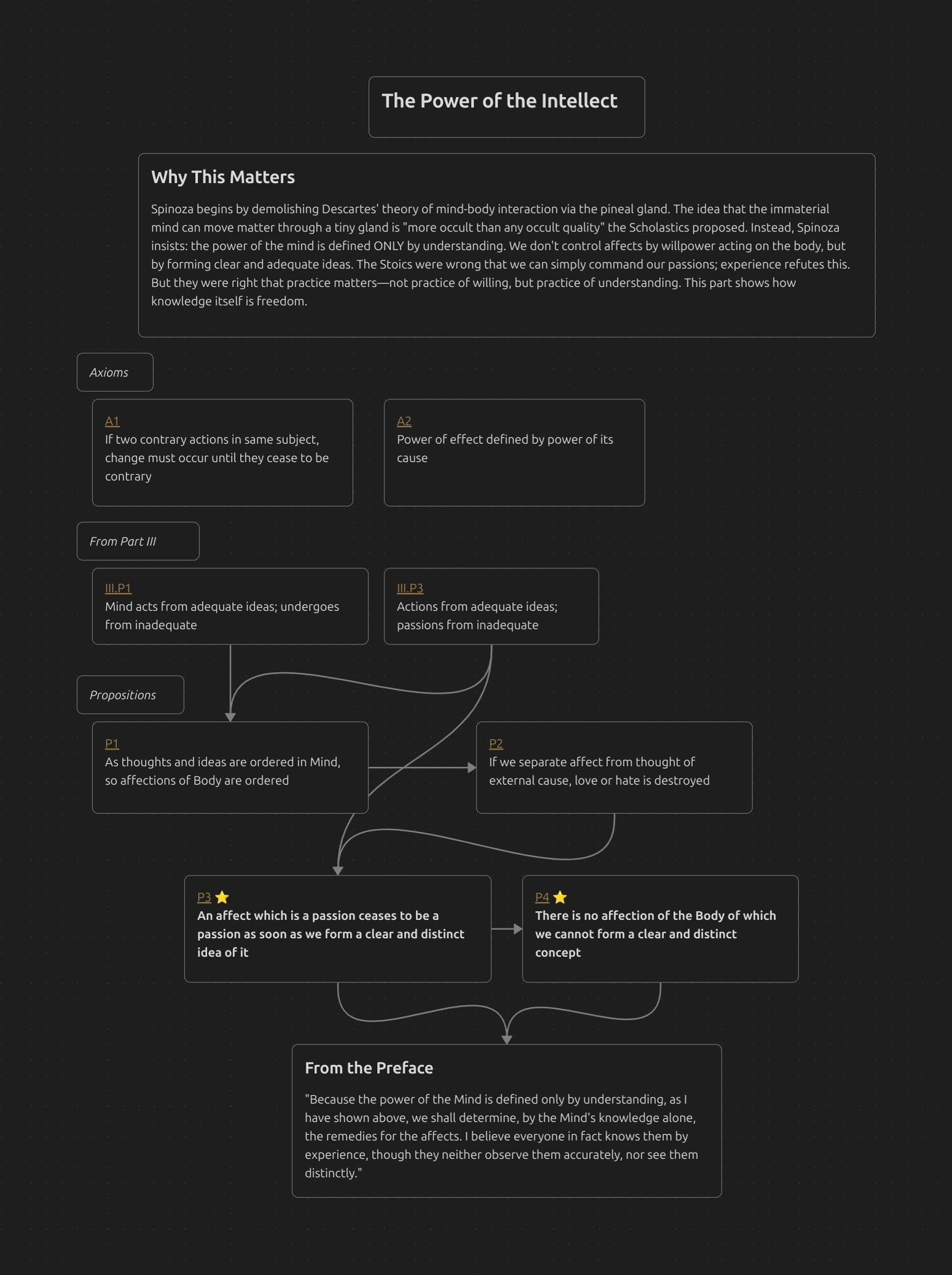
The Power of the Intellect
Why This Matters
Spinoza begins by demolishing Descartes’ theory of mind-body interaction via the pineal gland. The idea that the immaterial mind can move matter through a tiny gland is “more occult than any occult quality” the Scholastics proposed. Instead, Spinoza insists: the power of the mind is defined ONLY by understanding. We don’t control affects by willpower acting on the body, but by forming clear and adequate ideas. The Stoics were wrong that we can simply command our passions; experience refutes this. But they were right that practice matters—not practice of willing, but practice of understanding. This part shows how knowledge itself is mental freedom.
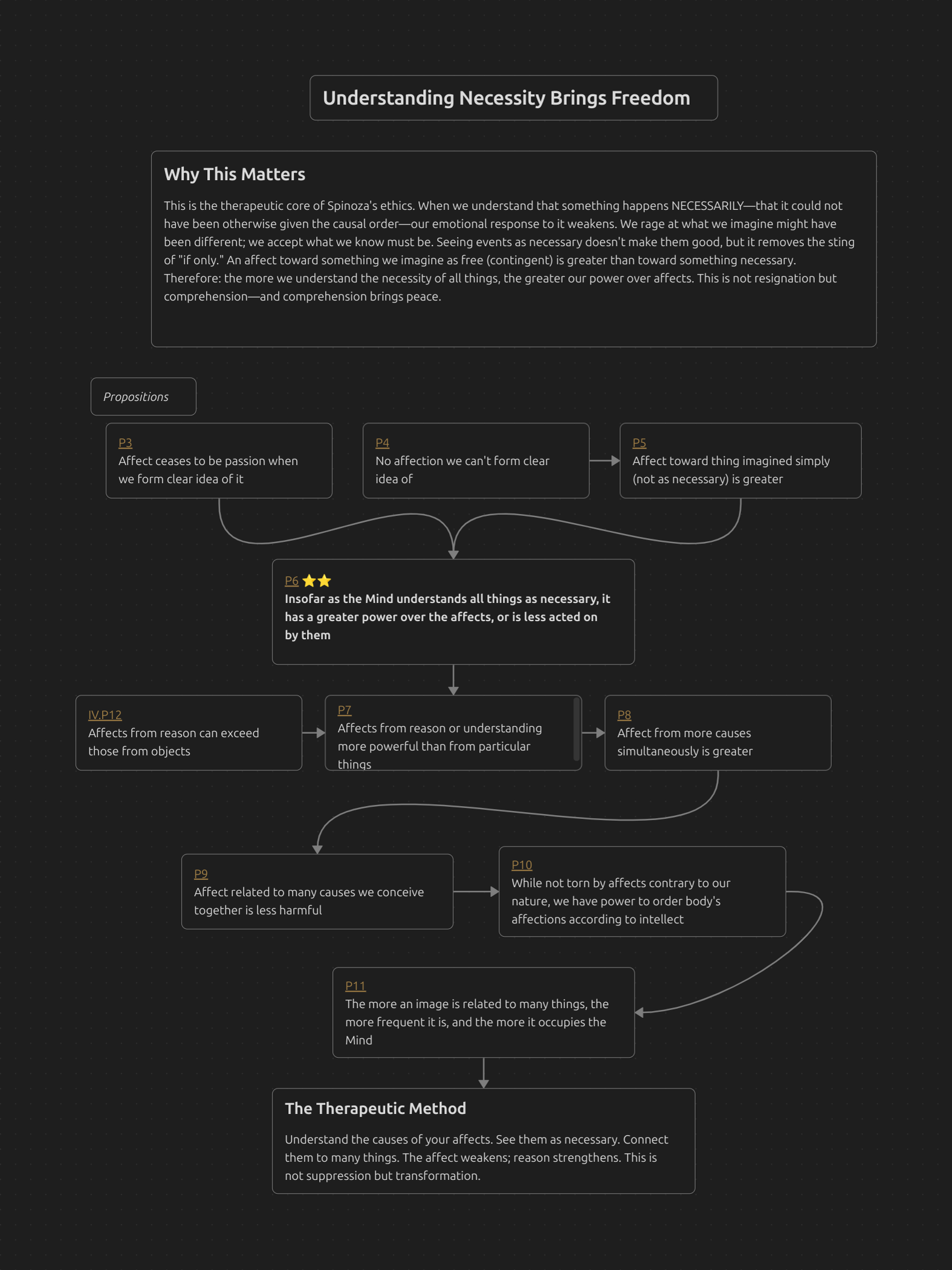
Understanding Necessity Brings Mental freedom
Why This Matters
This is the therapeutic core of Spinoza’s ethics. When we understand that something happens NECESSARILY—that it could not have been otherwise given the causal order—our emotional response to it weakens. We rage at what we imagine might have been different; we accept what we know must be. Seeing events as necessary doesn’t make them good, but it removes the sting of “if only.” An affect toward something we imagine as free (contingent) is greater than toward something necessary. Therefore: the more we understand the necessity of all things, the greater our power over affects. This is not resignation but comprehension—and comprehension brings peace.
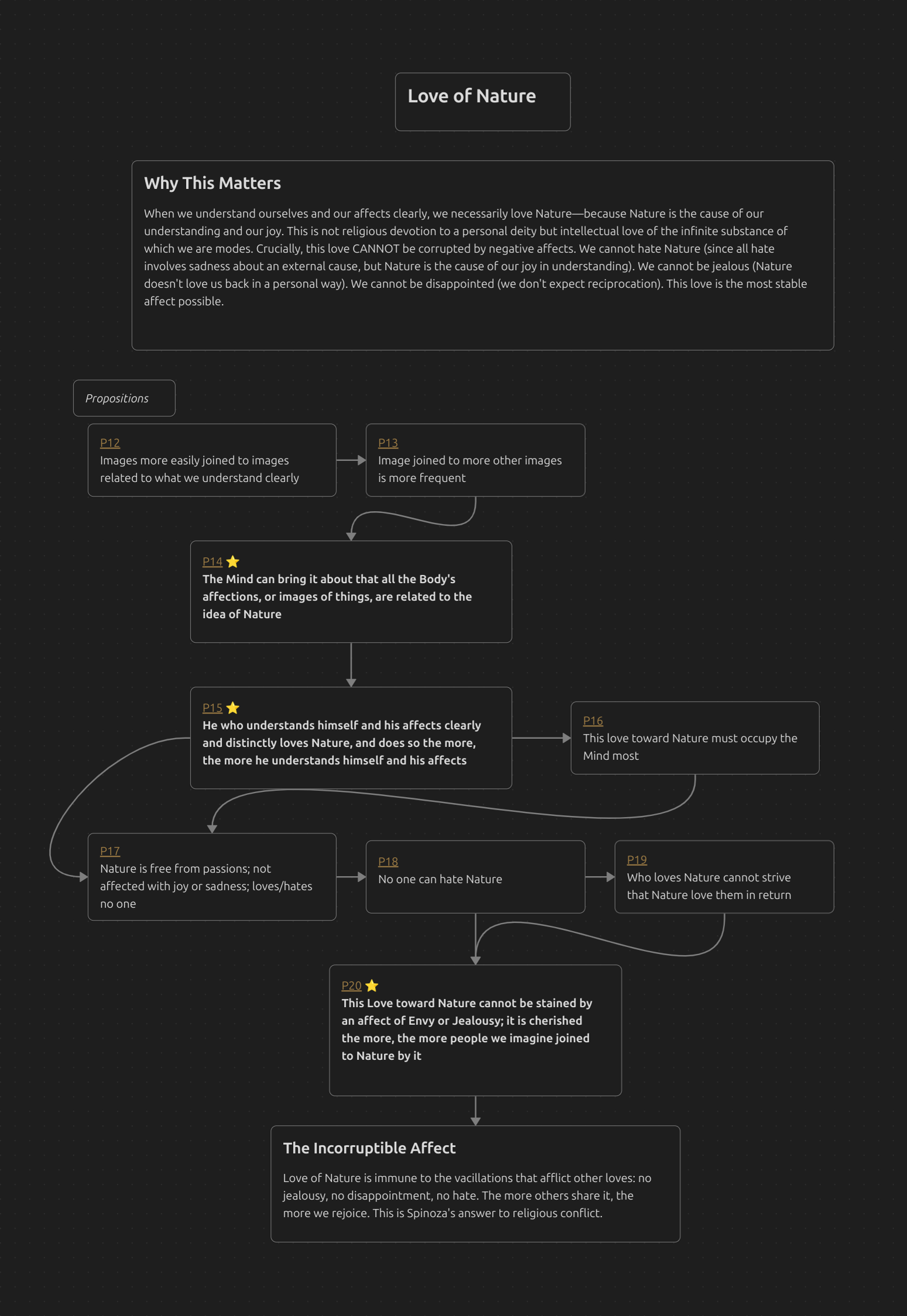
Love of Nature
Why This Matters
When we understand ourselves and our affects clearly, we necessarily love Nature—because Nature is the cause of our understanding and our joy. This is not religious devotion to a personal deity but intellectual love of the infinite substance of which we are modes. Crucially, this love CANNOT be corrupted by negative affects. We cannot hate Nature (since all hate involves sadness about an external cause, but Nature is the cause of our joy in understanding). We cannot be jealous (Nature doesn’t love us back in a personal way). We cannot be disappointed (we don’t expect reciprocation). This love is the most stable affect possible.
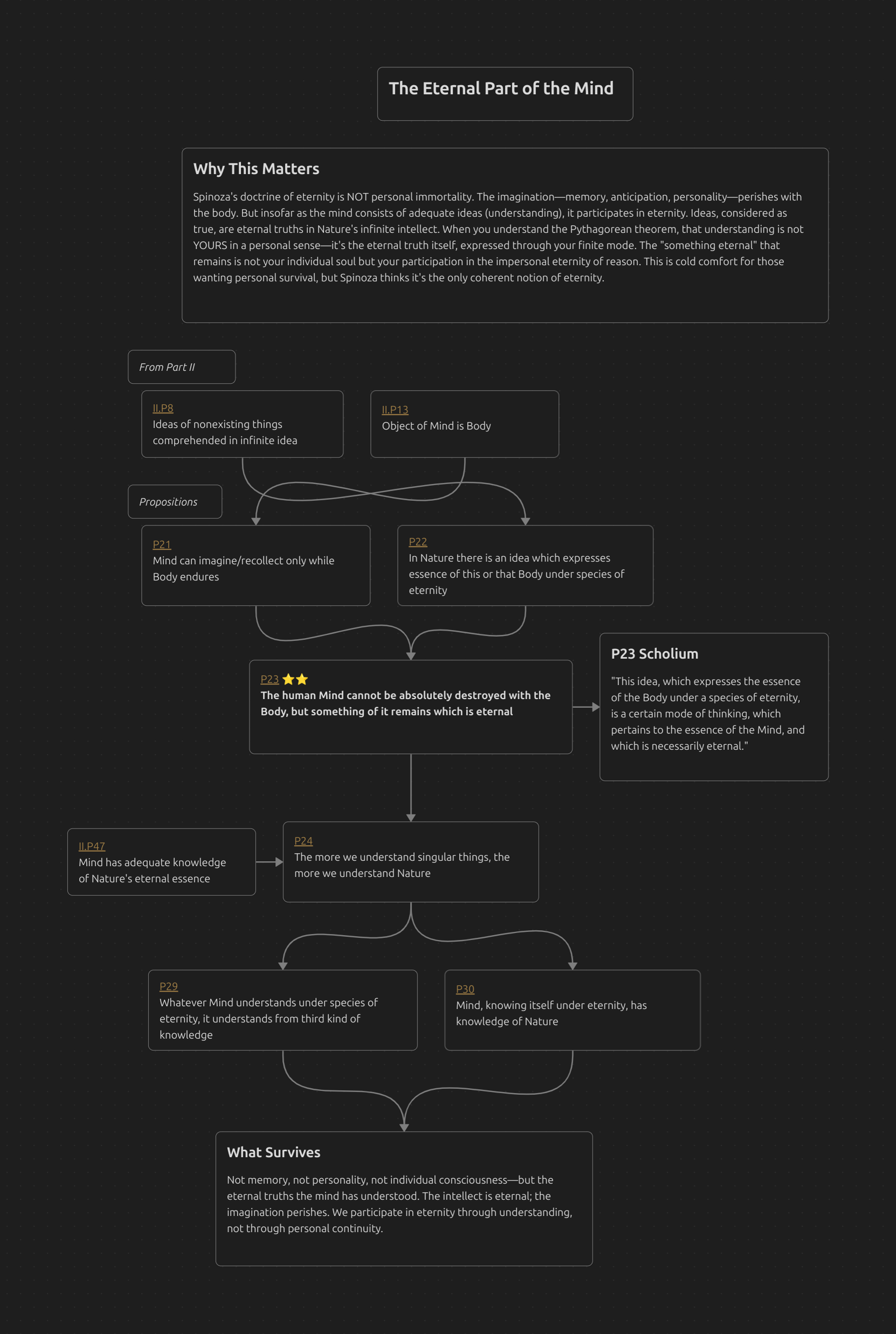
The Eternal Part of the Mind
Why This Matters
Spinoza’s doctrine of eternity is NOT personal immortality. The imagination—memory, anticipation, personality—perishes with the body. But insofar as the mind consists of adequate ideas (understanding), it participates in eternity. Ideas, considered as true, are eternal truths in Nature’s infinite intellect. When you understand the Pythagorean theorem, that understanding is not YOURS in a personal sense—it’s the eternal truth itself, expressed through your finite mode. The “something eternal” that remains is not your individual soul but your participation in the impersonal eternity of reason. This is cold comfort for those wanting personal survival, but Spinoza thinks it’s the only coherent notion of eternity.
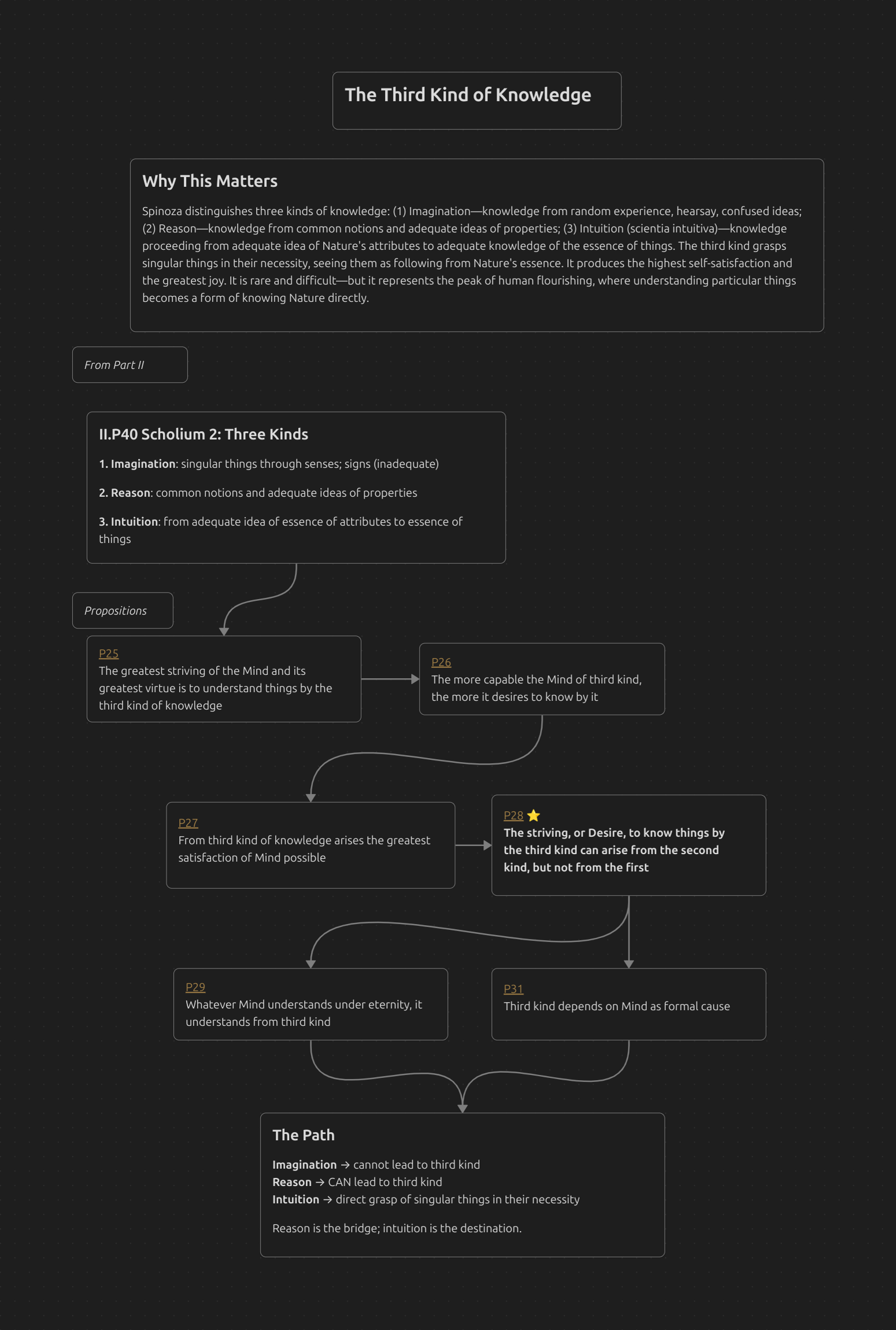
The third kind of knowledge
Why This Matters
Spinoza distinguishes three kinds of knowledge: (1) Imagination—knowledge from random experience, hearsay, confused ideas; (2) Reason—knowledge from common notions and adequate ideas of properties; (3) Intuition (scientia intuitiva)—knowledge proceeding from Adequate idea of Nature’s attributes to adequate knowledge of the essence of things. The third kind grasps singular things in their necessity, seeing them as following from Nature’s essence. It produces the highest self-satisfaction and the greatest joy. It is rare and difficult—but it represents the peak of human intellectual joy, where understanding particular things becomes a form of knowing Nature directly.
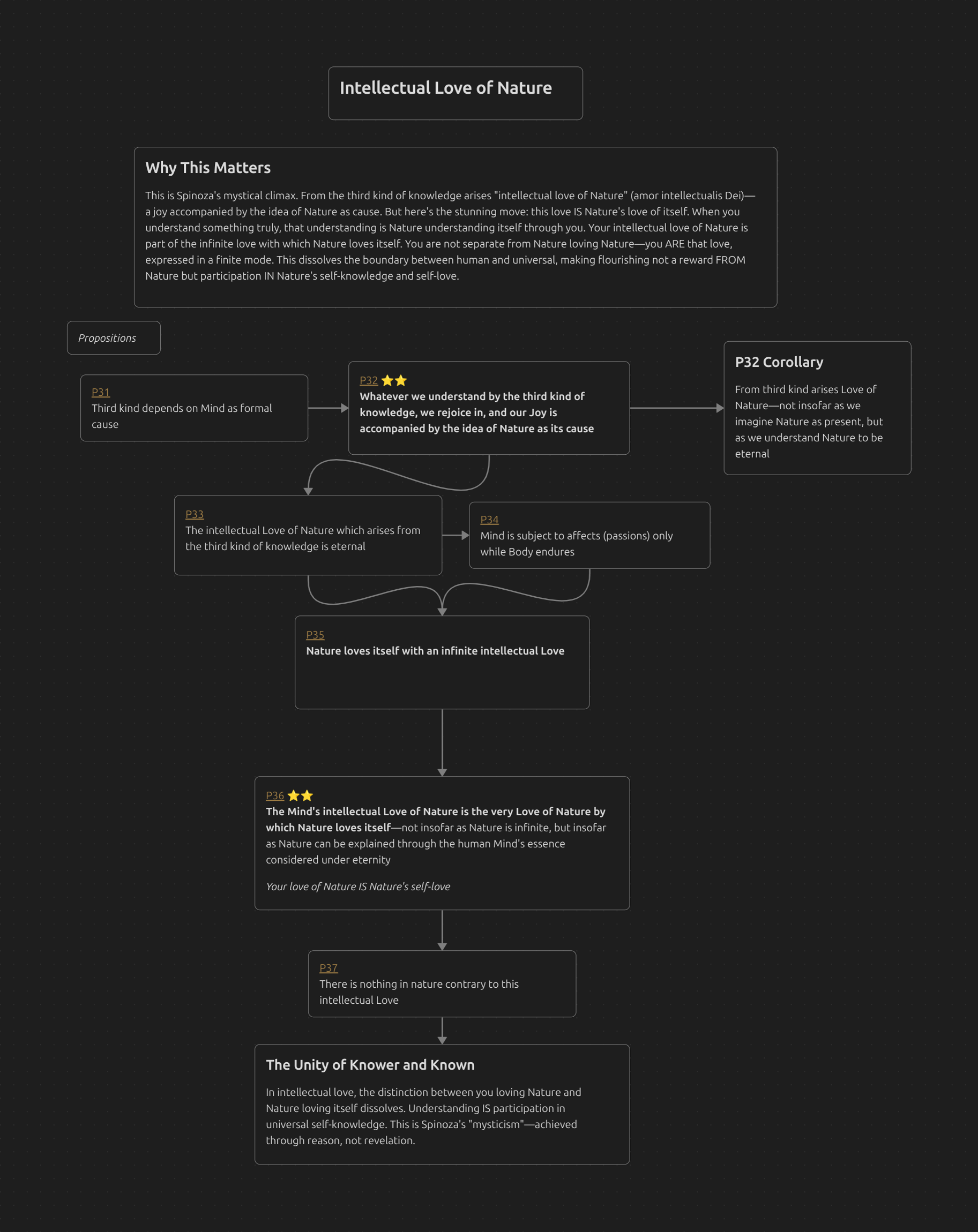
Intellectual Love of Natureof Nature
Why This Matters
This is Spinoza’s mystical climax. From the third kind of knowledge arises “intellectual love of Nature” (amor intellectualis Dei)—a joy accompanied by the idea of Nature as cause. But here’s the stunning move: this love IS Nature’s love of itself. When you understand something truly, that understanding is Nature understanding itself through you. Your intellectual love of Nature is part of the infinite love with which Nature loves itself. You are not separate from Nature loving Nature—you ARE that love, expressed in a finite mode. This dissolves the boundary between human and divine, making intellectual joy not a reward FROM Nature but participation IN Nature’s self-knowledge and self-love.
Intellectual joy Is Not the Reward of Virtue, But Virtue Itself
Why This Matters
The Ethics ends with its most famous proposition: intellectual joy is not a reward for virtue but IS virtue itself. We don’t restrain our lusts in order to be happy later—we ARE happy when we understand, and that happiness gives us power over lusts. This inverts the religious picture where morality is a burden rewarded after death. For Spinoza, understanding IS joy, virtue IS power, and intellectual joy IS the activity of knowing Nature. The wise person “never ceases to be, but always possesses true peace of mind.” The way is hard—“all things excellent are as difficult as they are rare”—but it is the only path to genuine mental freedom and peace.
Link to original

Preface
I pass, finally, to the remaining Part of the Ethics, which concerns the means, or way, leading to Mental freedom. Here, then, I shall treat of the power of reason, showing what it can do against the affects, and what Mental freedom of Mind, or blessedness/intellectual joy, is. From this we shall see how much more the wise man can do than the ignorant. But it does not pertain to this investigation to show how the intellect must be perfected, or in what way the Body must be cared for, so that it can perform its function properly. The former is the concern of Logic, and the latter of Medicine. Here, then, as I have said, I shall treat only of the power of the Mind, or of reason, and shall show, above all, how great its dominion over the affects is, and what kind of dominion it has for restraining and moderating them. For we have already demonstrated above that it does not have an absolute dominion over them. Nevertheless, the Stoics thought that they depend entirely on our will, and that we can command them absolutely. But experience cries out against this, and has forced them, in spite of their principles, to confess that much practice and application are required to restrain and moderate them. If I remember rightly, someone tried to show this by the example of two dogs, one a house dog, the other a hunting dog. For by practice he was finally able to bring it about that the house dog was accustomed to hunt, and the hunting dog to refrain from chasing hares.
Descartes was rather inclined to this opinion. For he maintained that the Soul, or Mind, was especially united to a certain part of the brain, called the pineal gland, by whose aid the Mind is aware of all the motions aroused in the body and of external objects, and which the Mind can move in various ways simply by willing. He contended that this gland was suspended in the middle of the brain in such a way that it could be moved by the least motion of the animal spirits. He maintained further that this gland is suspended in the middle of the brain in as many varying ways as there are varying ways that the animal spirits strike against it, and moreover, that as many varying traces are impressed upon it as there are varying external objects which drive the animal spirits against it. That is why, if the Soul’s will afterwards moves the gland so that it is suspended as it once was by the motion of the animal spirits, the gland will drive and determine the animal spirits in the same way as when they were driven back before by a similar placement of the gland.
Furthermore, he maintained that each will of the Mind is united by nature to a certain fixed motion of this gland. For example, if someone has a will to look at a distant object, this will brings it about that the pupil is dilated. But if he thinks only of the pupil which is to be dilated, nothing will be accomplished by having a will for this, because nature has not joined the motion of the gland which serves to drive the animal spirits against the Optic nerve in a way suitable for dilating or contracting the pupil with the will to dilate or contract it. Instead, it has joined that motion with the will to look at distant or near objects.
Finally, he maintained that even though each motion of this gland seems to have been connected by nature from the beginning of our life with a particular one of our thoughts, they can still be joined by habit to others. He tries to prove this in The Passions of the Soul I.
From these claims, he infers that there is no Soul so weak that it cannot—when it is well directed—acquire an absolute power over its Passions. For as he defines them, these are … perceptions, or feelings, or emotions of the soul, which are particularly related to the soul, and which {NB} are produced, preserved, and strengthened by some motion of the spirits (see The Passions of the Soul I, 27).3 But since to any will we can join any motion of the gland (and consequently any motion of the spirits), and since the determination of the will depends only on our power, we shall acquire an absolute dominion over our Passions, if we determine our will by firm and certain judgments according to which we will to direct the actions of our life, and if we join to these judgments the motions of the passions we will to have. Such is the opinion of that most distinguished Man—as far as I can gather it from his words. I would hardly have believed it had been propounded by so great a Man, had it not been so subtle. Indeed, I cannot wonder enough that a Philosopher of his caliber—one who had firmly decided to deduce nothing except from principles known through themselves, and to affirm nothing which he did not perceive clearly and distinctly, one who had so often censured the Scholastics for wishing to explain obscure things by occult qualities—that such a Philosopher should assume a Hypothesis more occult than any occult quality. What, I ask, does he understand by the union of Mind and Body? What clear and distinct concept does he have of a thought so closely united to some little portion of quantity? Indeed, I wish he had explained this union by its proximate cause. But he had conceived the Mind to be so distinct from the Body that he could not assign any singular cause, either of this union or of the Mind itself. Instead, it was necessary for him to have recourse to the cause of the whole Universe, i.e., to God/Nature.
Again, I should like very much to know how many degrees of motion the Mind can give to that pineal gland, and how great a force is required to hold it in suspense. For I do not know whether this gland is driven about more slowly by the Mind than by the animal spirits, or more quickly; nor do I know whether the motions of the Passions which we have joined closely to firm judgments can be separated from them again by corporeal causes. If so, it would follow that although the Mind had firmly resolved to face dangers, and had joined the motions of daring to this decision, nevertheless, once the danger had been seen, the gland might be so suspended that the Mind could think only of flight. And of course, since there is no common measure between the will and motion, there is also no comparison between the power, or forces, of the Mind and those of the Body. Consequently, the forces of the Body cannot in any way be determined by those of the Mind.
To this we may add that this gland is not found to be so placed in the middle of the brain that it can be driven about so easily and in so many ways, and that not all the nerves extend to the cavities of the brain. Finally, I pass over all those things he claimed about the will and its mental freedom, since I have already shown, more than adequately, that they are false.
Therefore, because the power of the Mind is defined only by understanding, as I have shown above, we shall determine, by the Mind’s knowledge alone, the remedies for the affects. I believe everyone in fact knows them by experience, though they neither observe them accurately, nor see them distinctly. From that we shall deduce all those things which concern the Mind’s blessedness/intellectual joy.
Axioms (2)
- Part V Axiom 1 - If two contrary actions in same subject, change must occur
- Part V Axiom 2 - Power of effect defined by power of its cause
Propositions (42)
- Part V Proposition 1 - Affects ordered according to order of thoughts | Deps: III.P1, III.P3
- Part V Proposition 2 - If we separate affect from thought of external cause, affect destroyed | Deps: P1
- Part V Proposition 3 - Affect ceasing to be passion becomes true idea ⭐ | Deps: P2, III.P3
- Part V Proposition 4 - No affection of body we can’t form clear idea of ⭐ | Deps: P3
- Part V Proposition 5 - Affect toward thing we imagine simply is greater | Deps: P4
- Part V Proposition 6 - Insofar as Mind understands all as necessary, greater power over affects ⭐⭐ | Deps: P5
- Part V Proposition 7 - Affects from reason more powerful than toward individual things | Deps: P6, IV.P12
- Part V Proposition 8 - Greater number of causes affect arises from, greater it is | Deps: P7, IV.P11
- Part V Proposition 9 - Affect related to more causes has greater power over us | Deps: P8
- Part V Proposition 10 - While not torn by contrary affects, we have power to order affections | Deps: P9
- Part V Proposition 11 - Affect related to more causes, less harmful | Deps: P10
- Part V Proposition 12 - Images of things more easily joined to images related to what we understand | Deps: P11
- Part V Proposition 13 - Image more easily joined to more images | Deps: P12
- Part V Proposition 14 - Mind can bring all body’s affections to thoughts of Nature ⭐ | Deps: P13
- Part V Proposition 15 - Who understands self and affects clearly loves Nature ⭐ | Deps: P14
- Part V Proposition 16 - This love must occupy Mind most | Deps: P15
- Part V Proposition 17 - Nature free from passions of love/hate toward us | Deps: P15, P16
- Part V Proposition 18 - No one can hate Nature | Deps: P17
- Part V Proposition 19 - Who loves Nature can’t strive that Nature love them | Deps: P18
- Part V Proposition 20 - This love toward Nature can’t be corrupted by affects | Deps: P19
- Part V Proposition 21 - Mind can imagine nothing nor recollect except while Body endures | Deps: II.P13
- Part V Proposition 22 - In Nature there is idea expressing essence of this/that body under eternity | Deps: II.P8
- Part V Proposition 23 - Mind can’t be absolutely destroyed; something eternal remains ⭐⭐ | Deps: P22
- Part V Proposition 24 - The more we understand individual things, the more we understand Nature | Deps: P23, II.P47
- Part V Proposition 25 - Mind’s highest striving is to know things by third kind of knowledge | Deps: P24
- Part V Proposition 26 - Mind more capable of understanding more things by third kind | Deps: P25
- Part V Proposition 27 - From third kind of knowledge arises highest self-satisfaction | Deps: P26
- Part V Proposition 28 - Striving to know things by third kind arises from second kind ⭐ | Deps: P27
- Part V Proposition 29 - Whatever Mind understands under eternity, understands from third kind | Deps: P28
- Part V Proposition 30 - Our Mind, insofar as it knows itself and Body under eternity, has knowledge of Nature | Deps: P29
- Part V Proposition 31 - Third kind of knowledge depends on Mind as formal cause | Deps: P30
- Part V Proposition 32 - We rejoice in whatever we understand by third kind, with idea of Nature as cause ⭐⭐ | Deps: P31
- Part V Proposition 33 - Intellectual love of Nature arising from third kind is eternal | Deps: P32
- Part V Proposition 34 - Mind subject to affects only while Body endures | Deps: P33
- Part V Proposition 35 - Nature loves itself with infinite intellectual love | Deps: P34
- Part V Proposition 36 - Mind’s intellectual love of Nature is Nature’s love with which Nature loves itself ⭐⭐ | Deps: P35
- Part V Proposition 37 - Nothing in nature contrary to this love | Deps: P36
- Part V Proposition 38 - The more Mind understands by second/third kind, the less it suffers from evil affects | Deps: P37
- Part V Proposition 39 - Who has body capable of many things has mind of which greatest part is eternal | Deps: P38
- Part V Proposition 40 - The more perfection each thing has, the more active and less passive | Deps: P39
- Part V Proposition 41 - Even if we didn’t know mind eternal, piety/religion still primary | Deps: IV.P67, IV.P68, IV.P69, IV.P70, IV.P71, IV.P72, IV.P73
- Part V Proposition 42 - Intellectual joy is not reward of virtue, but virtue itself ⭐⭐⭐ | Deps: P32, P33, P34, P35, P36, P37, P38, P39, P40, P41
If the way I have shown to lead to these things now seems very hard, still, it can be found.
And of course, what is found so rarely must be hard. For if salvation/mental freedom were at hand, and could be found without great effort, how could nearly everyone neglect it? But all things excellent are as difficult as they are rare.