The Power of the Intellect
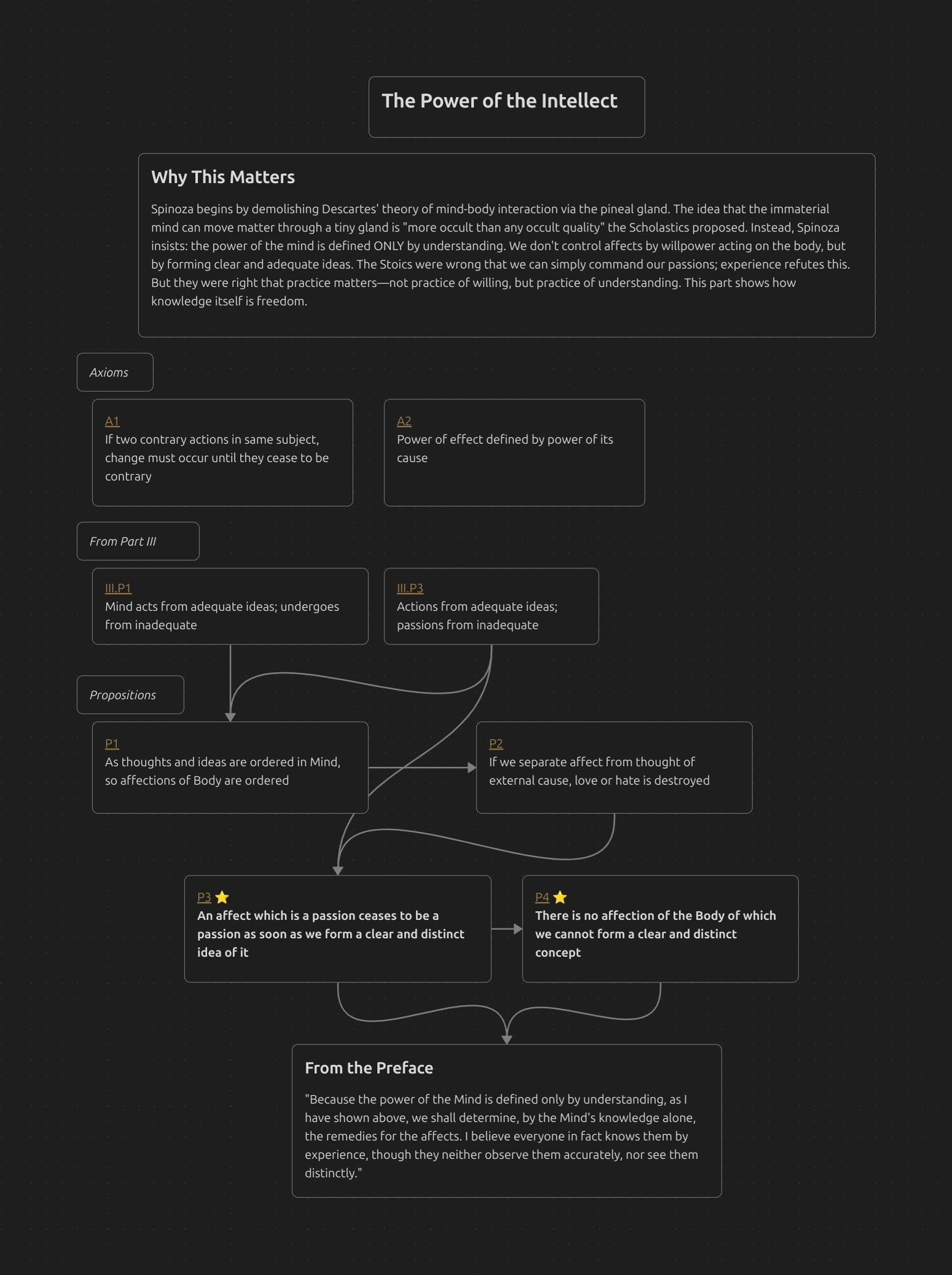
Why This Matters
Spinoza begins by demolishing Descartes’ theory of mind-body interaction via the pineal gland. The idea that the immaterial mind can move matter through a tiny gland is “more occult than any occult quality” the Scholastics proposed. Instead, Spinoza insists: the power of the mind is defined ONLY by understanding. We don’t control affects by willpower acting on the body, but by forming clear and adequate ideas. The Stoics were wrong that we can simply command our passions; experience refutes this. But they were right that practice matters—not practice of willing, but practice of understanding. This part shows how knowledge itself is mental freedom.
Understanding Necessity Brings Mental freedom
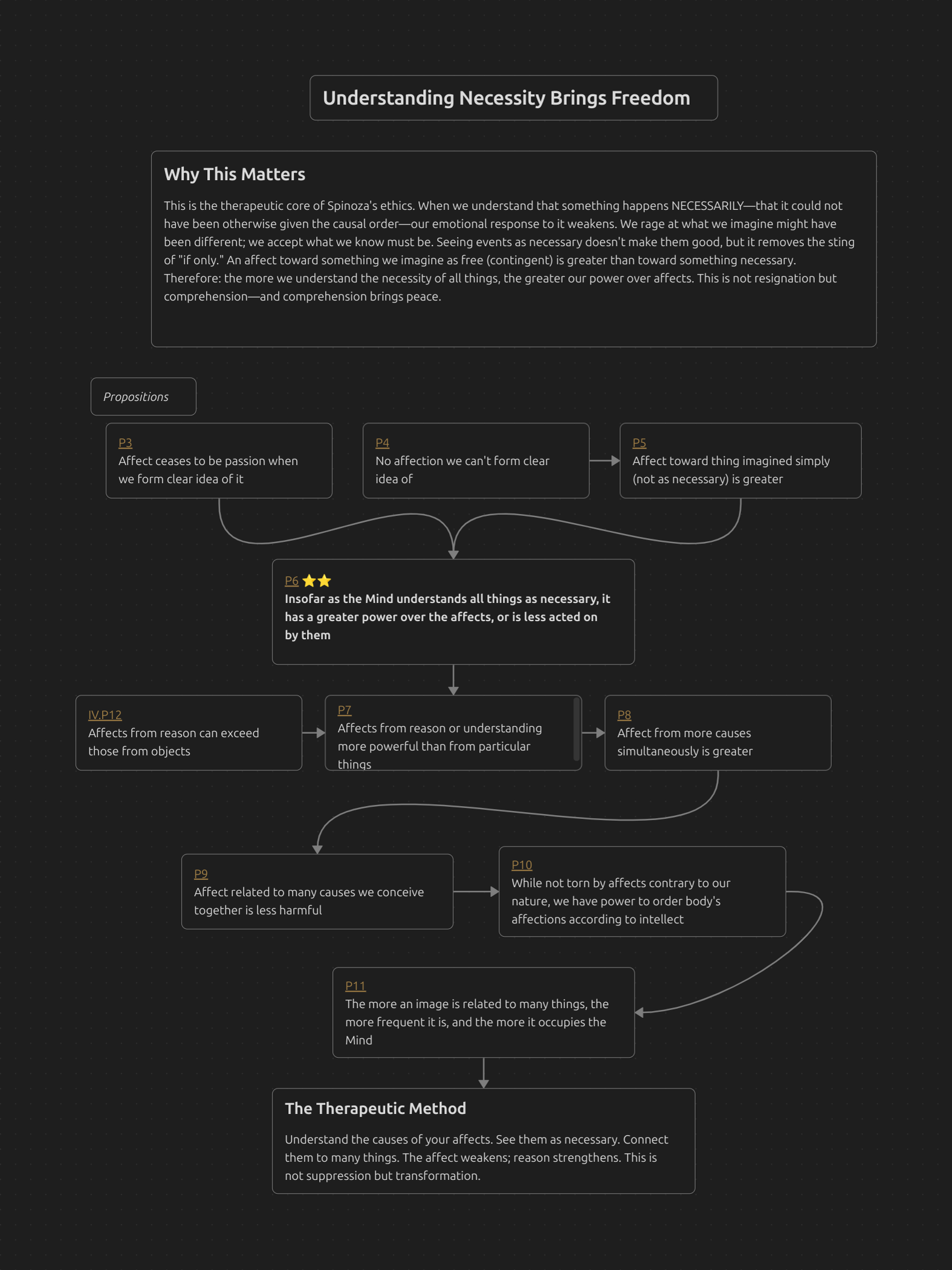
Why This Matters
This is the therapeutic core of Spinoza’s ethics. When we understand that something happens NECESSARILY—that it could not have been otherwise given the causal order—our emotional response to it weakens. We rage at what we imagine might have been different; we accept what we know must be. Seeing events as necessary doesn’t make them good, but it removes the sting of “if only.” An affect toward something we imagine as free (contingent) is greater than toward something necessary. Therefore: the more we understand the necessity of all things, the greater our power over affects. This is not resignation but comprehension—and comprehension brings peace.
Love of Nature
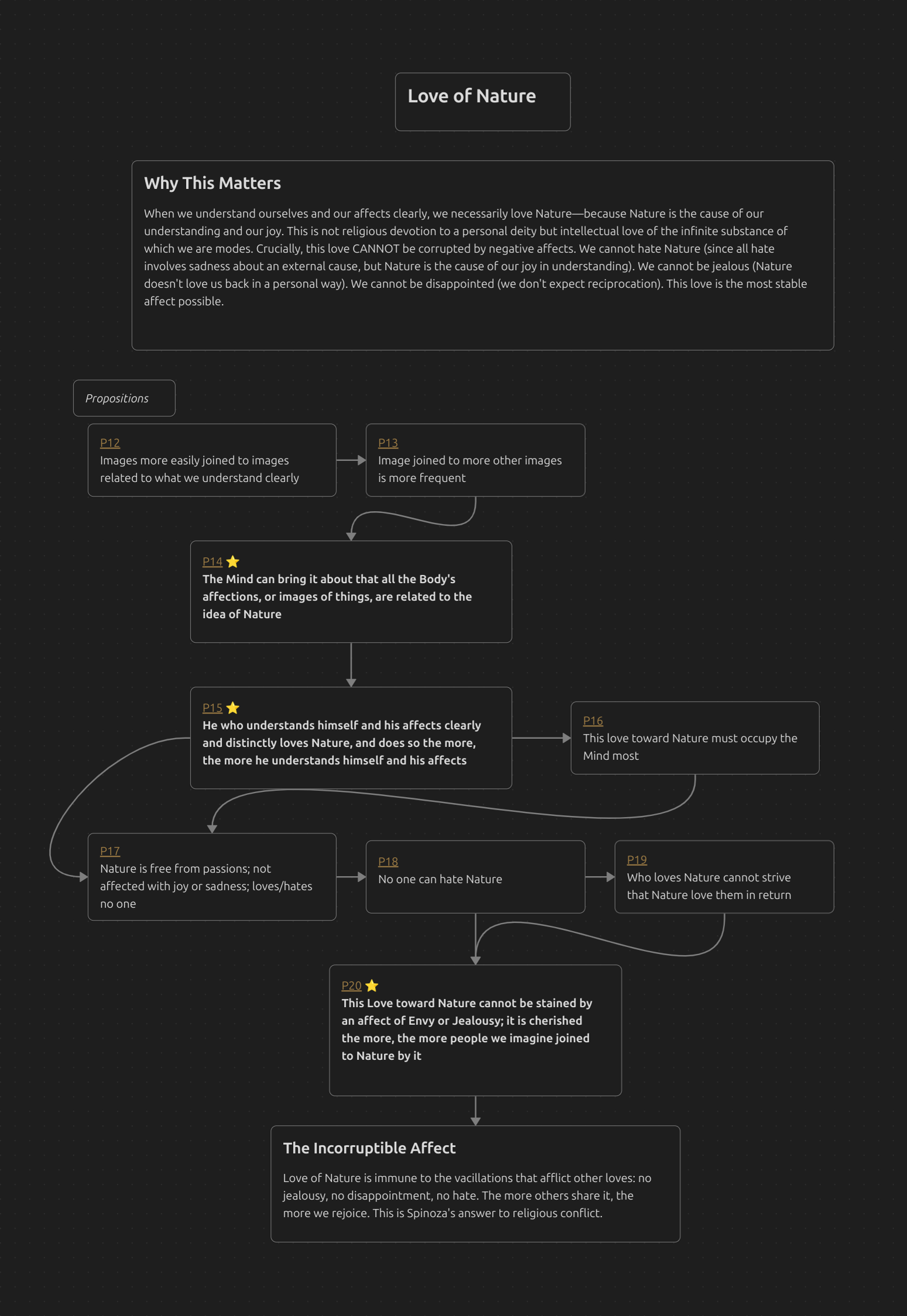
Why This Matters
When we understand ourselves and our affects clearly, we necessarily love Nature—because Nature is the cause of our understanding and our joy. This is not religious devotion to a personal deity but intellectual love of the infinite substance of which we are modes. Crucially, this love CANNOT be corrupted by negative affects. We cannot hate Nature (since all hate involves sadness about an external cause, but Nature is the cause of our joy in understanding). We cannot be jealous (Nature doesn’t love us back in a personal way). We cannot be disappointed (we don’t expect reciprocation). This love is the most stable affect possible.
The Eternal Part of the Mind
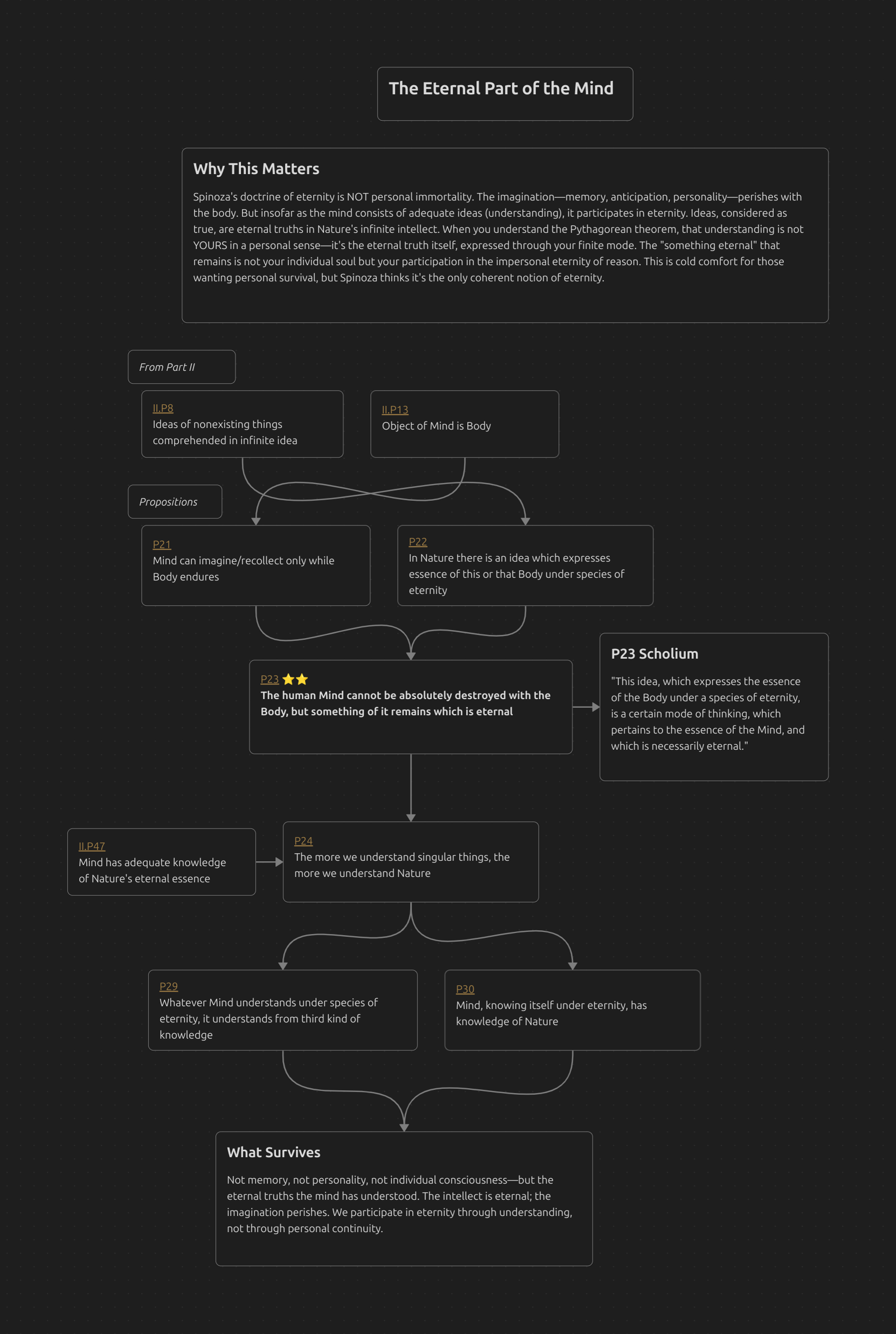
Why This Matters
Spinoza’s doctrine of eternity is NOT personal immortality. The imagination—memory, anticipation, personality—perishes with the body. But insofar as the mind consists of adequate ideas (understanding), it participates in eternity. Ideas, considered as true, are eternal truths in Nature’s infinite intellect. When you understand the Pythagorean theorem, that understanding is not YOURS in a personal sense—it’s the eternal truth itself, expressed through your finite mode. The “something eternal” that remains is not your individual soul but your participation in the impersonal eternity of reason. This is cold comfort for those wanting personal survival, but Spinoza thinks it’s the only coherent notion of eternity.
The third kind of knowledge
Why This Matters
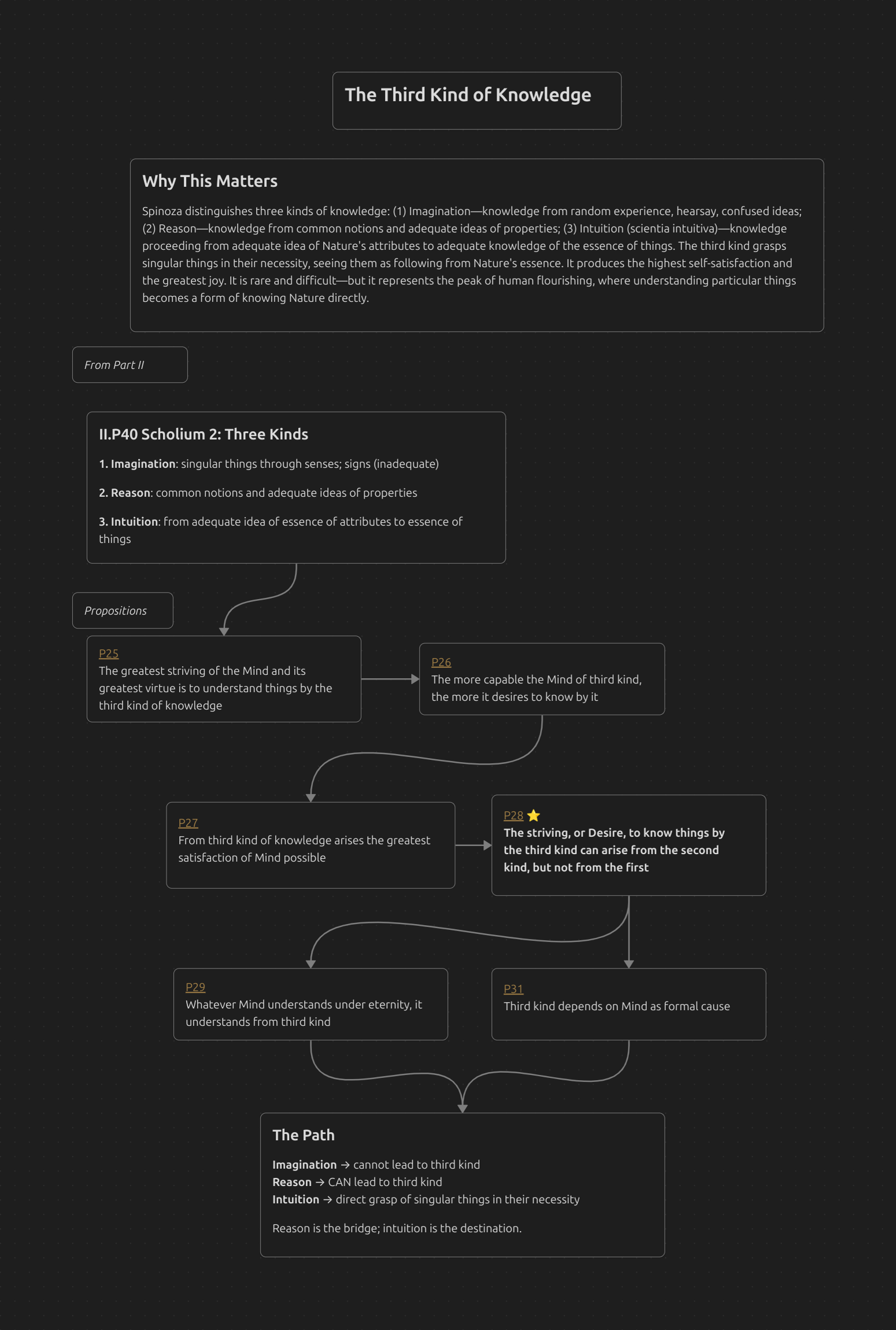
Spinoza distinguishes three kinds of knowledge: (1) Imagination—knowledge from random experience, hearsay, confused ideas; (2) Reason—knowledge from common notions and adequate ideas of properties; (3) Intuition (scientia intuitiva)—knowledge proceeding from Adequate idea of Nature’s attributes to adequate knowledge of the essence of things. The third kind grasps singular things in their necessity, seeing them as following from Nature’s essence. It produces the highest self-satisfaction and the greatest joy. It is rare and difficult—but it represents the peak of human intellectual joy, where understanding particular things becomes a form of knowing Nature directly.
Intellectual Love of Natureof Nature
Why This Matters
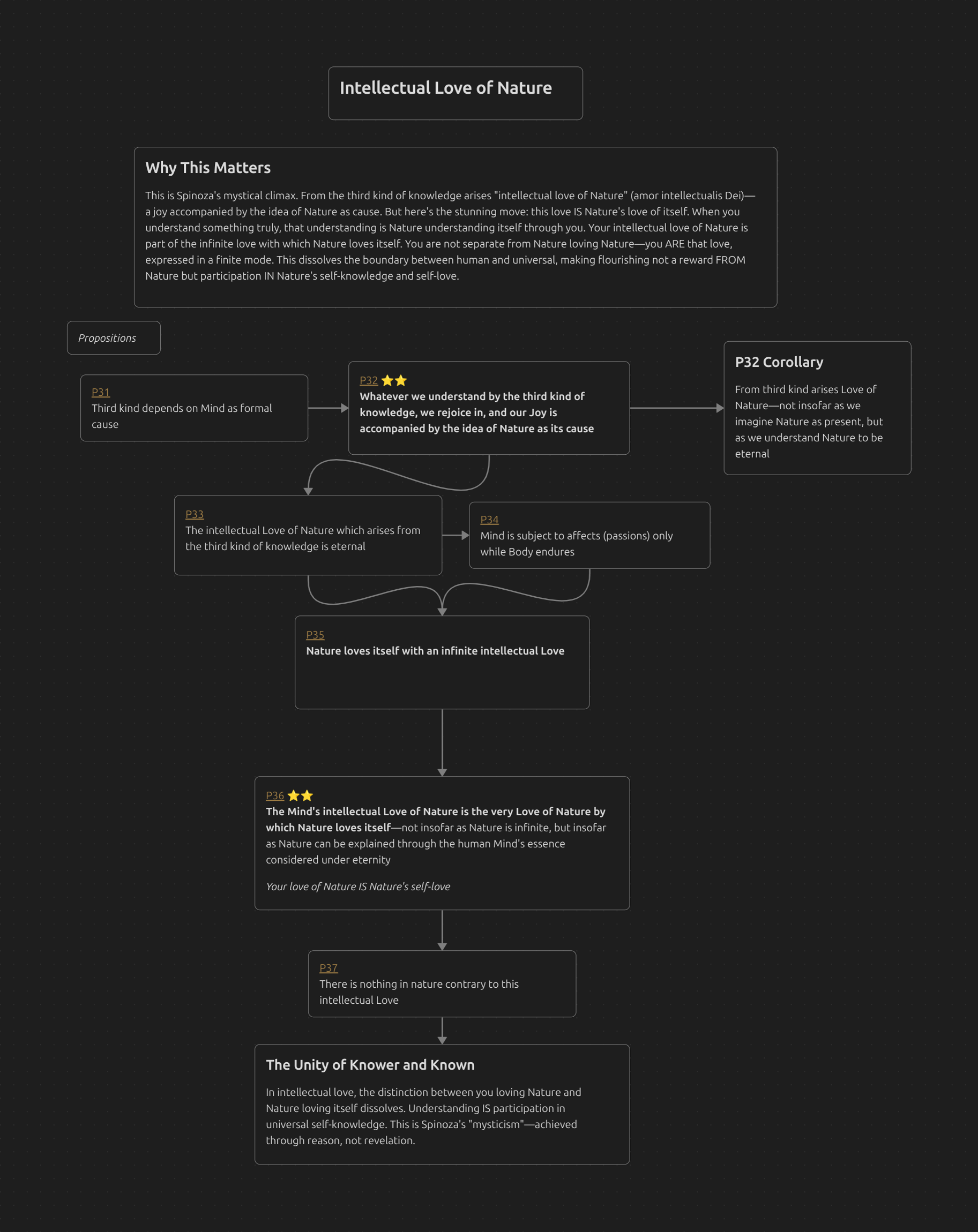
This is Spinoza’s mystical climax. From the third kind of knowledge arises “intellectual love of Nature” (amor intellectualis Dei)—a joy accompanied by the idea of Nature as cause. But here’s the stunning move: this love IS Nature’s love of itself. When you understand something truly, that understanding is Nature understanding itself through you. Your intellectual love of Nature is part of the infinite love with which Nature loves itself. You are not separate from Nature loving Nature—you ARE that love, expressed in a finite mode. This dissolves the boundary between human and divine, making intellectual joy not a reward FROM Nature but participation IN Nature’s self-knowledge and self-love.
Intellectual joy Is Not the Reward of Virtue, But Virtue Itself

Why This Matters
The Ethics ends with its most famous proposition: intellectual joy is not a reward for virtue but IS virtue itself. We don’t restrain our lusts in order to be happy later—we ARE happy when we understand, and that happiness gives us power over lusts. This inverts the religious picture where morality is a burden rewarded after death. For Spinoza, understanding IS joy, virtue IS power, and intellectual joy IS the activity of knowing Nature. The wise person “never ceases to be, but always possesses true peace of mind.” The way is hard—“all things excellent are as difficult as they are rare”—but it is the only path to genuine mental freedom and peace.