Affects Follow Natural Laws
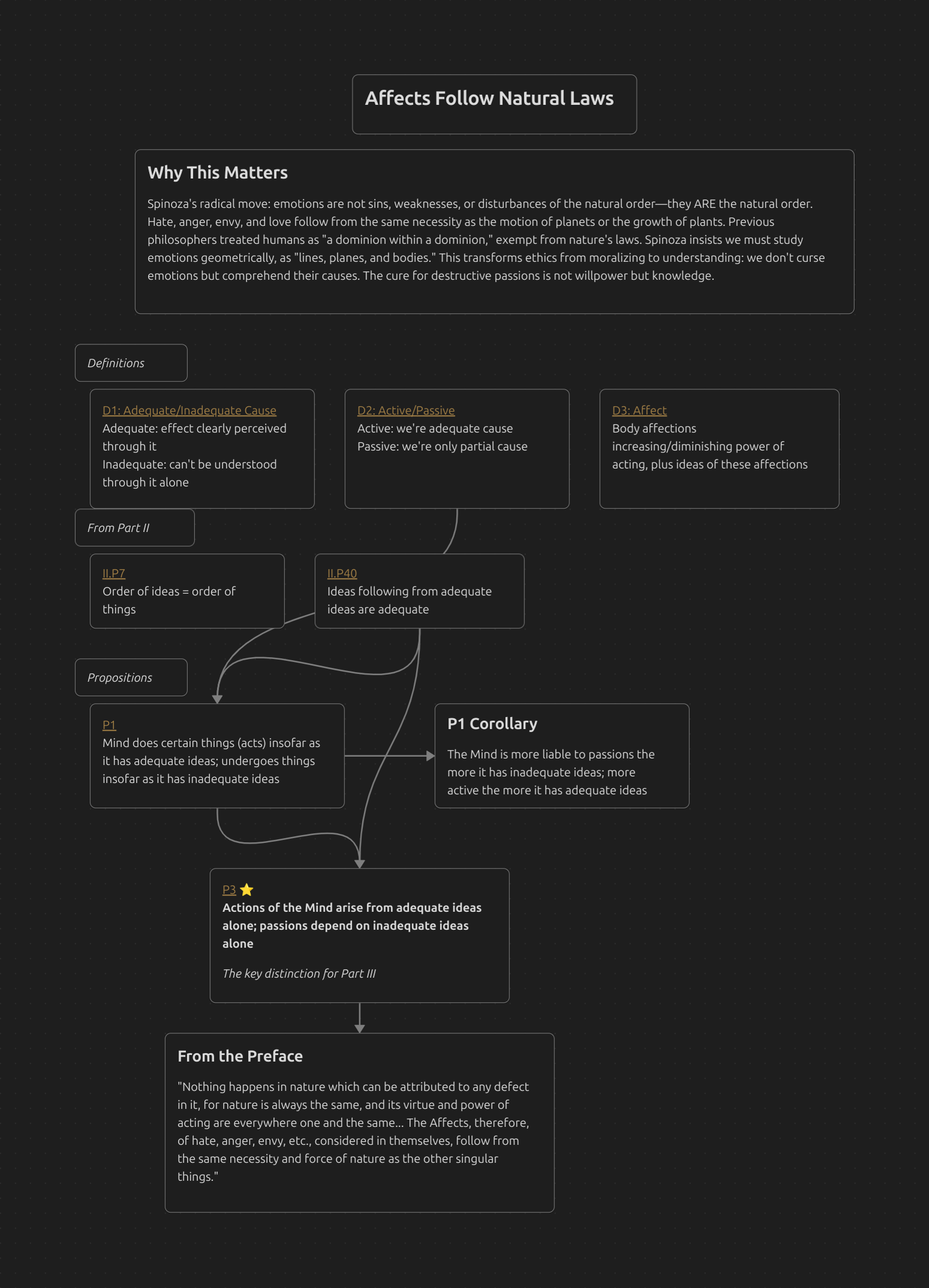
Why This Matters
Spinoza’s radical move: emotions are not sins, weaknesses, or disturbances of the natural order—they ARE the natural order. Hate, anger, envy, and love follow from the same necessity as the motion of planets or the growth of plants. Previous philosophers treated humans as “a dominion within a dominion,” exempt from nature’s laws. Spinoza insists we must study emotions geometrically, as “lines, planes, and bodies.” This transforms ethics from moralizing to understanding: we don’t curse emotions but comprehend their causes. The cure for destructive passions is not willpower but knowledge.
Mind Cannot Move Body, Body Cannot Move Mind
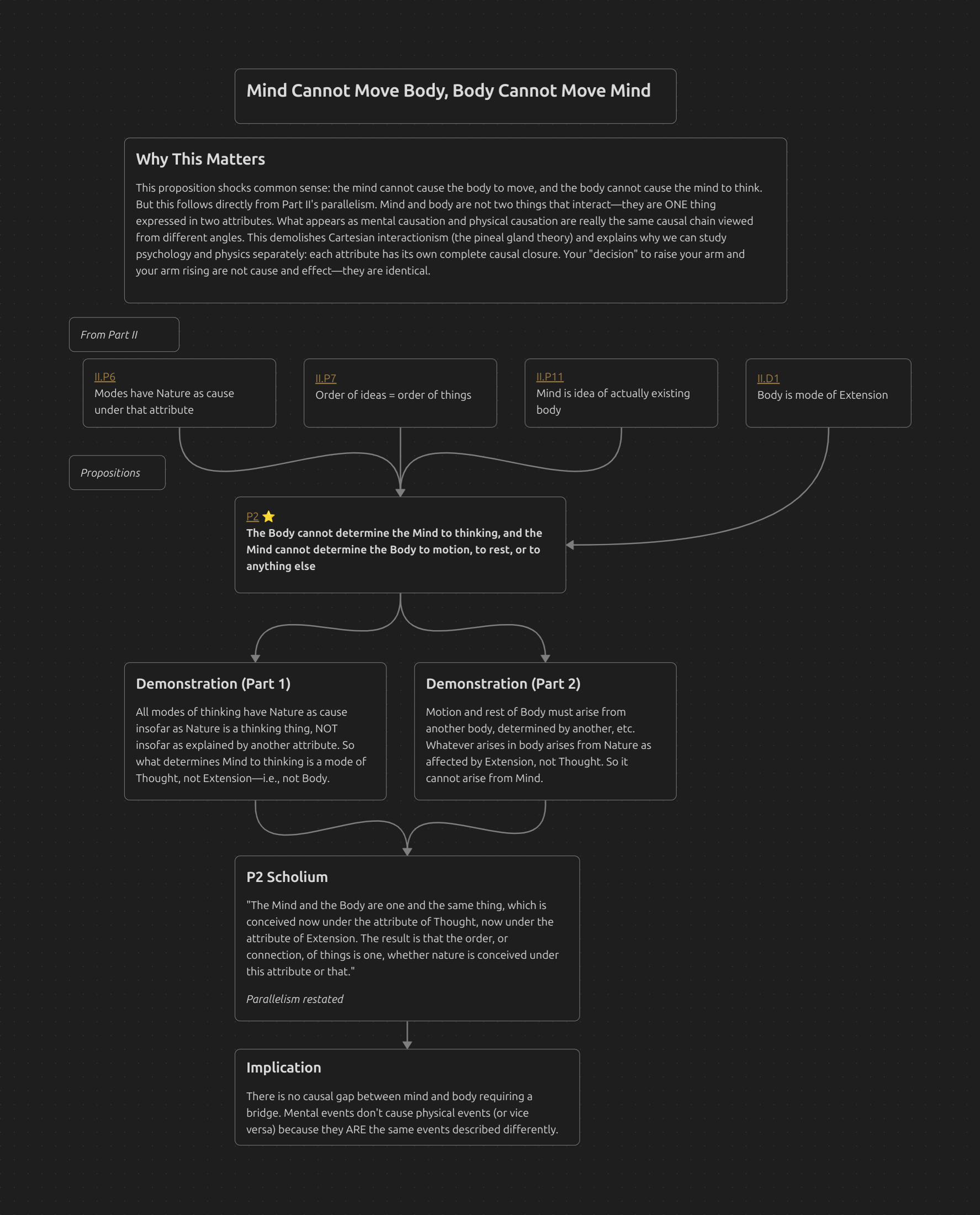
Why This Matters
This proposition shocks common sense: the mind cannot cause the body to move, and the body cannot cause the mind to think. But this follows directly from Part II’s parallelism. Mind and body are not two things that interact—they are ONE thing expressed in two attributes. What appears as mental causation and physical causation are really the same causal chain viewed from different angles. This demolishes Cartesian interactionism (the pineal gland theory) and explains why we can study psychology and physics separately: each attribute has its own complete causal closure. Your “decision” to raise your arm and your arm rising are not cause and effect—they are identical.
Conatus: Everything Strives to Persist
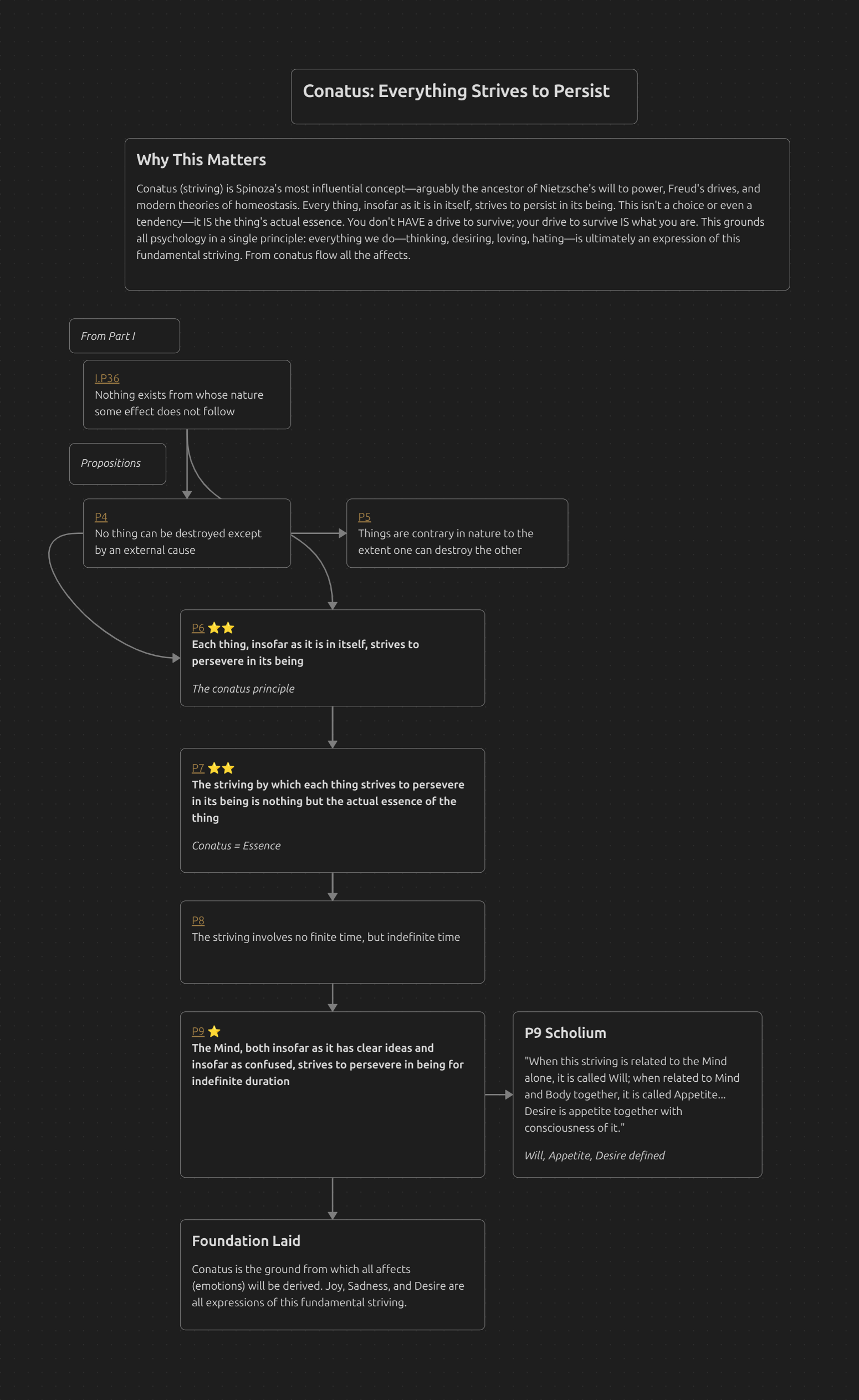
Why This Matters
Conatus (striving) is Spinoza’s most influential concept—arguably the ancestor of Nietzsche’s will to power, Freud’s drives, and modern theories of homeostasis. Every thing, insofar as it is in itself, strives to persist in its being. This isn’t a choice or even a tendency—it IS the thing’s actual essence. You don’t HAVE a drive to survive; your drive to survive IS what you are. This grounds all psychology in a single principle: everything we do—thinking, desiring, loving, hating—is ultimately an expression of this fundamental striving. From conatus flow all the affects.
Joy, Sadness, Desire: The Three Primary Affects
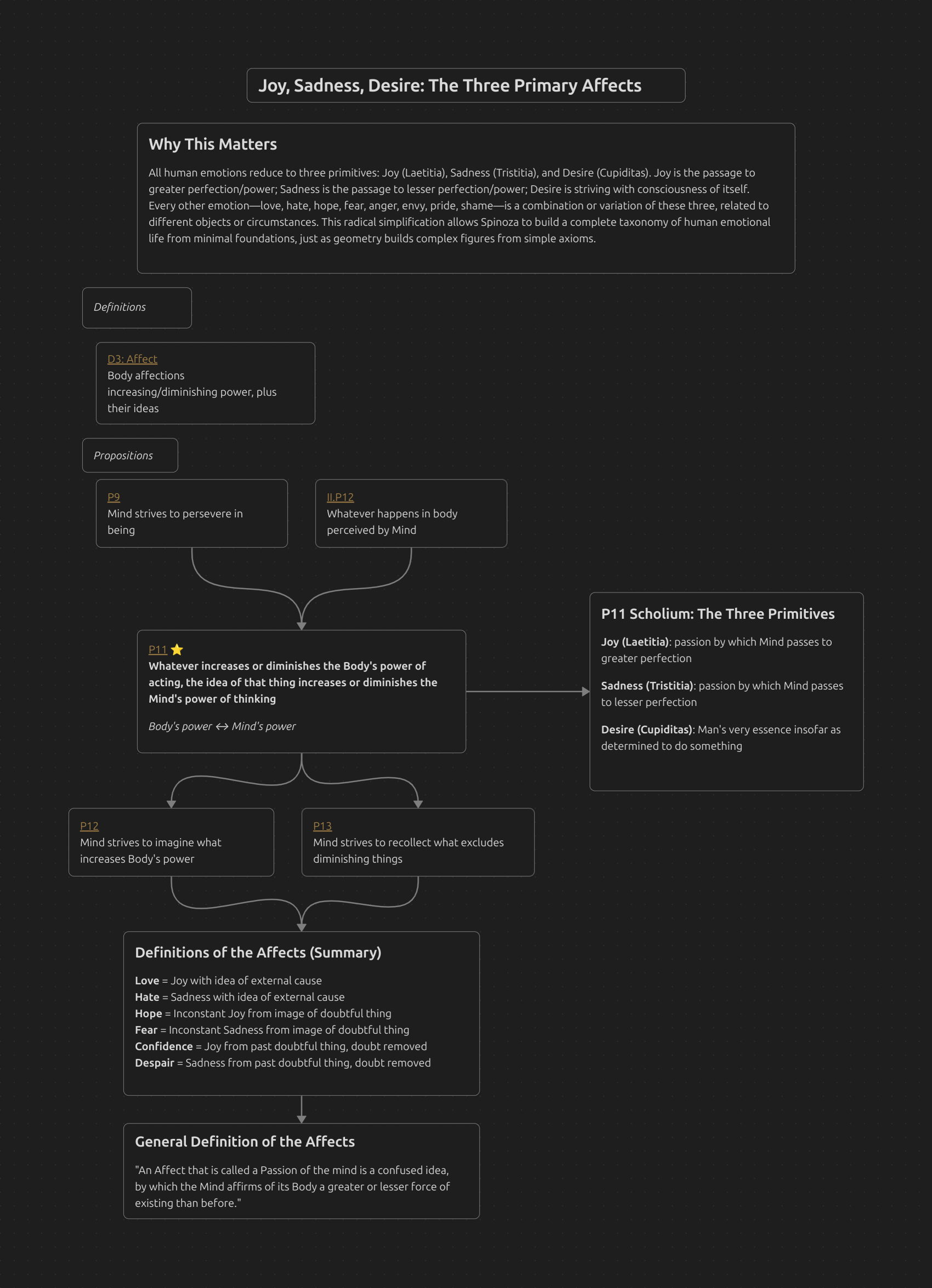
Why This Matters
All human emotions reduce to three primitives: Joy (Laetitia), Sadness (Tristitia), and Desire (Cupiditas). Joy is the passage to greater perfection/power; Sadness is the passage to lesser perfection/power; Desire is striving with consciousness of itself. Every other emotion—love, hate, hope, fear, anger, envy, pride, shame—is a combination or variation of these three, related to different objects or circumstances. This radical simplification allows Spinoza to build a complete taxonomy of human emotional life from minimal foundations, just as geometry builds complex figures from simple axioms.
Association: How Love and Hate Arise
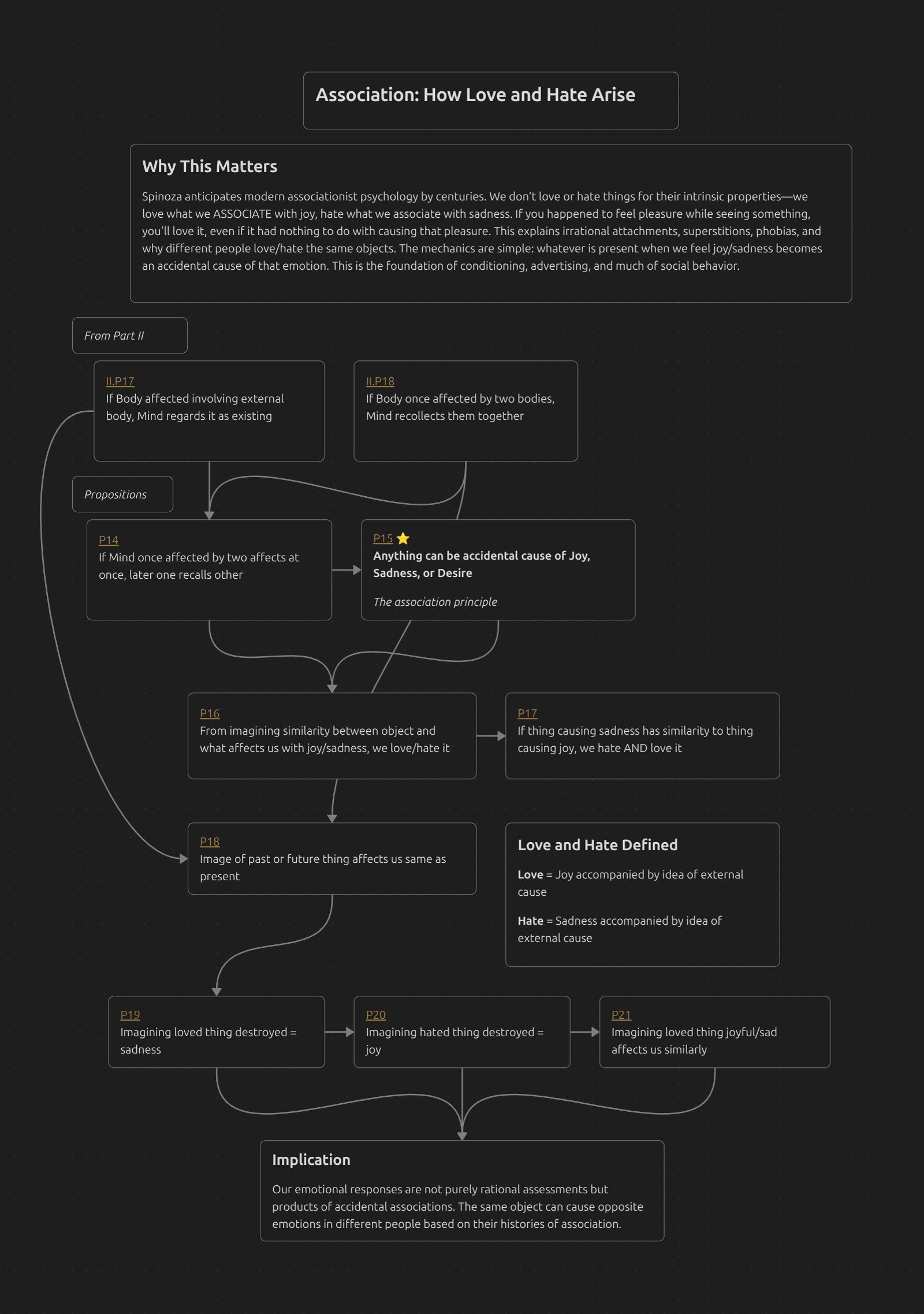
Why This Matters
Spinoza anticipates modern associationist psychology by centuries. We don’t love or hate things for their intrinsic properties—we love what we ASSOCIATE with joy, hate what we associate with sadness. If you happened to feel pleasure while seeing something, you’ll love it, even if it had nothing to do with causing that pleasure. This explains irrational attachments, superstitions, phobias, and why different people love/hate the same objects. The mechanics are simple: whatever is present when we feel joy/sadness becomes an accidental cause of that emotion. This is the foundation of conditioning, advertising, and much of social behavior.
Imitation of Affects
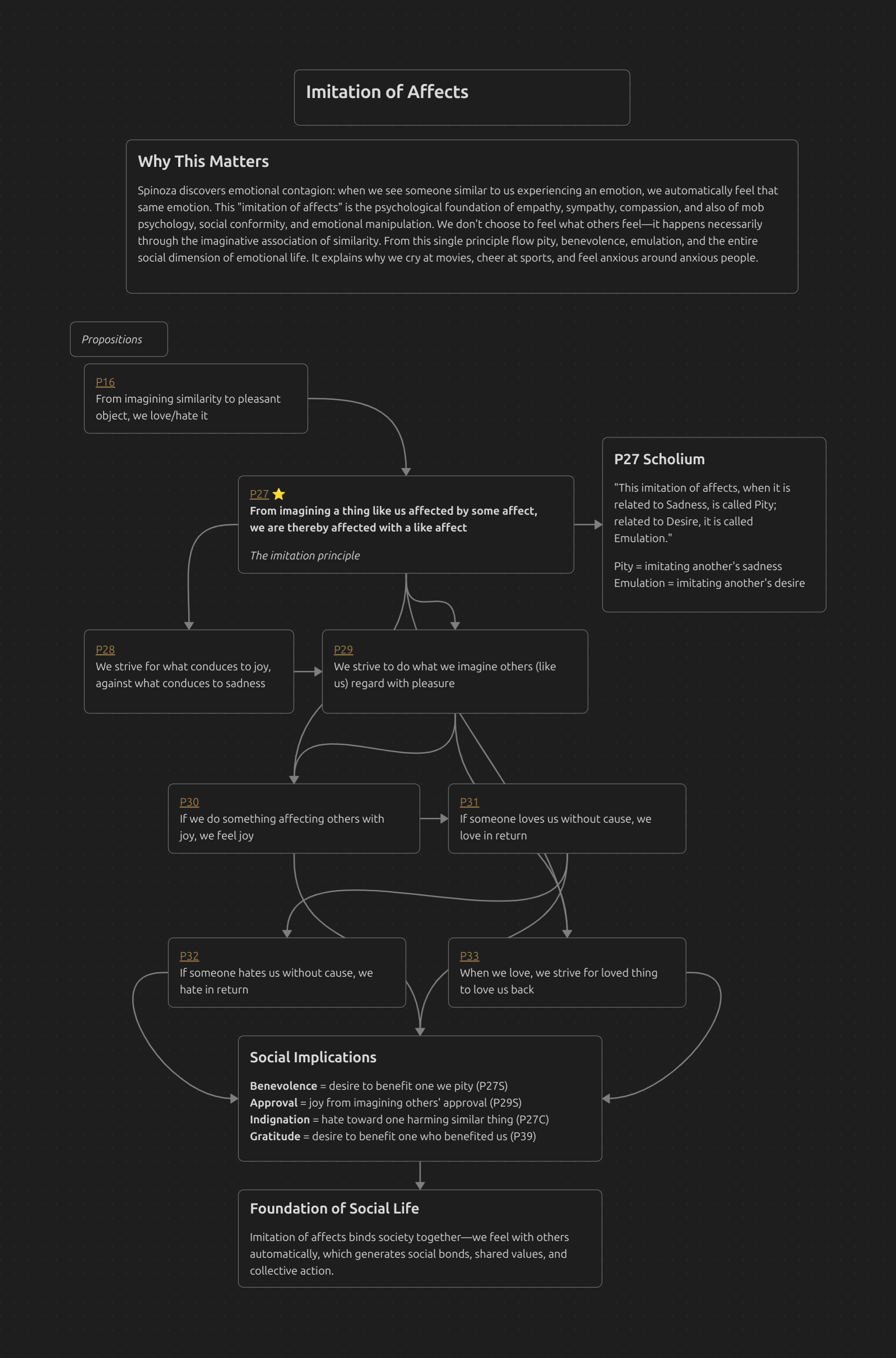
Why This Matters
Spinoza discovers emotional contagion: when we see someone similar to us experiencing an emotion, we automatically feel that same emotion. This “imitation of affects” is the psychological foundation of empathy, sympathy, compassion, and also of mob psychology, social conformity, and emotional manipulation. We don’t choose to feel what others feel—it happens necessarily through the imaginative association of similarity. From this single principle flow pity, benevolence, emulation, and the entire social dimension of emotional life. It explains why we cry at movies, cheer at sports, and feel anxious around anxious people.
Conflict of Affects and Vacillation
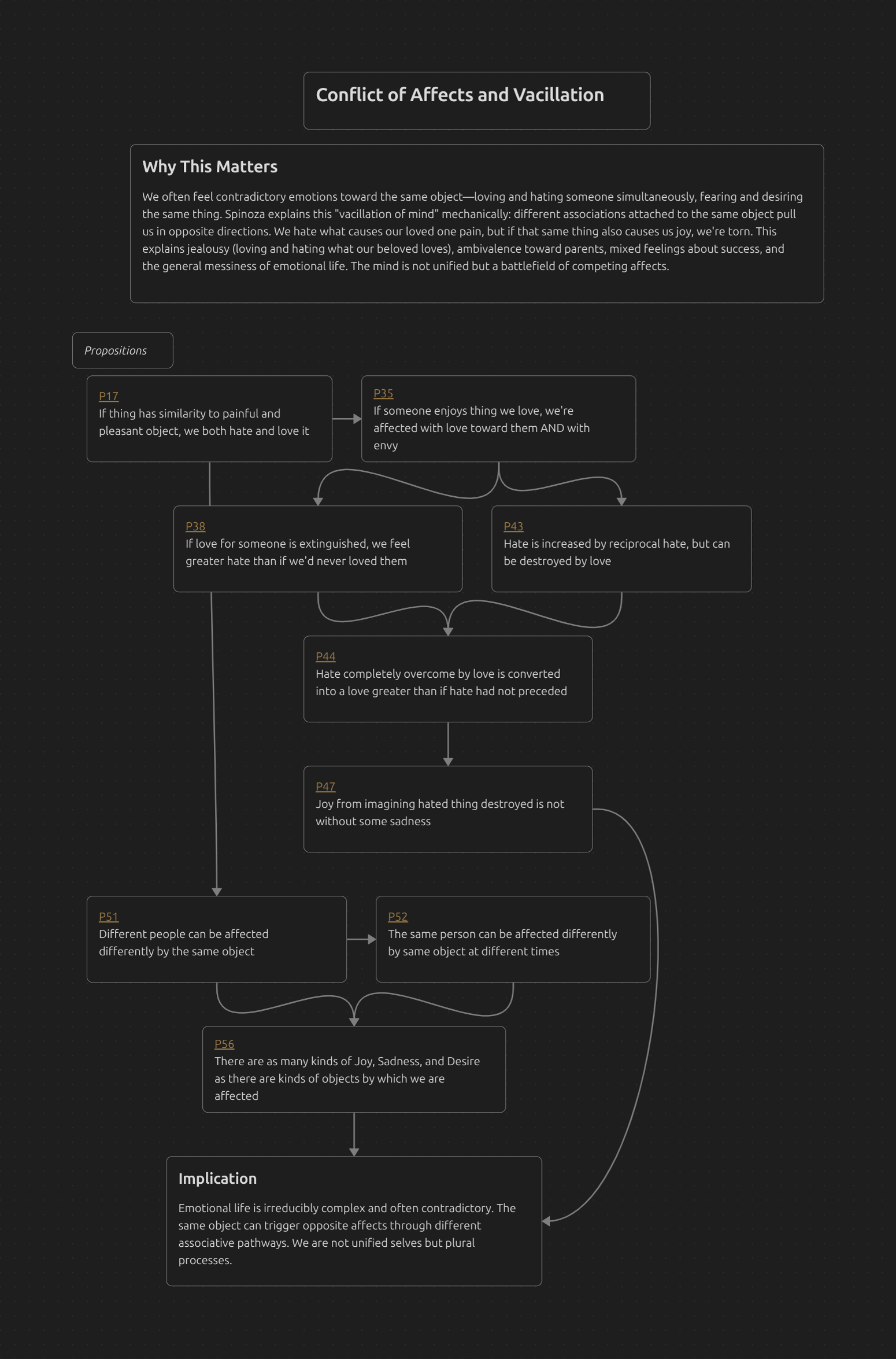
Why This Matters
We often feel contradictory emotions toward the same object—loving and hating someone simultaneously, fearing and desiring the same thing. Spinoza explains this “vacillation of mind” mechanically: different associations attached to the same object pull us in opposite directions. We hate what causes our loved one pain, but if that same thing also causes us joy, we’re torn. This explains jealousy (loving and hating what our beloved loves), ambivalence toward parents, mixed feelings about success, and the general messiness of emotional life. The mind is not unified but a battlefield of competing affects.
Active vs Passive Affects
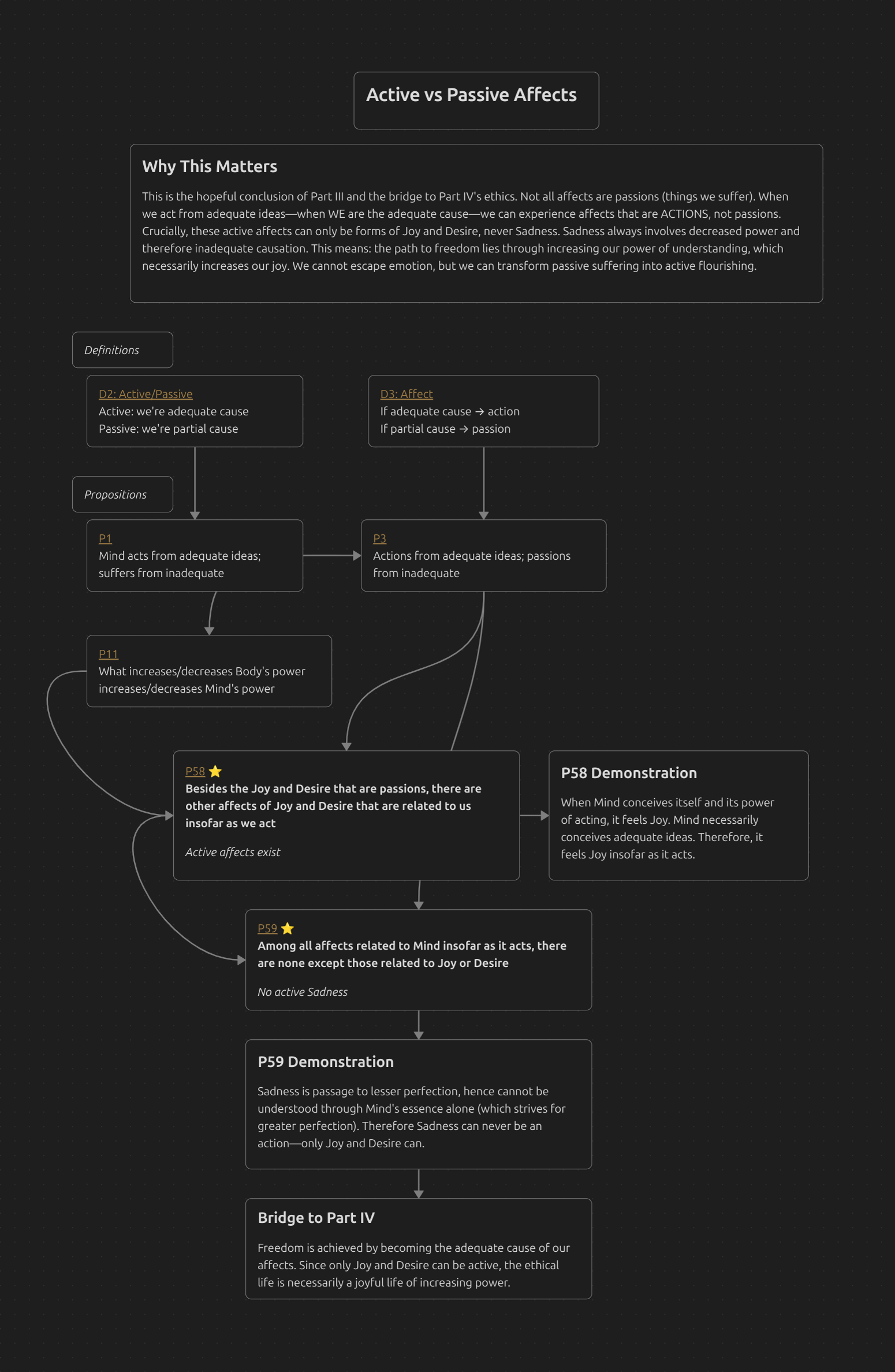
Why This Matters
This is the hopeful conclusion of Part III and the bridge to Part IV’s ethics. Not all affects are passions (things we suffer). When we act from adequate ideas—when WE are the adequate cause—we can experience affects that are ACTIONS, not passions. Crucially, these active affects can only be forms of Joy and Desire, never Sadness. Sadness always involves decreased power and therefore inadequate causation. This means: the path to mental freedom lies through increasing our power of understanding, which necessarily increases our joy. We cannot escape emotion, but we can transform passive suffering into active intellectual joy.