Part 1 Important Concepts
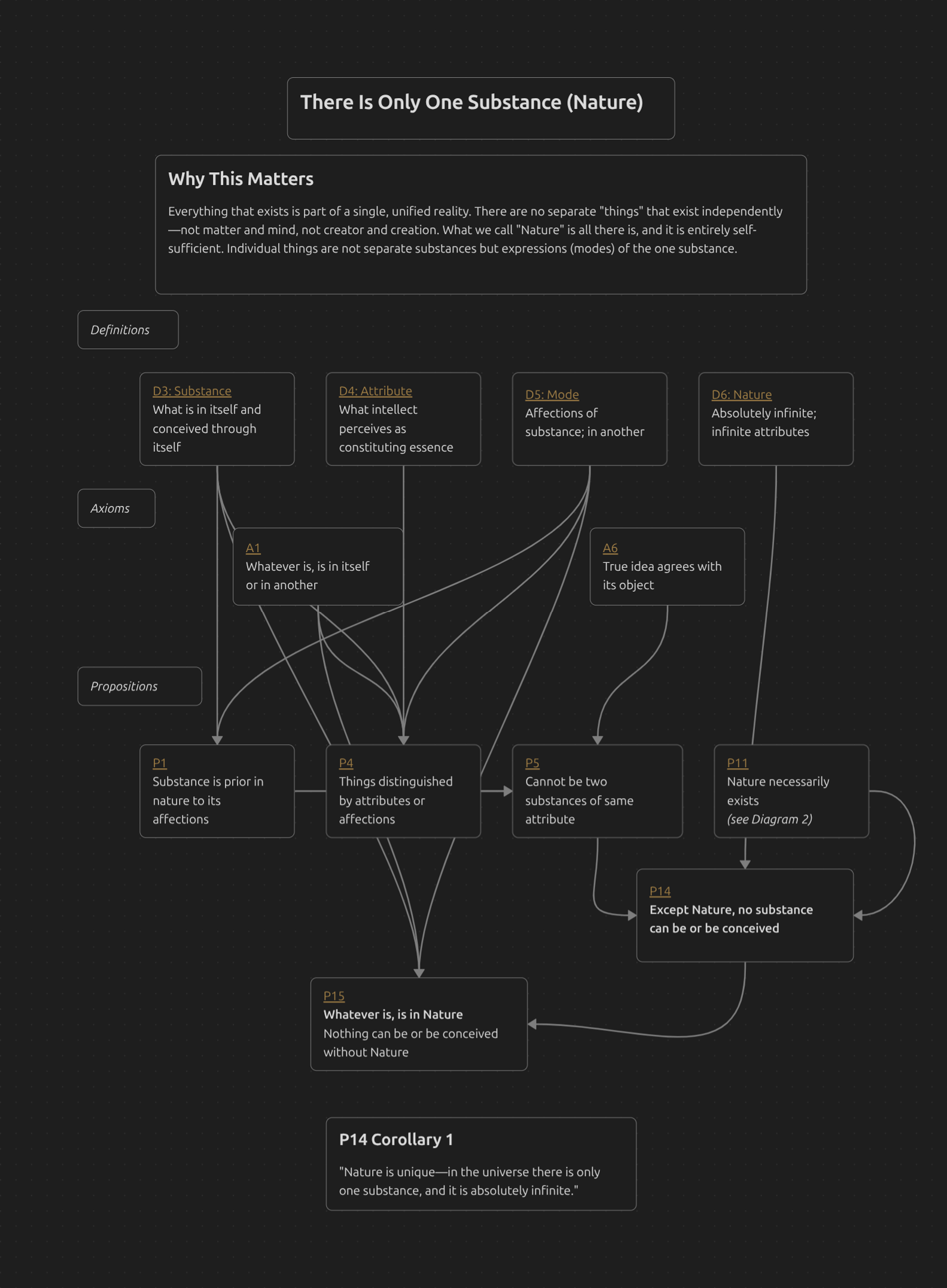
There Is Only One Substance (Nature)
Why This Matters
Everything that exists is part of a single, unified reality. There are no separate “things” that exist independently—not matter and mind, not creator and creation. What we call “Nature” is all there is, and it is entirely self-sufficient. Individual things are not separate substances but expressions (modes) of the one substance.
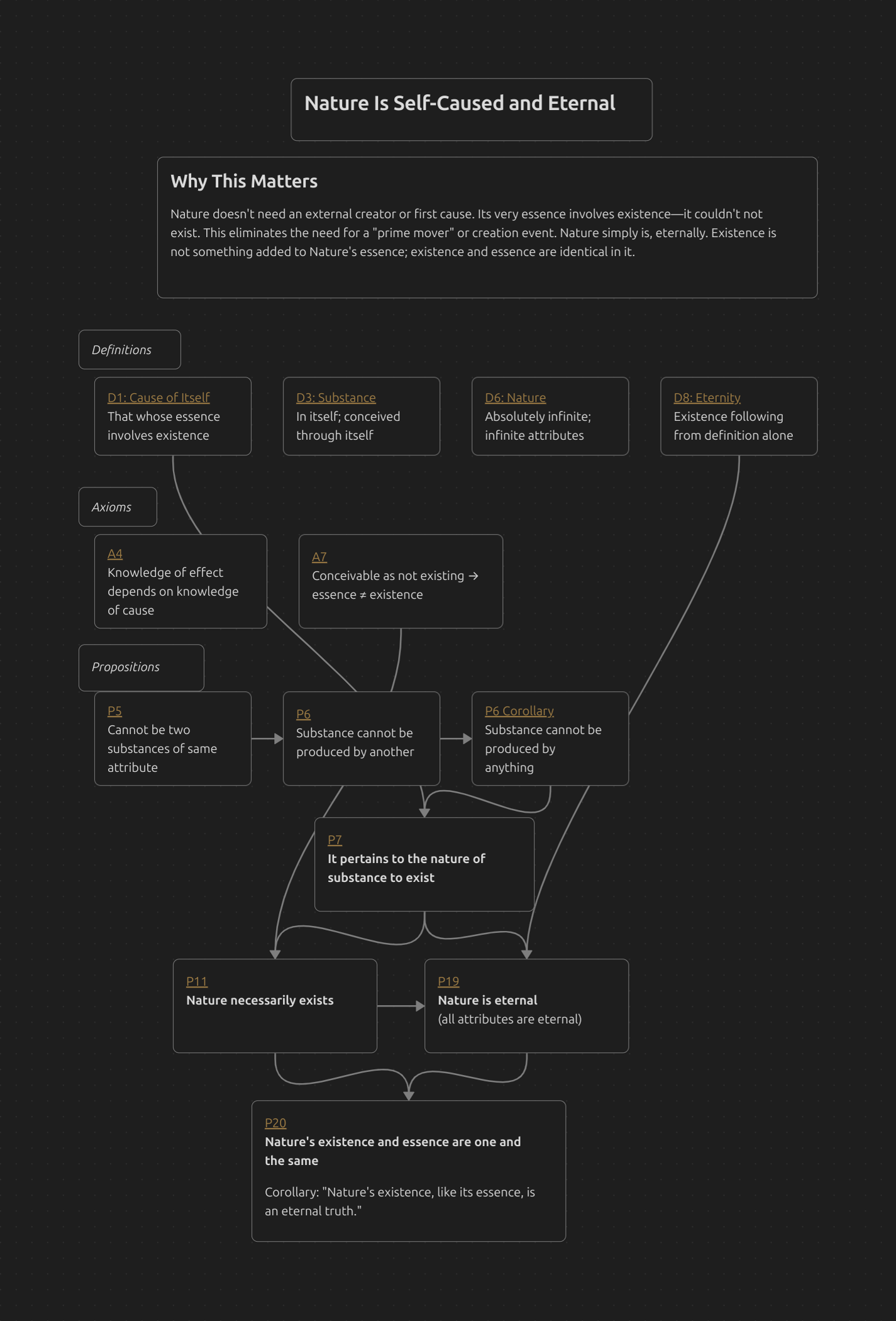
Nature Is Self-Caused and Eternal
Why This Matters
Nature doesn’t need an external creator or first cause. Its very essence involves existence—it couldn’t not exist. This eliminates the need for a “prime mover” or creation event. Nature simply is, eternally. Existence is not something added to Nature’s essence; existence and essence are identical in it.
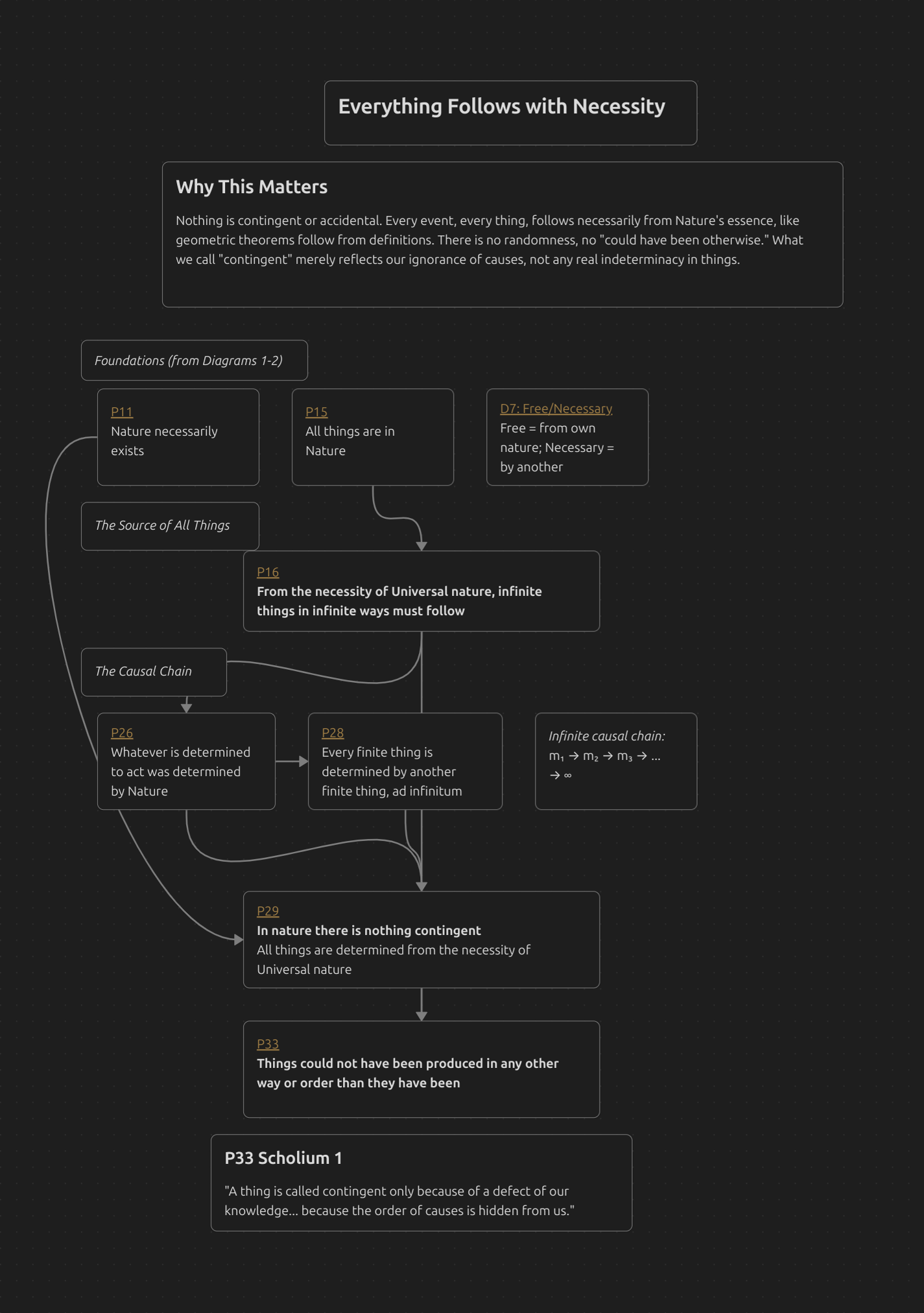
Everything Follows with Necessity
Why This Matters
Nothing is contingent or accidental. Every event, every thing, follows necessarily from Nature’s essence, like geometric theorems follow from definitions. There is no randomness, no “could have been otherwise.” What we call “contingent” merely reflects our ignorance of causes, not any real indeterminacy in things.
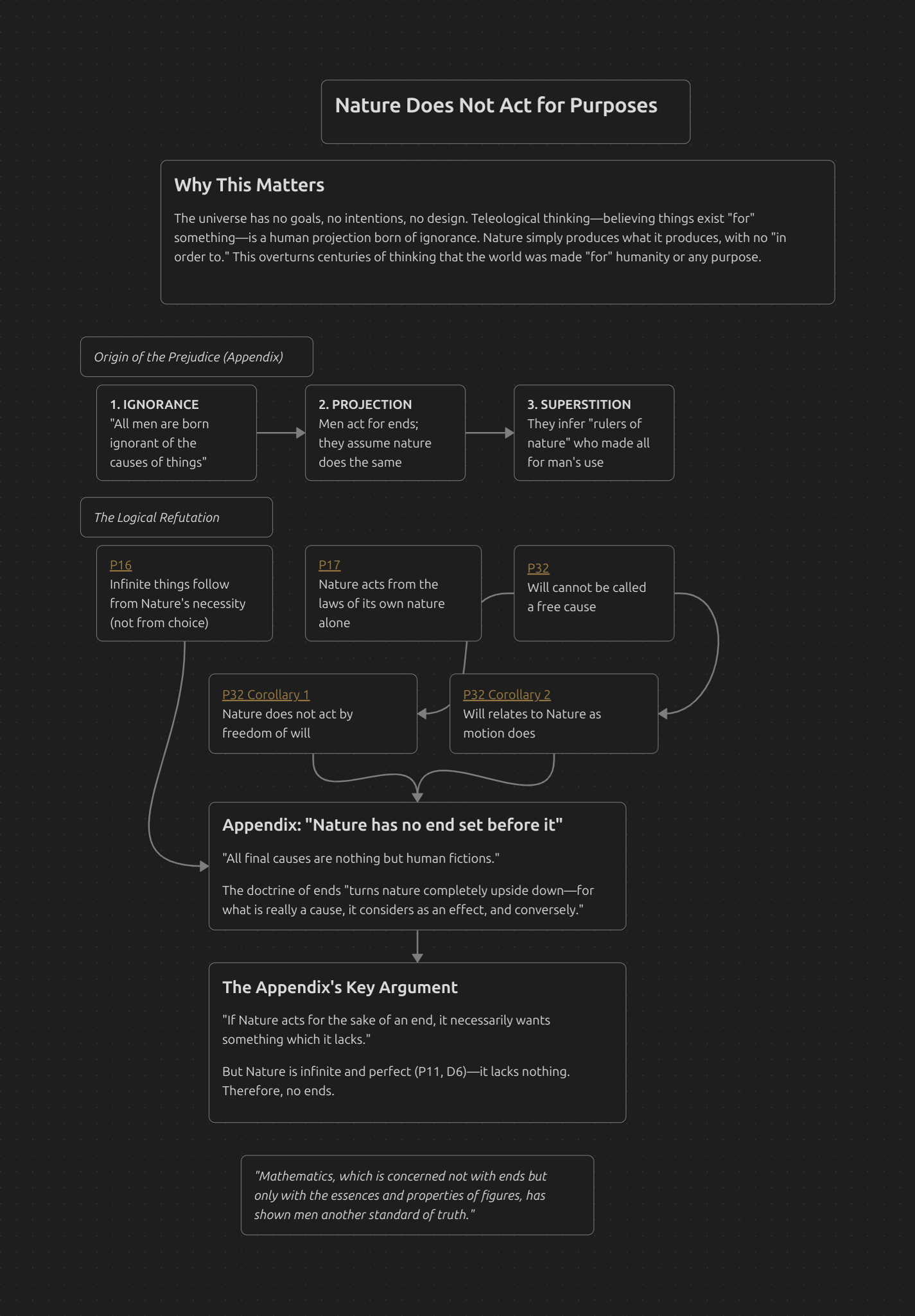
Nature Does Not Act for Purposes
Why This Matters
The universe has no goals, no intentions, no design. Teleological thinking—believing things exist “for” something—is a human projection born of ignorance. Nature simply produces what it produces, with no “in order to.” This overturns centuries of thinking that the world was made “for” humanity or any purpose.
Mental freedom Is Acting from One’s Own Nature
Why This Matters
True mental freedom isn’t “free will”—choosing without cause. Mental freedom is acting from the necessity of your own nature, not being compelled by external forces. Nature alone is truly free, since it acts entirely from itself. Humans approach mental freedom through understanding necessity and acting from reason rather than compulsion.
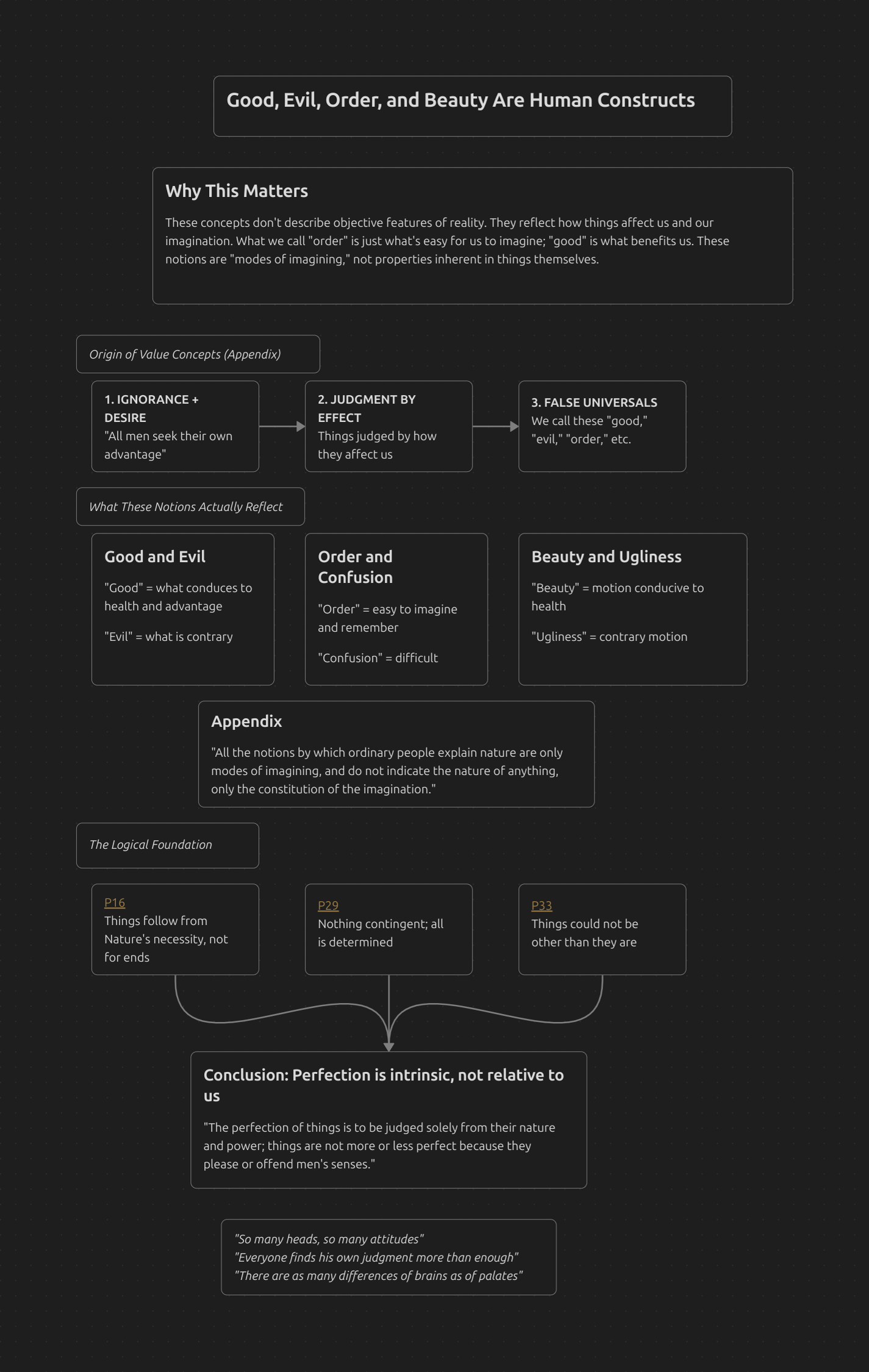
Good, Evil, Order, and Beauty Are Human Constructs
Why This Matters
These concepts don’t describe objective features of reality. They reflect how things affect us and our imagination. What we call “order” is just what’s easy for us to imagine; “good” is what benefits us. These notions are “modes of imagining,” not properties inherent in things themselves.
Link to original

Part 2 Important Concepts
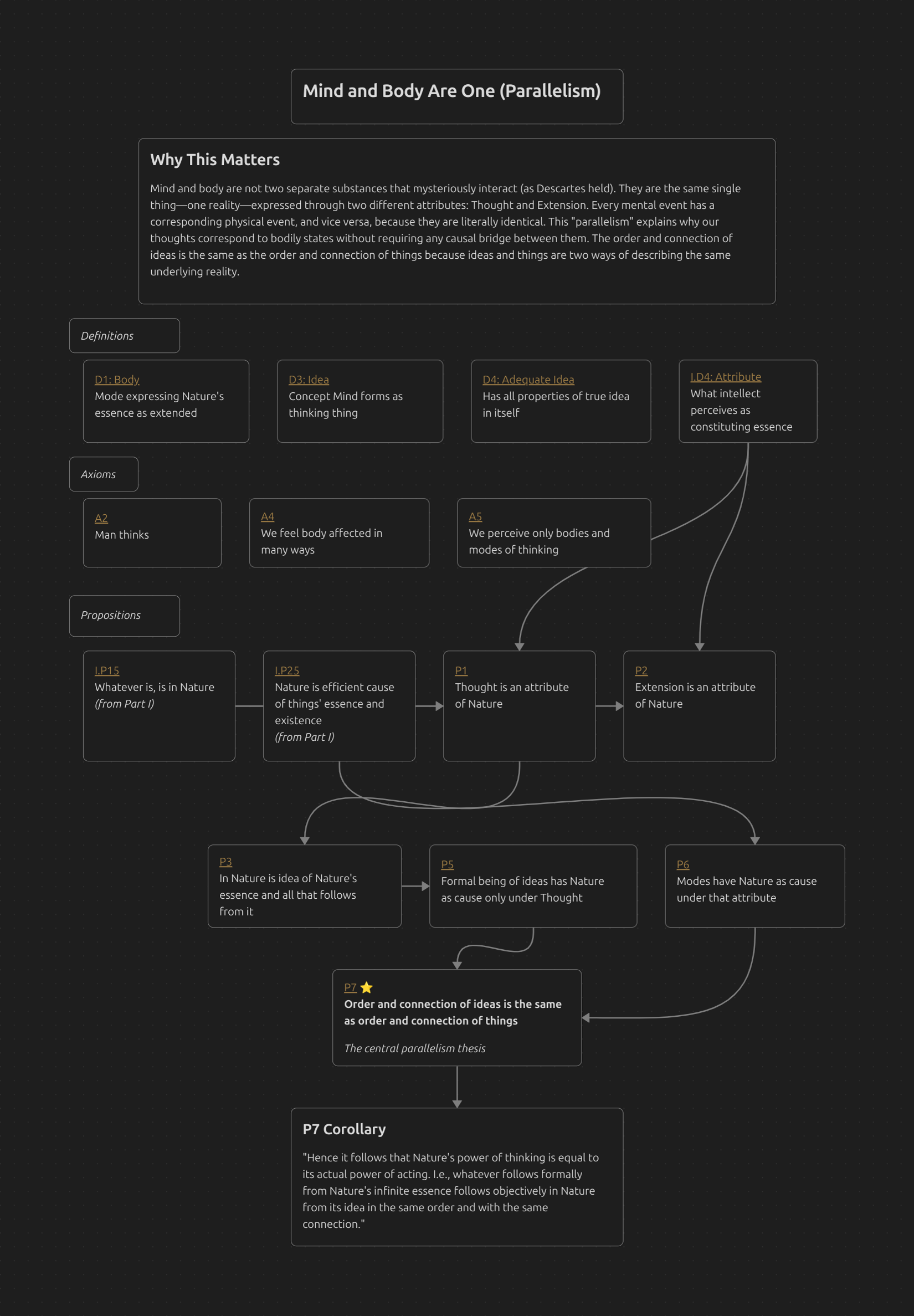
Mind and Body Are One (Parallelism)
Why This Matters
Mind and body are not two separate substances that mysteriously interact (as Descartes held). They are the same single thing—one reality—expressed through two different attributes: Thought and Extension. Every mental event has a corresponding physical event, and vice versa, because they are literally identical. This “parallelism” explains why our thoughts correspond to bodily states without requiring any causal bridge between them. The order and connection of ideas is the same as the order and connection of things because ideas and things are two ways of describing the same underlying reality.
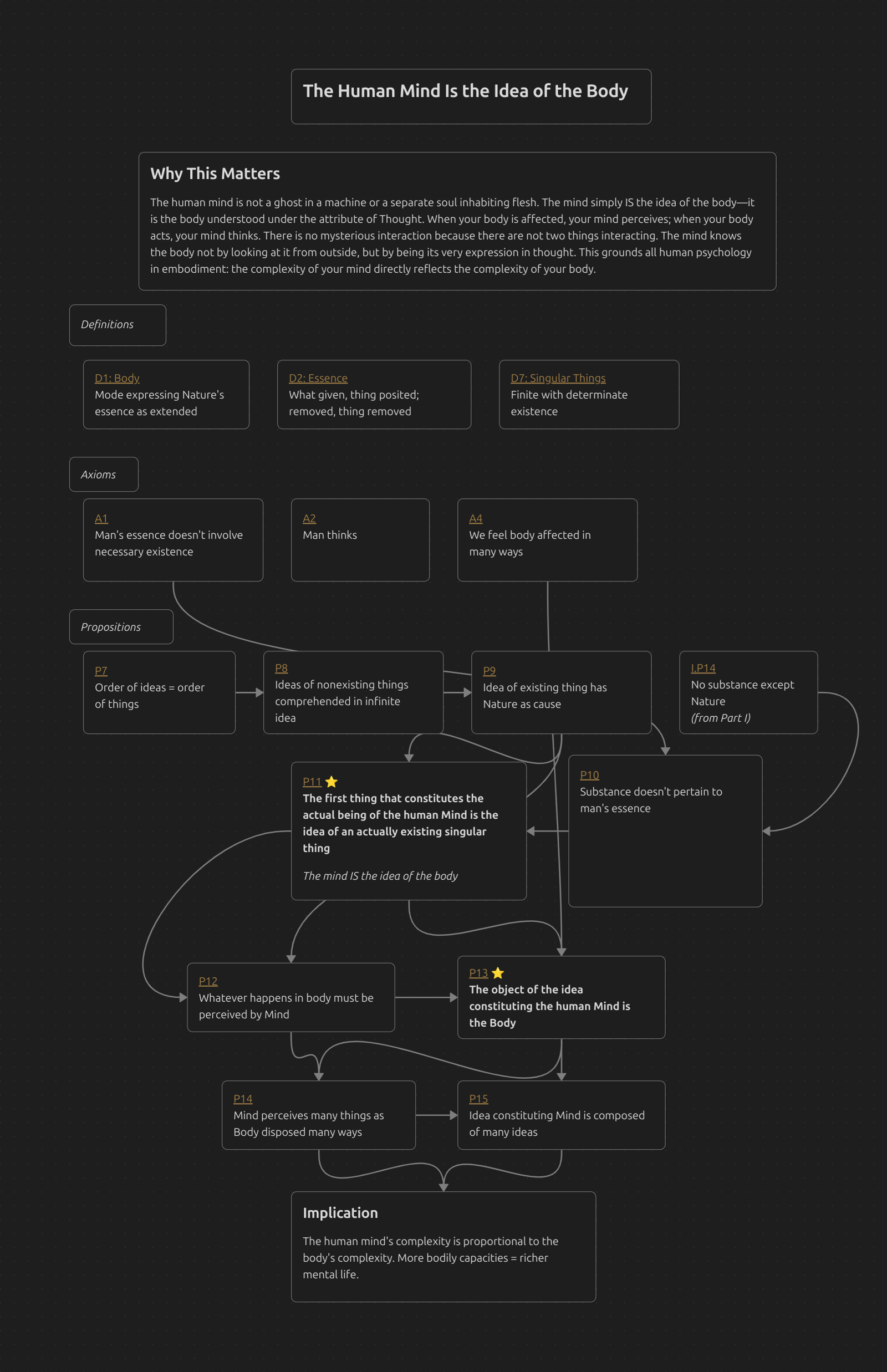
The Human Mind Is the Idea of the Body
Why This Matters
The human mind is not a ghost in a machine or a separate soul inhabiting flesh. The mind simply IS the idea of the body—it is the body understood under the attribute of Thought. When your body is affected, your mind perceives; when your body acts, your mind thinks. There is no mysterious interaction because there are not two things interacting. The mind knows the body not by looking at it from outside, but by being its very expression in thought. This grounds all human psychology in embodiment: the complexity of your mind directly reflects the complexity of your body.
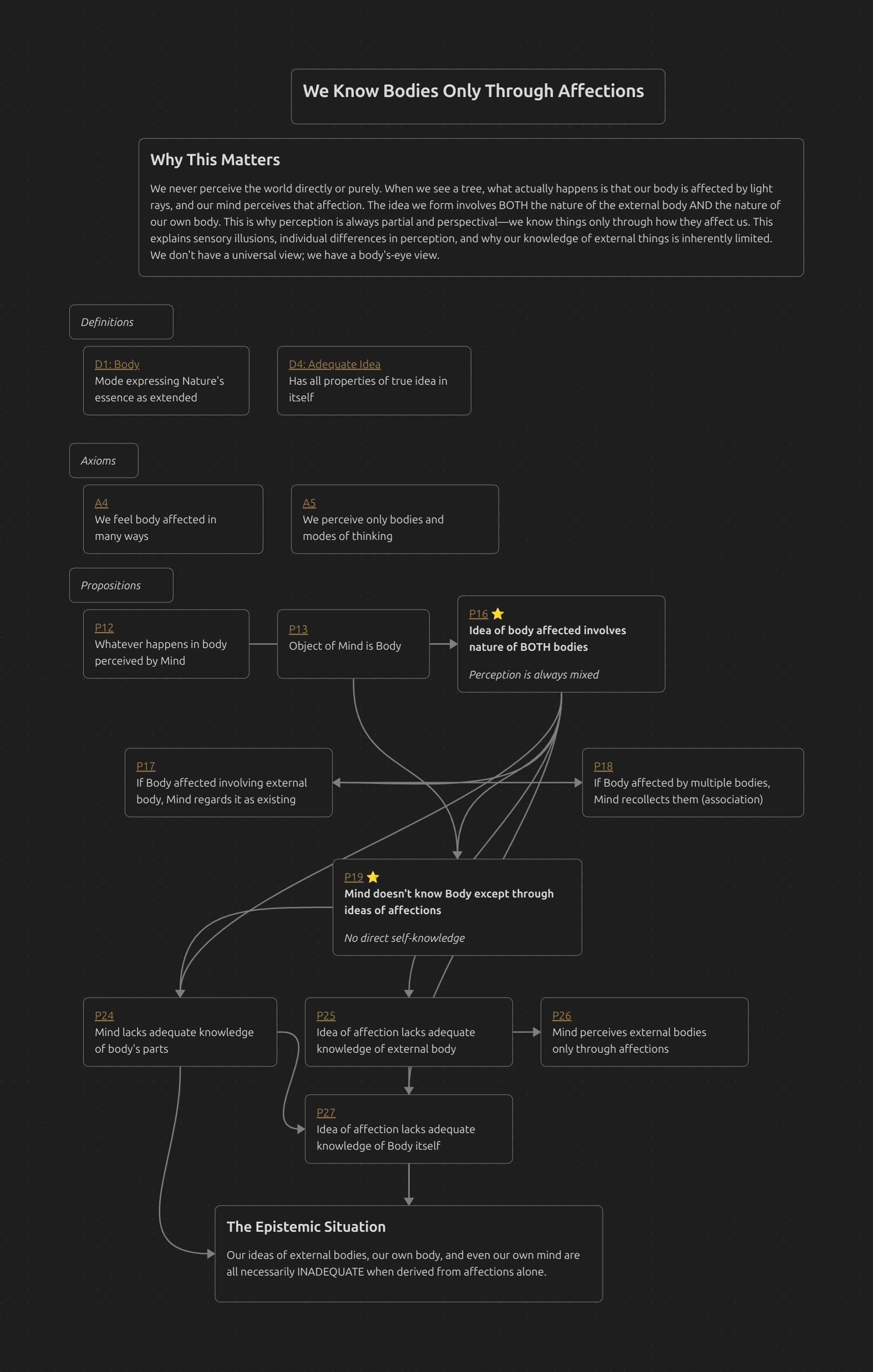
We Know Bodies Only Through Affections
Why This Matters
We never perceive the world directly or purely. When we see a tree, what actually happens is that our body is affected by light rays, and our mind perceives that affection. The idea we form involves BOTH the nature of the external body AND the nature of our own body. This is why perception is always partial and perspectival—we know things only through how they affect us. This explains sensory illusions, individual differences in perception, and why our knowledge of external things is inherently limited. We don’t have a divine view; we have a body’s-eye view.
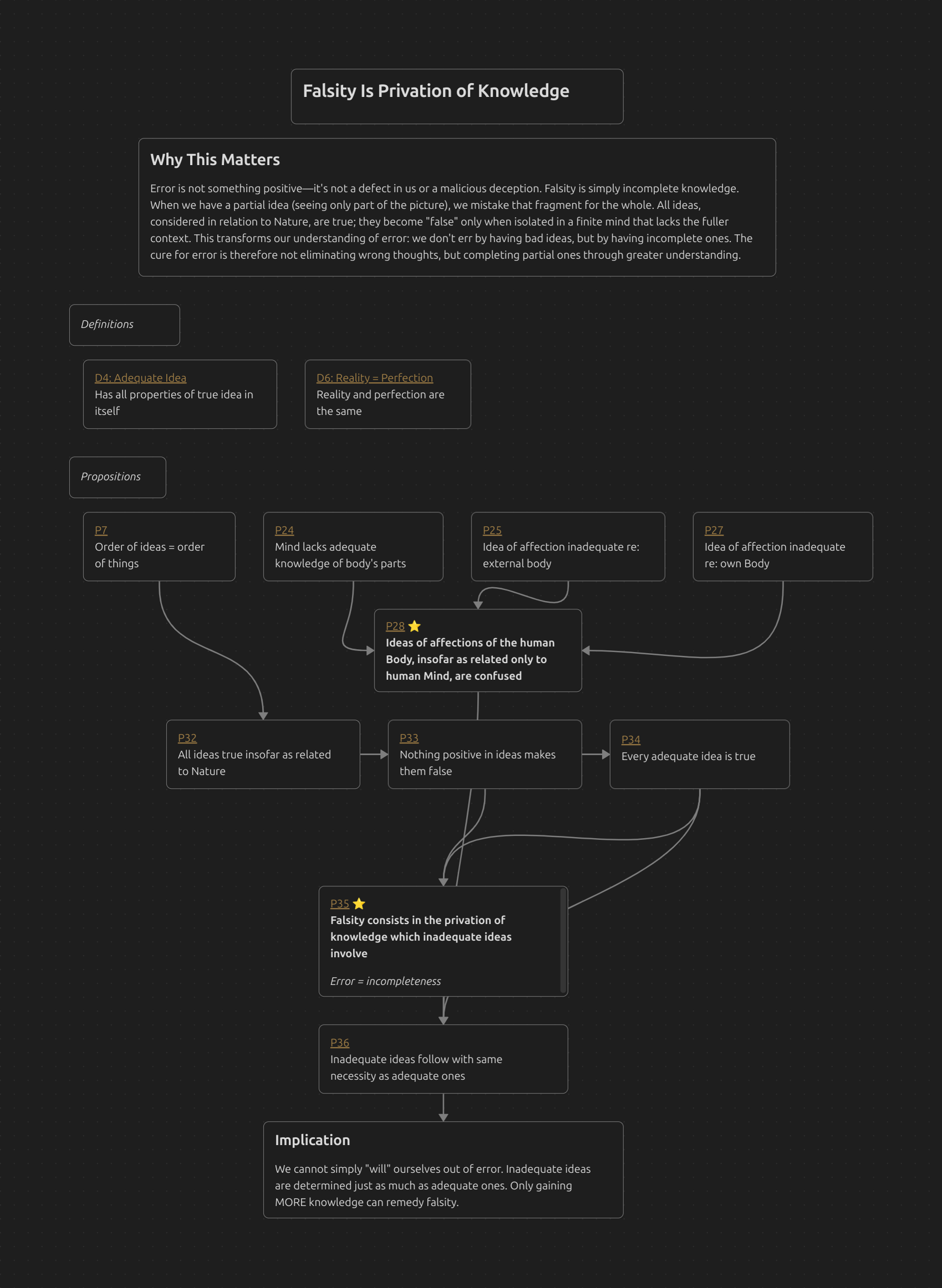
Falsity Is Privation of Knowledge
Why This Matters
Error is not something positive—it’s not a defect in us or a malicious deception. Falsity is simply incomplete knowledge. When we have a partial idea (seeing only part of the picture), we mistake that fragment for the whole. All ideas, considered in relation to Nature, are true; they become “false” only when isolated in a finite mind that lacks the fuller context. This transforms our understanding of error: we don’t err by having bad ideas, but by having incomplete ones. The cure for error is therefore not eliminating wrong thoughts, but completing partial ones through greater understanding.
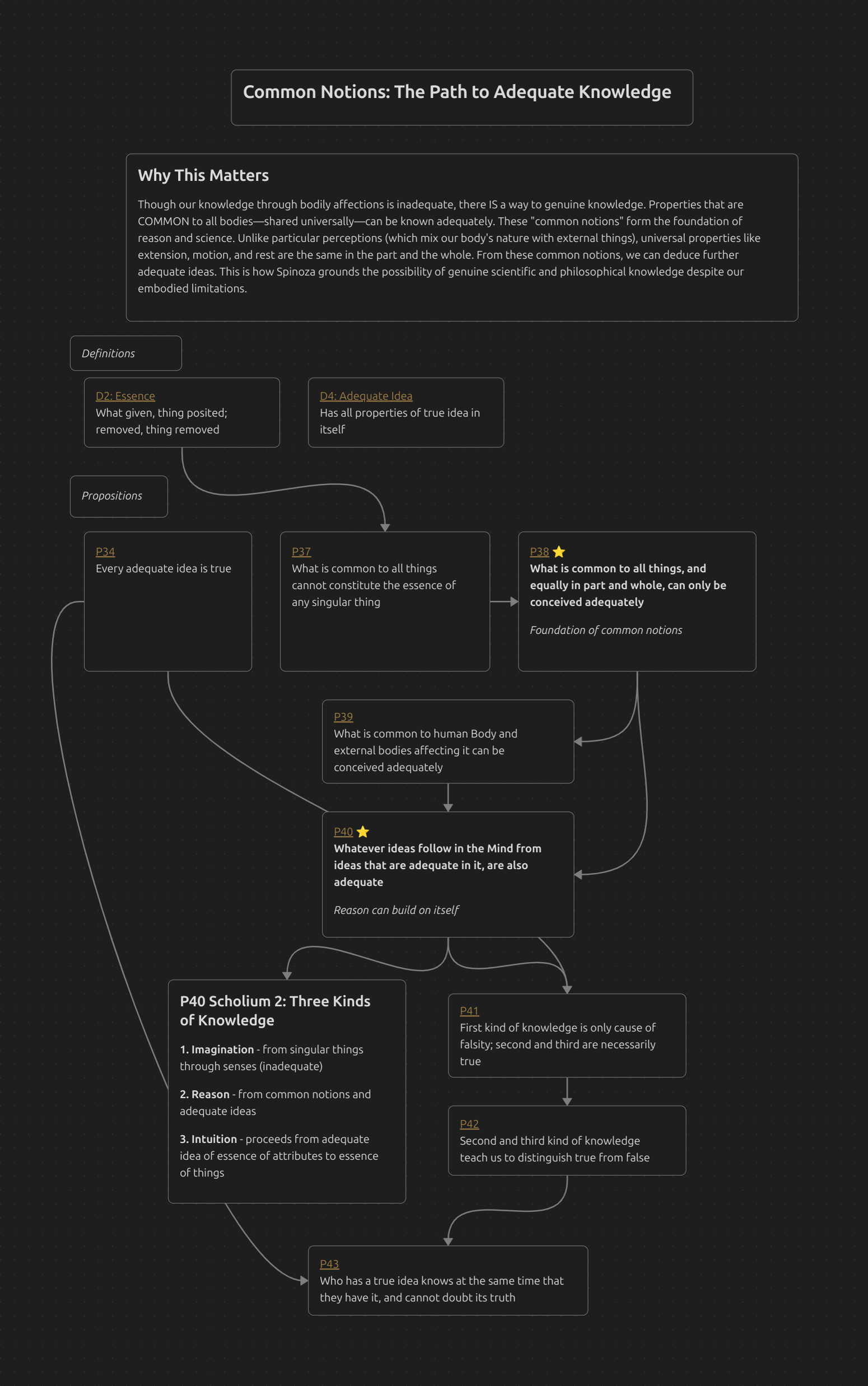
Common Notions: The Path to Adequate Knowledge
Why This Matters
Though our knowledge through bodily affections is inadequate, there IS a way to genuine knowledge. Properties that are COMMON to all bodies—shared universally—can be known adequately. These “common notions” form the foundation of reason and science. Unlike particular perceptions (which mix our body’s nature with external things), divine properties like extension, motion, and rest are the same in the part and the whole. From these common notions, we can deduce further adequate ideas. This is how Spinoza grounds the possibility of genuine scientific and philosophical knowledge despite our embodied limitations.
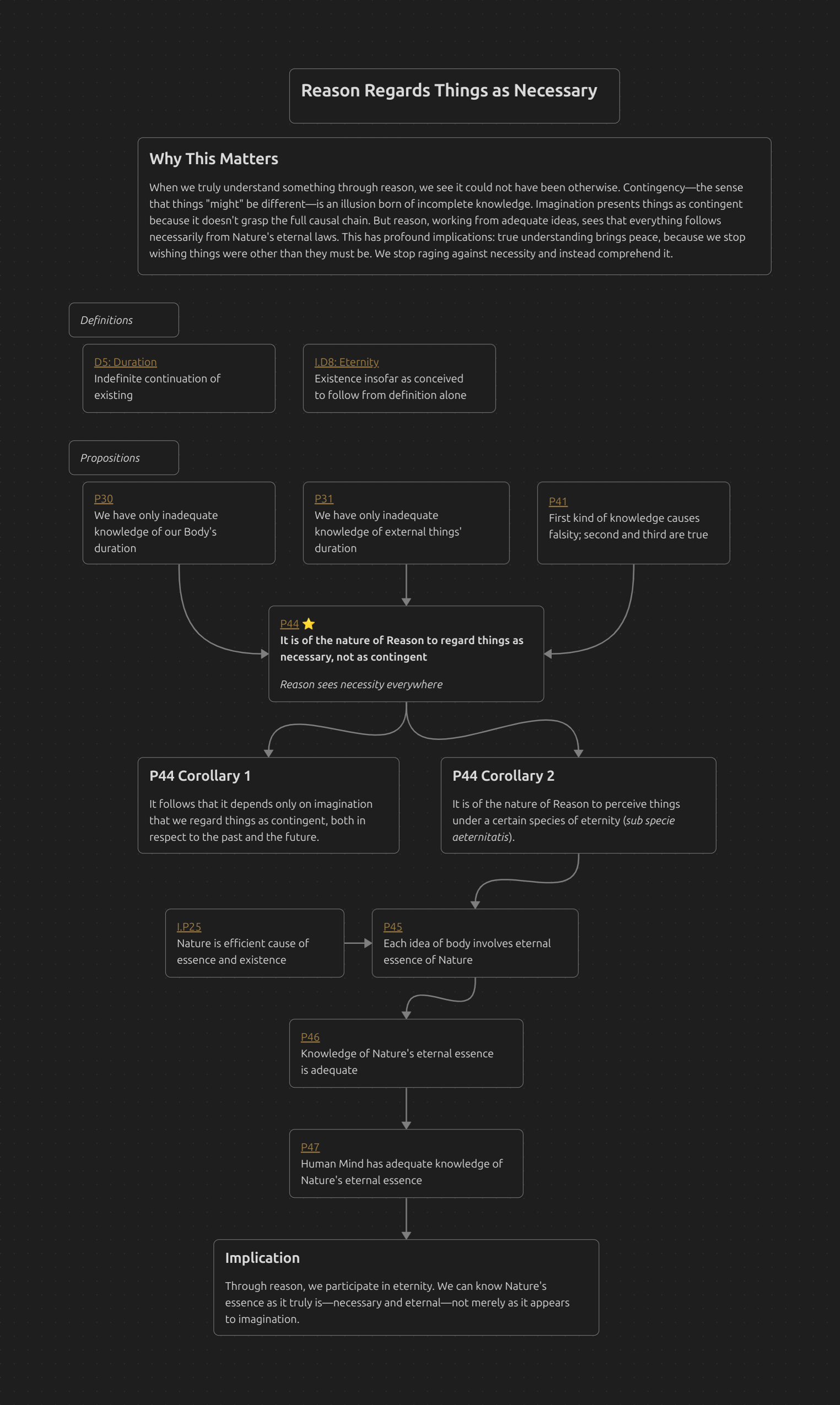
Reason Regards Things as Necessary
Why This Matters
When we truly understand something through reason, we see it could not have been otherwise. Contingency—the sense that things “might” be different—is an illusion born of incomplete knowledge. Imagination presents things as contingent because it doesn’t grasp the full causal chain. But reason, working from adequate ideas, sees that everything follows necessarily from Nature’s eternal laws. This has profound implications: true understanding brings peace, because we stop wishing things were other than they must be. We stop raging against necessity and instead comprehend it.
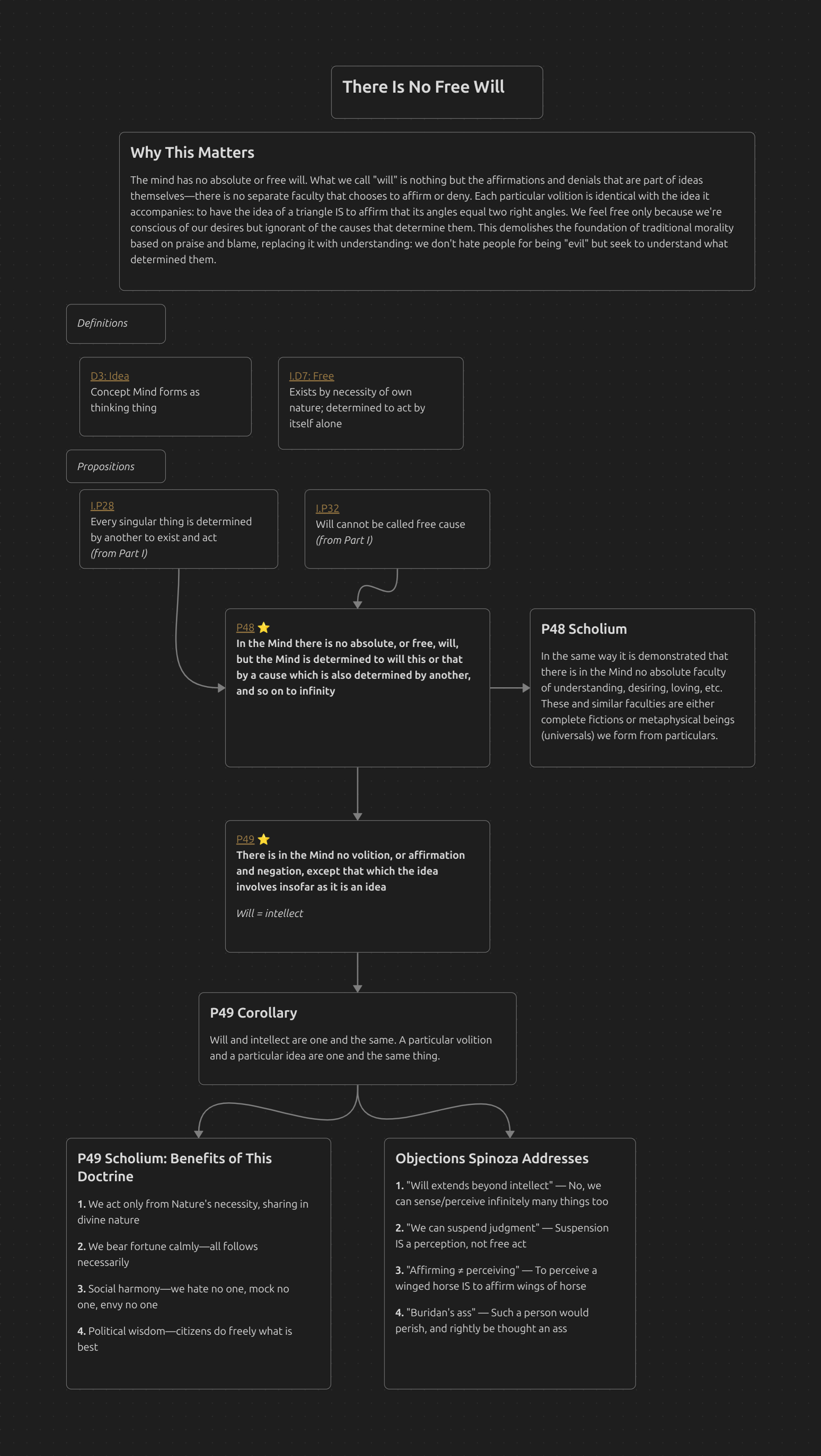
There Is No Free Will
Why This Matters
The mind has no absolute or free will. What we call “will” is nothing but the affirmations and denials that are part of ideas themselves—there is no separate faculty that chooses to affirm or deny. Each particular volition is identical with the idea it accompanies: to have the idea of a triangle IS to affirm that its angles equal two right angles. We feel free only because we’re conscious of our desires but ignorant of the causes that determine them. This demolishes the foundation of traditional morality based on praise and blame, replacing it with understanding: we don’t hate people for being “evil” but seek to understand what determined them.
Link to original
Part 3 Important Concepts
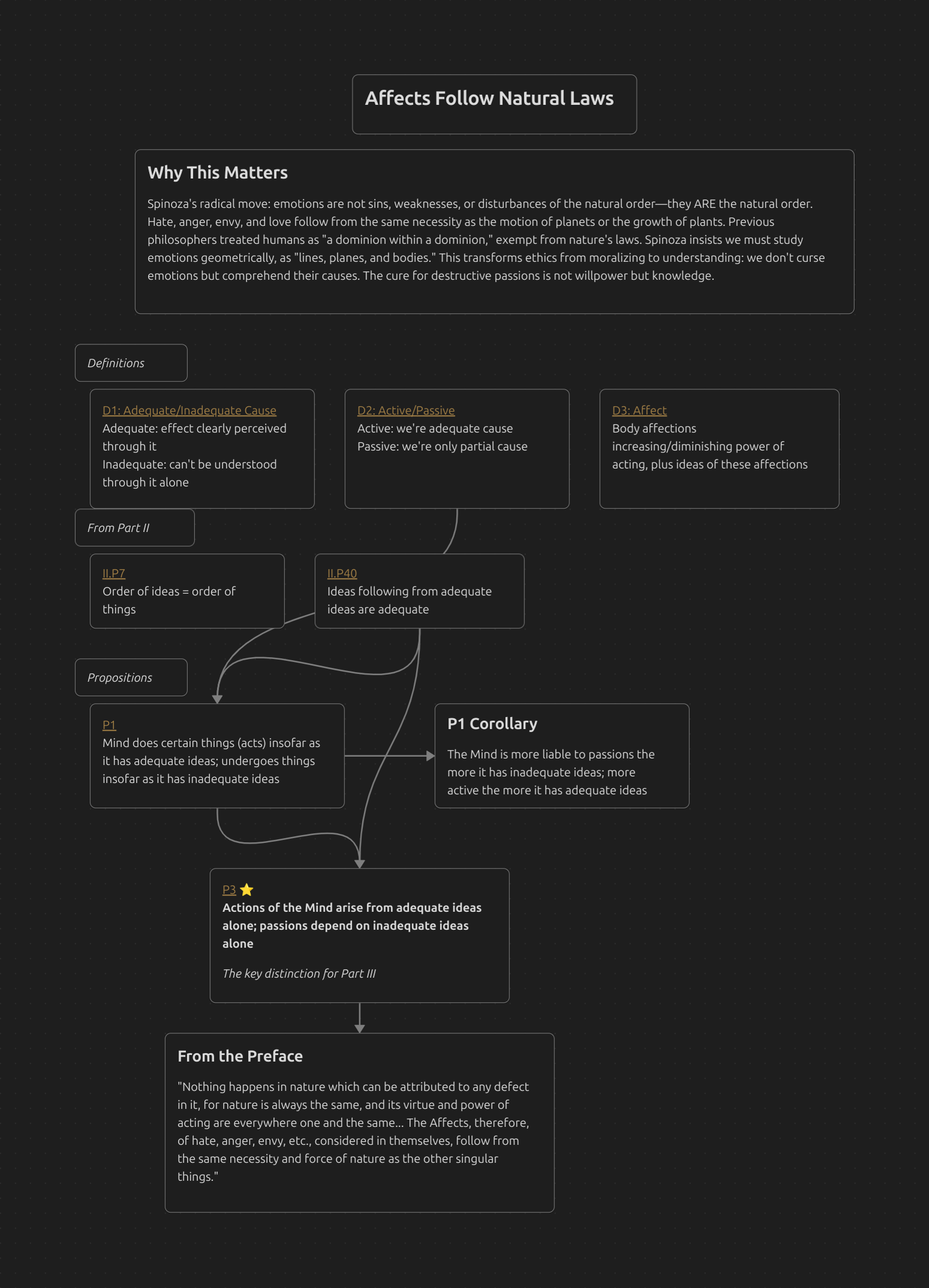
Affects Follow Natural Laws
Why This Matters
Spinoza’s radical move: emotions are not sins, weaknesses, or disturbances of the natural order—they ARE the natural order. Hate, anger, envy, and love follow from the same necessity as the motion of planets or the growth of plants. Previous philosophers treated humans as “a dominion within a dominion,” exempt from nature’s laws. Spinoza insists we must study emotions geometrically, as “lines, planes, and bodies.” This transforms ethics from moralizing to understanding: we don’t curse emotions but comprehend their causes. The cure for destructive passions is not willpower but knowledge.
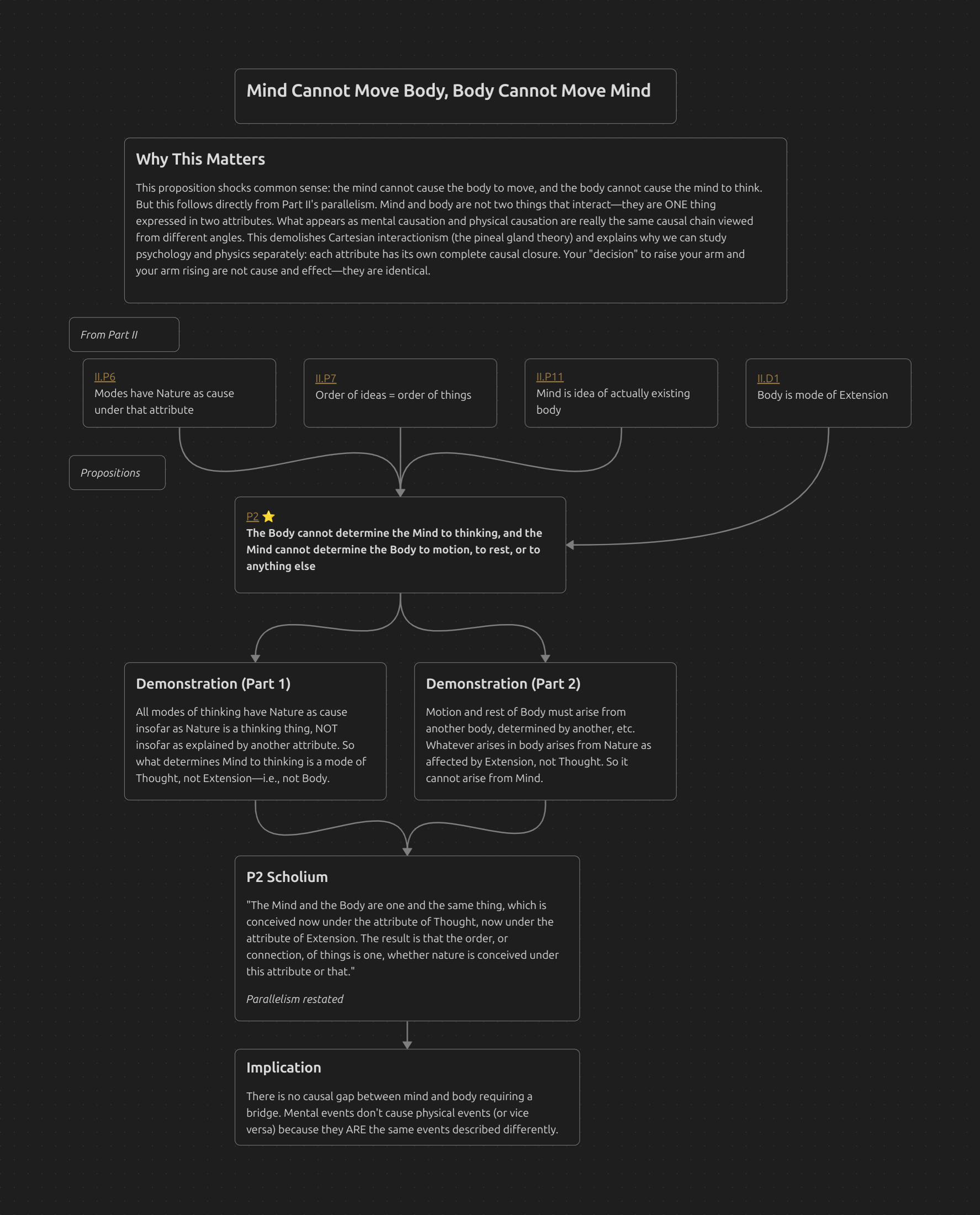
Mind Cannot Move Body, Body Cannot Move Mind
Why This Matters
This proposition shocks common sense: the mind cannot cause the body to move, and the body cannot cause the mind to think. But this follows directly from Part II’s parallelism. Mind and body are not two things that interact—they are ONE thing expressed in two attributes. What appears as mental causation and physical causation are really the same causal chain viewed from different angles. This demolishes Cartesian interactionism (the pineal gland theory) and explains why we can study psychology and physics separately: each attribute has its own complete causal closure. Your “decision” to raise your arm and your arm rising are not cause and effect—they are identical.
Conatus: Everything Strives to Persist
Why This Matters
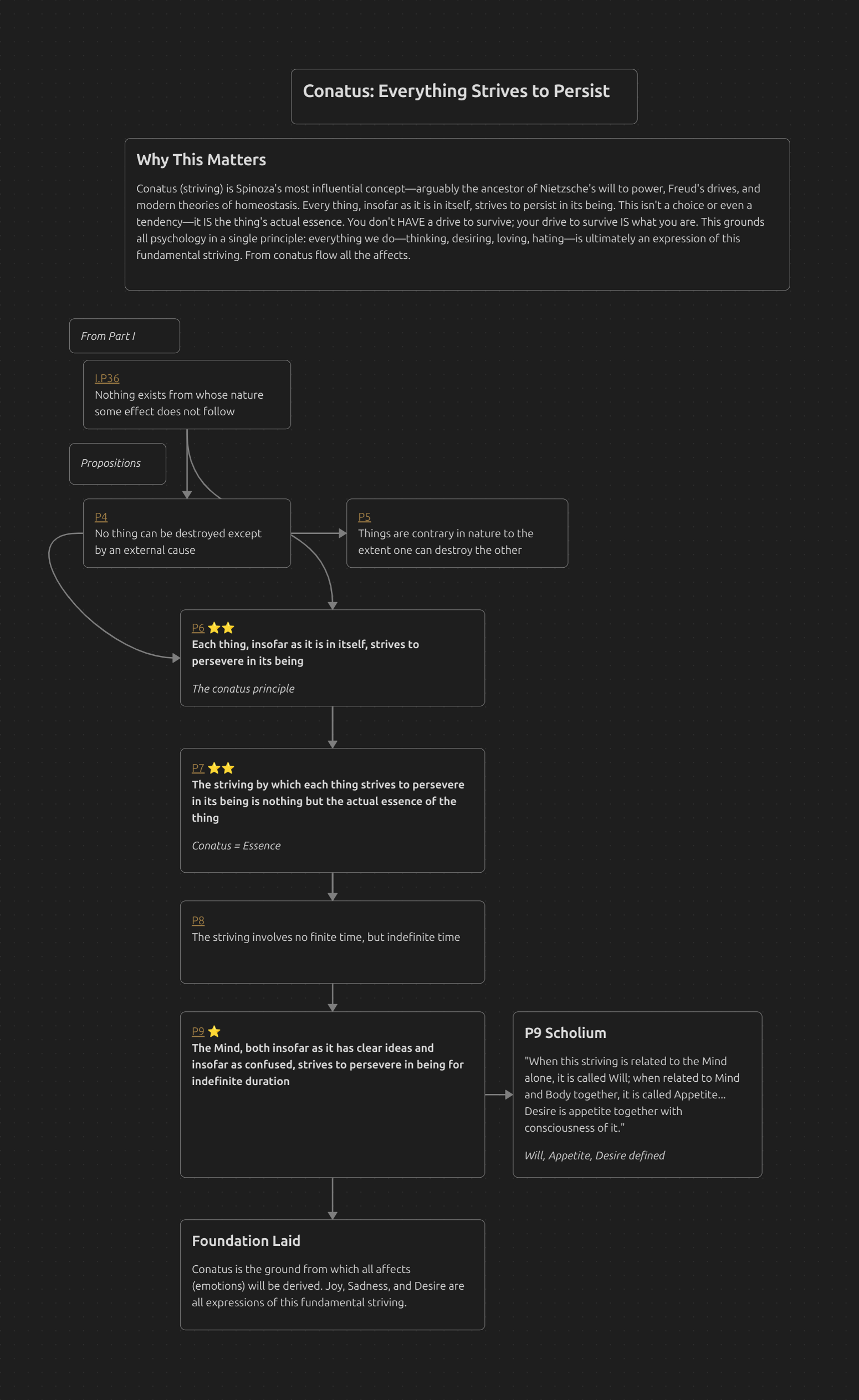
Conatus (striving) is Spinoza’s most influential concept—arguably the ancestor of Nietzsche’s will to power, Freud’s drives, and modern theories of homeostasis. Every thing, insofar as it is in itself, strives to persist in its being. This isn’t a choice or even a tendency—it IS the thing’s actual essence. You don’t HAVE a drive to survive; your drive to survive IS what you are. This grounds all psychology in a single principle: everything we do—thinking, desiring, loving, hating—is ultimately an expression of this fundamental striving. From conatus flow all the affects.
Joy, Sadness, Desire: The Three Primary Affects
Why This Matters
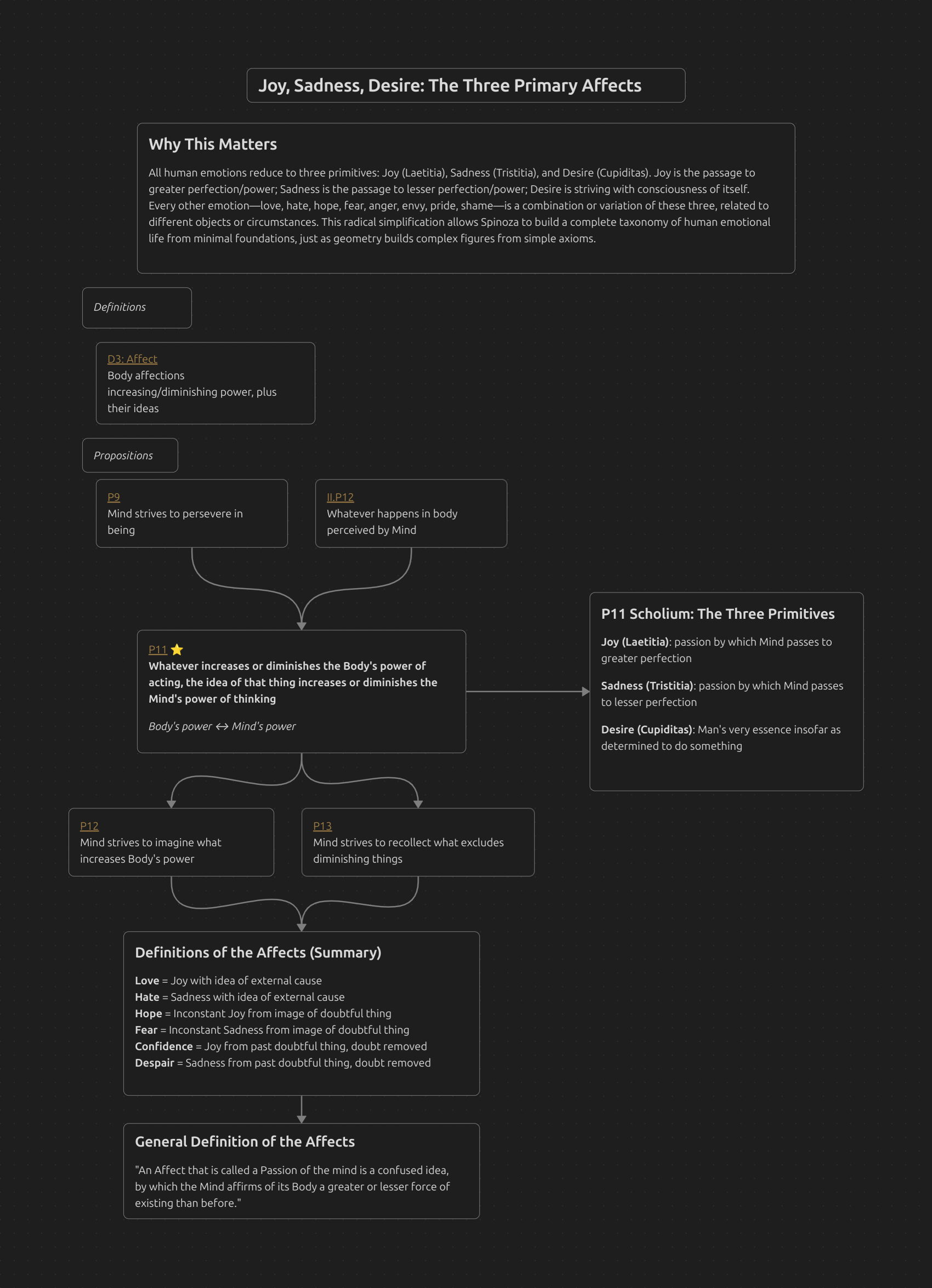
All human emotions reduce to three primitives: Joy (Laetitia), Sadness (Tristitia), and Desire (Cupiditas). Joy is the passage to greater perfection/power; Sadness is the passage to lesser perfection/power; Desire is striving with consciousness of itself. Every other emotion—love, hate, hope, fear, anger, envy, pride, shame—is a combination or variation of these three, related to different objects or circumstances. This radical simplification allows Spinoza to build a complete taxonomy of human emotional life from minimal foundations, just as geometry builds complex figures from simple axioms.
Association: How Love and Hate Arise
Why This Matters
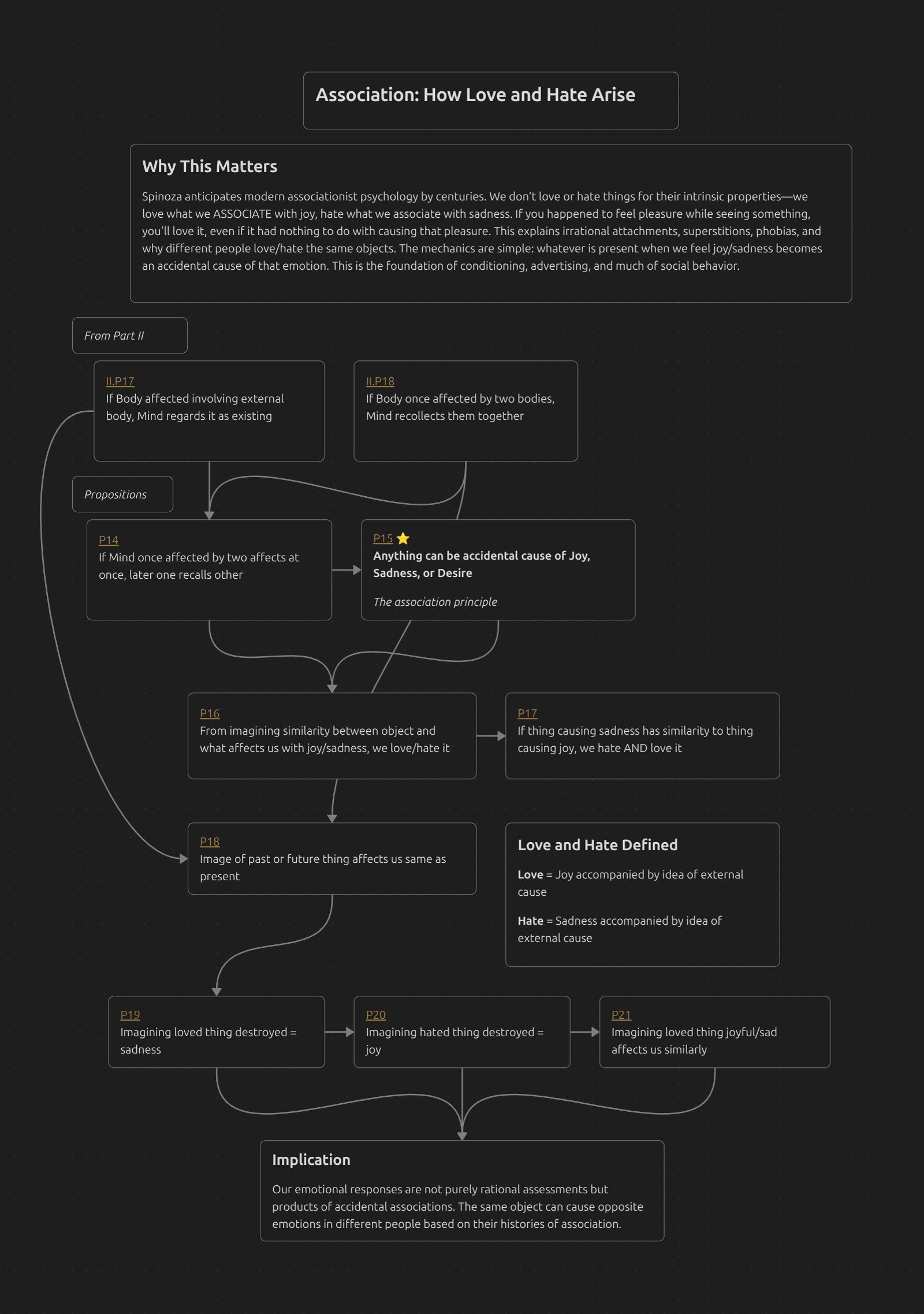
Spinoza anticipates modern associationist psychology by centuries. We don’t love or hate things for their intrinsic properties—we love what we ASSOCIATE with joy, hate what we associate with sadness. If you happened to feel pleasure while seeing something, you’ll love it, even if it had nothing to do with causing that pleasure. This explains irrational attachments, superstitions, phobias, and why different people love/hate the same objects. The mechanics are simple: whatever is present when we feel joy/sadness becomes an accidental cause of that emotion. This is the foundation of conditioning, advertising, and much of social behavior.
Imitation of Affects
Why This Matters
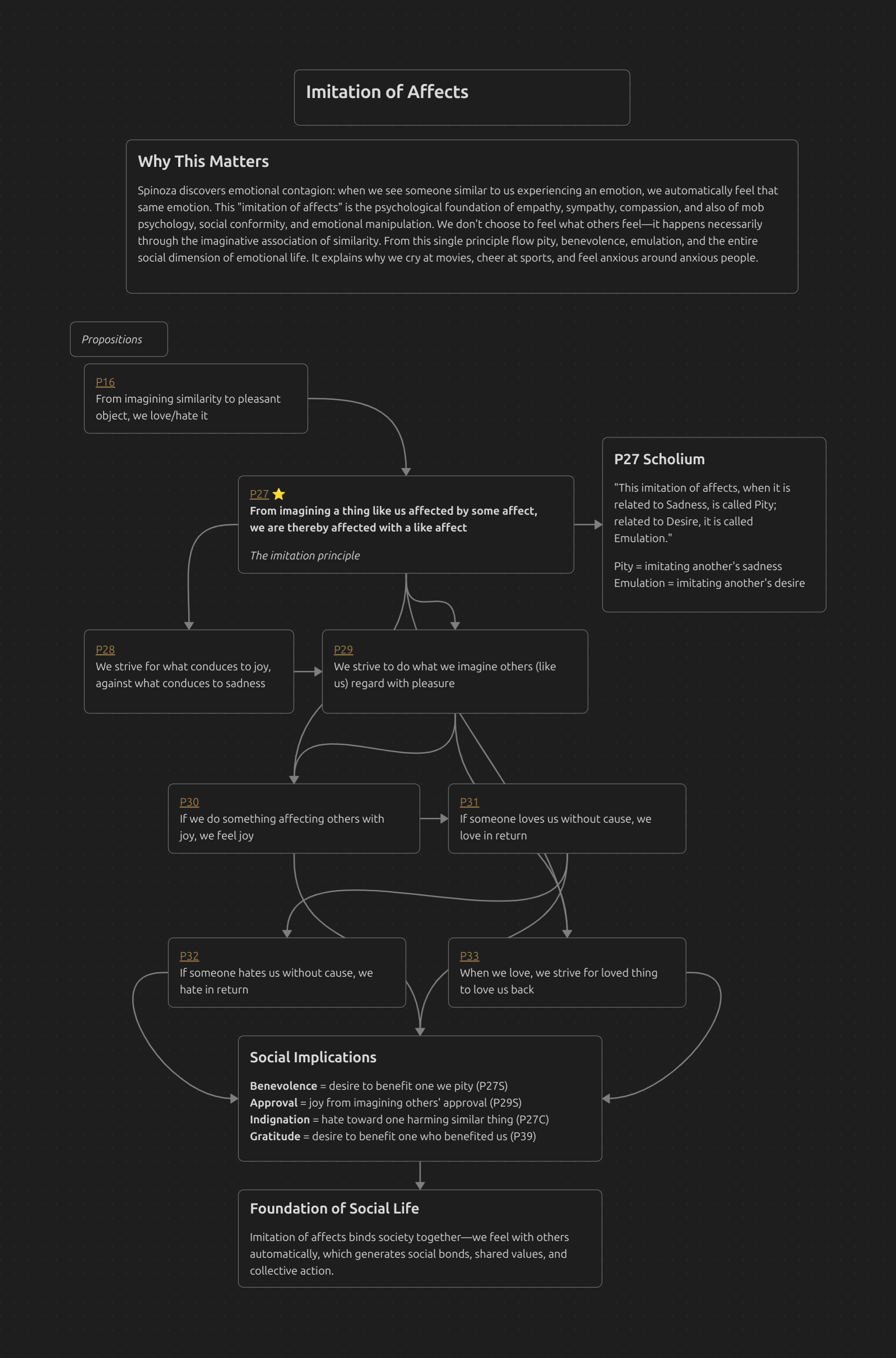
Spinoza discovers emotional contagion: when we see someone similar to us experiencing an emotion, we automatically feel that same emotion. This “imitation of affects” is the psychological foundation of empathy, sympathy, compassion, and also of mob psychology, social conformity, and emotional manipulation. We don’t choose to feel what others feel—it happens necessarily through the imaginative association of similarity. From this single principle flow pity, benevolence, emulation, and the entire social dimension of emotional life. It explains why we cry at movies, cheer at sports, and feel anxious around anxious people.
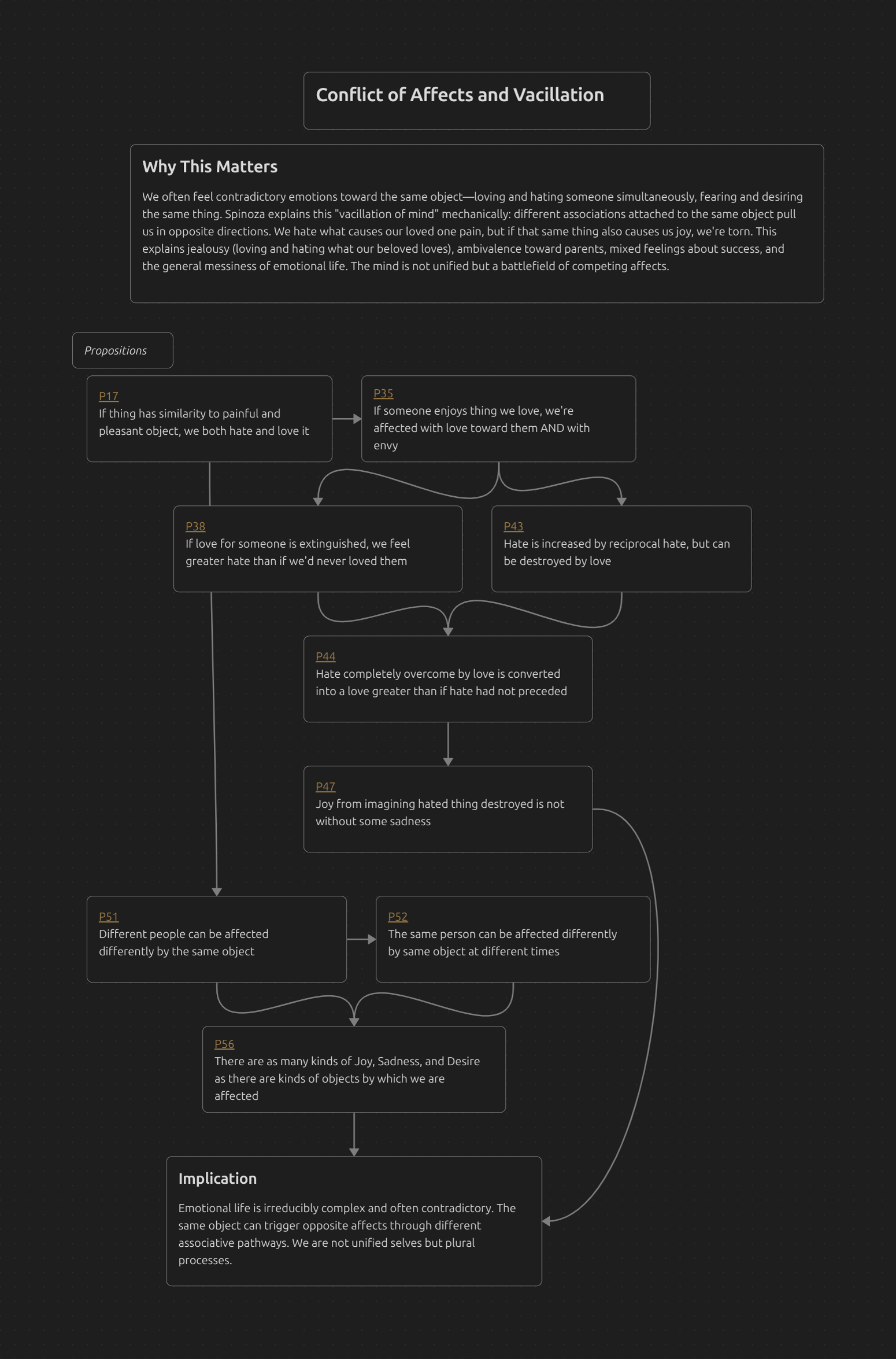
Conflict of Affects and Vacillation
Why This Matters
We often feel contradictory emotions toward the same object—loving and hating someone simultaneously, fearing and desiring the same thing. Spinoza explains this “vacillation of mind” mechanically: different associations attached to the same object pull us in opposite directions. We hate what causes our loved one pain, but if that same thing also causes us joy, we’re torn. This explains jealousy (loving and hating what our beloved loves), ambivalence toward parents, mixed feelings about success, and the general messiness of emotional life. The mind is not unified but a battlefield of competing affects.
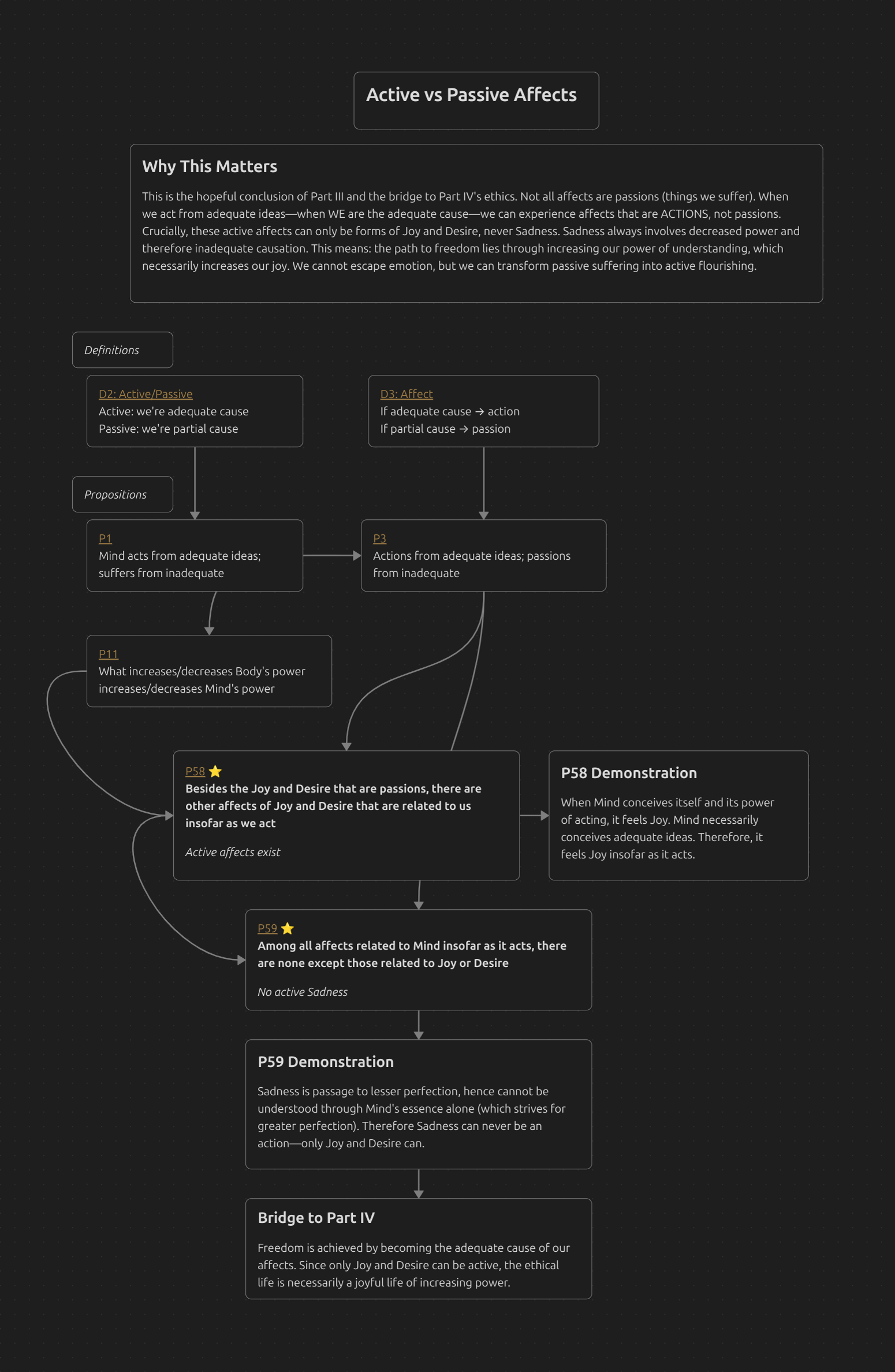
Active vs Passive Affects
Why This Matters
This is the hopeful conclusion of Part III and the bridge to Part IV’s ethics. Not all affects are passions (things we suffer). When we act from adequate ideas—when WE are the adequate cause—we can experience affects that are ACTIONS, not passions. Crucially, these active affects can only be forms of Joy and Desire, never Sadness. Sadness always involves decreased power and therefore inadequate causation. This means: the path to mental freedom lies through increasing our power of understanding, which necessarily increases our joy. We cannot escape emotion, but we can transform passive suffering into active intellectual joy.
Link to original
Part 4 Important Concepts
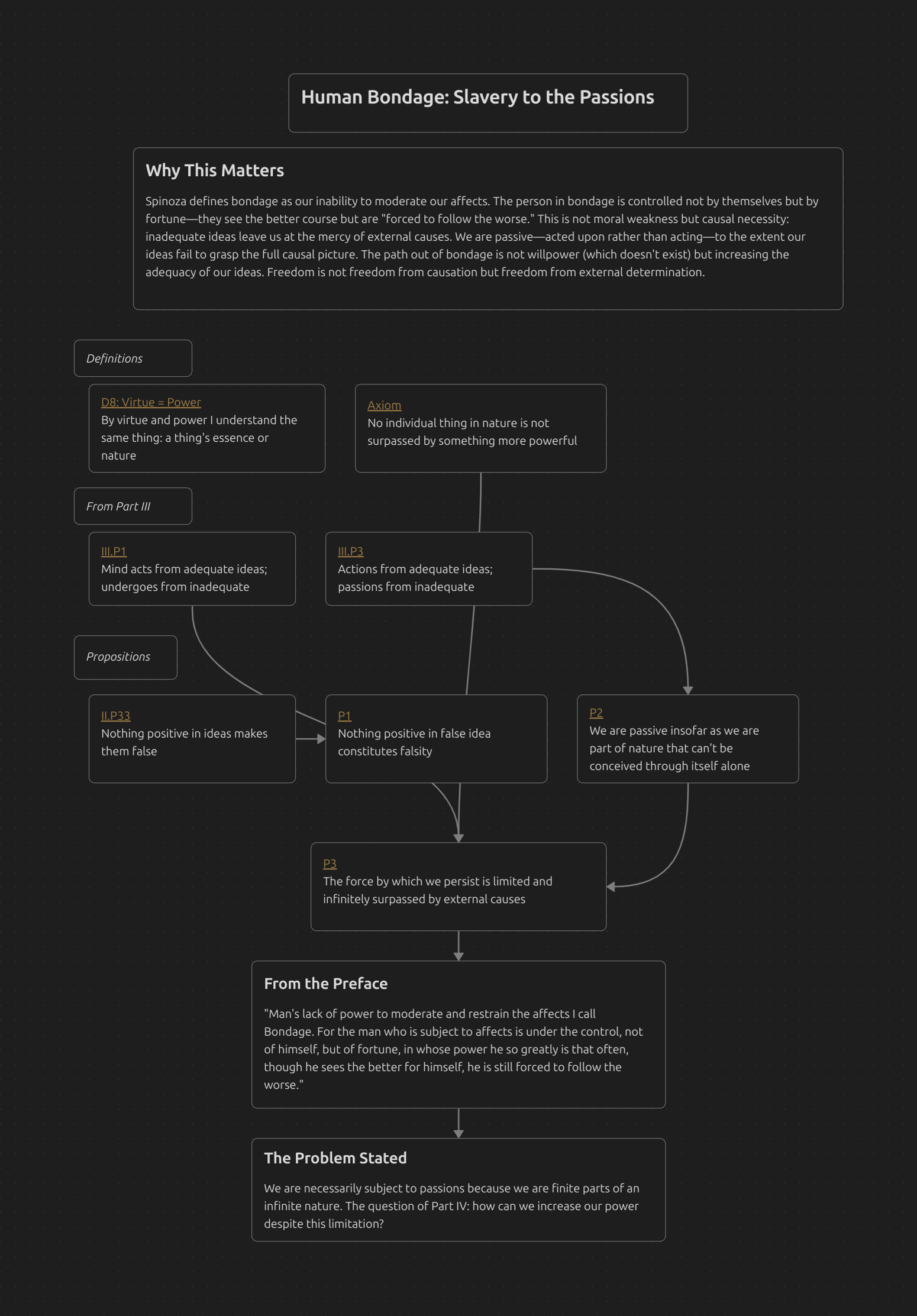
Human Bondage: Slavery to the Passions
Why This Matters
Spinoza defines bondage as our inability to moderate our affects. The person in bondage is controlled not by themselves but by fortune—they see the better course but are “forced to follow the worse.” This is not moral weakness but causal necessity: inadequate ideas leave us at the mercy of external causes. We are passive—acted upon rather than acting—to the extent our ideas fail to grasp the full causal picture. The path out of bondage is not willpower (which doesn’t exist) but increasing the adequacy of our ideas. Mental freedom is not mental freedom from causation but mental freedom from external determination.
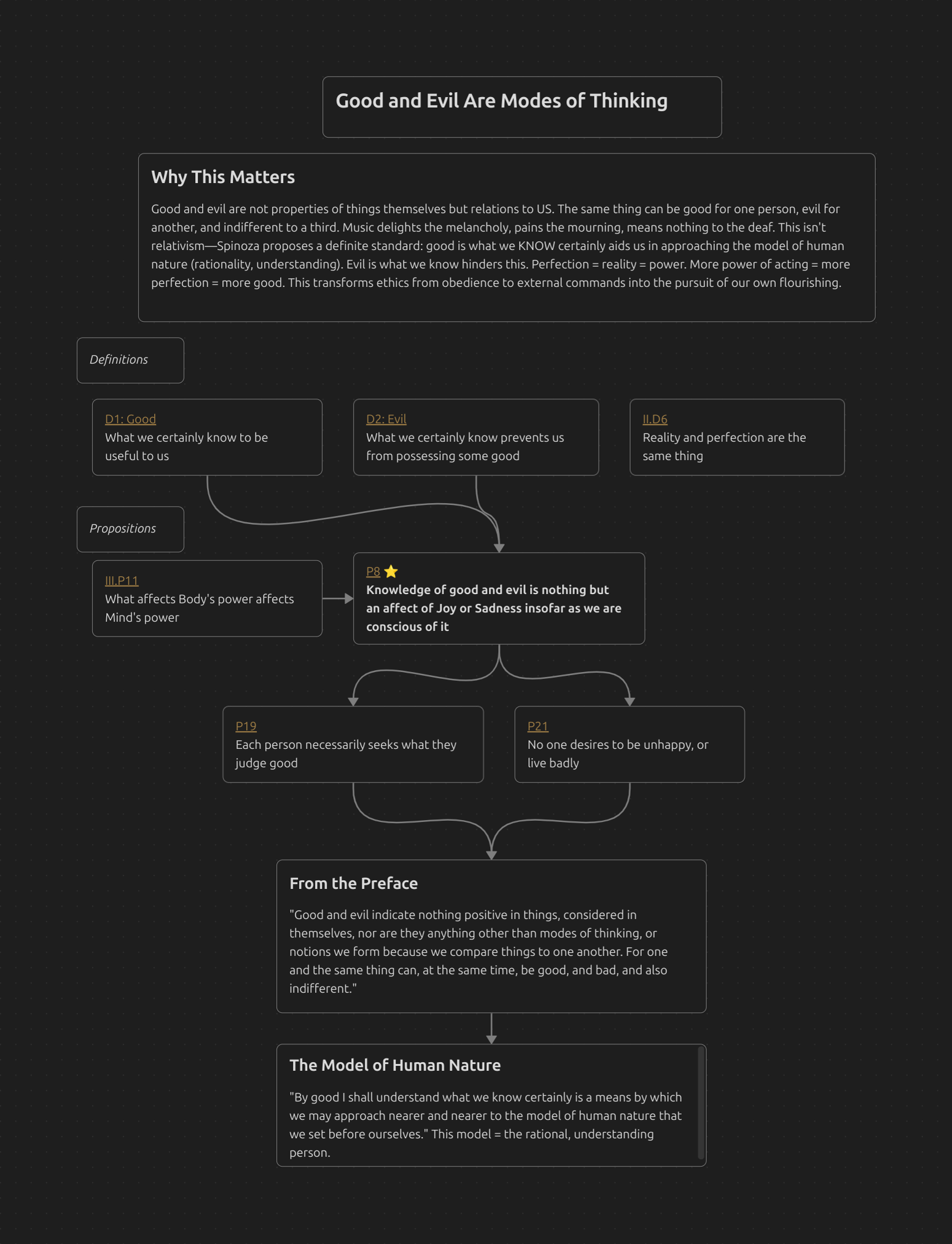
Good and Evil Are Modes of Thinking
Why This Matters
Good and evil are not properties of things themselves but relations to US. The same thing can be good for one person, evil for another, and indifferent to a third. Music delights the melancholy, pains the mourning, means nothing to the deaf. This isn’t relativism—Spinoza proposes a definite standard: good is what we KNOW certainly aids us in approaching the model of human nature (rationality, understanding). Evil is what we know hinders this. Perfection = reality = power. More power of acting = more perfection = more good. This transforms ethics from obedience to external commands into the pursuit of our own intellectual joy.
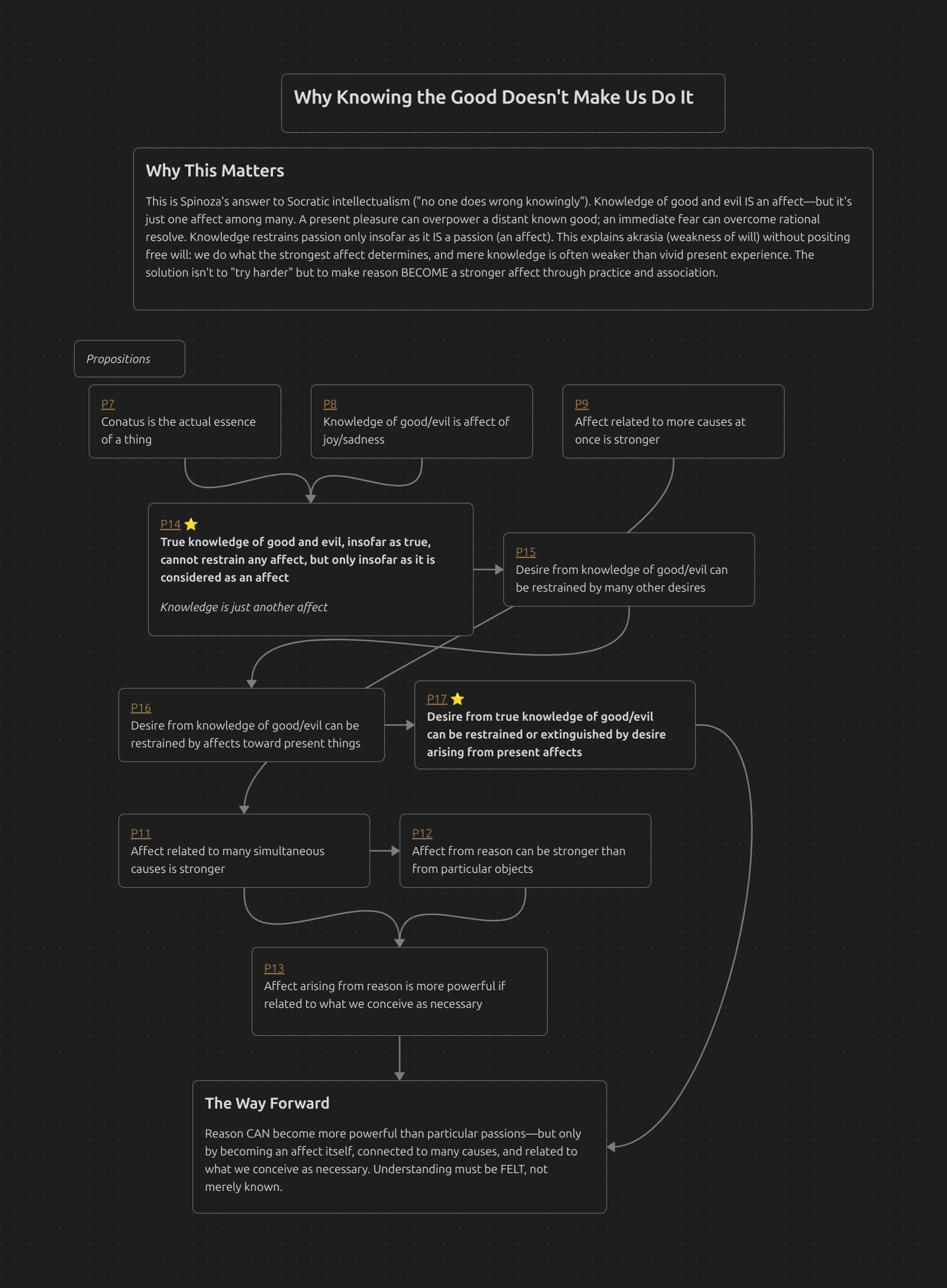
Why Knowing the Good Doesn’t Make Us Do It
Why This Matters
This is Spinoza’s answer to Socratic intellectualism (“no one does wrong knowingly”). Knowledge of good and evil IS an affect—but it’s just one affect among many. A present pleasure can overpower a distant known good; an immediate fear can overcome rational resolve. Knowledge restrains passion only insofar as it IS a passion (an affect). This explains akrasia (weakness of will) without positing free will: we do what the strongest affect determines, and mere knowledge is often weaker than vivid present experience. The solution isn’t to “try harder” but to make reason BECOME a stronger affect through practice and association.
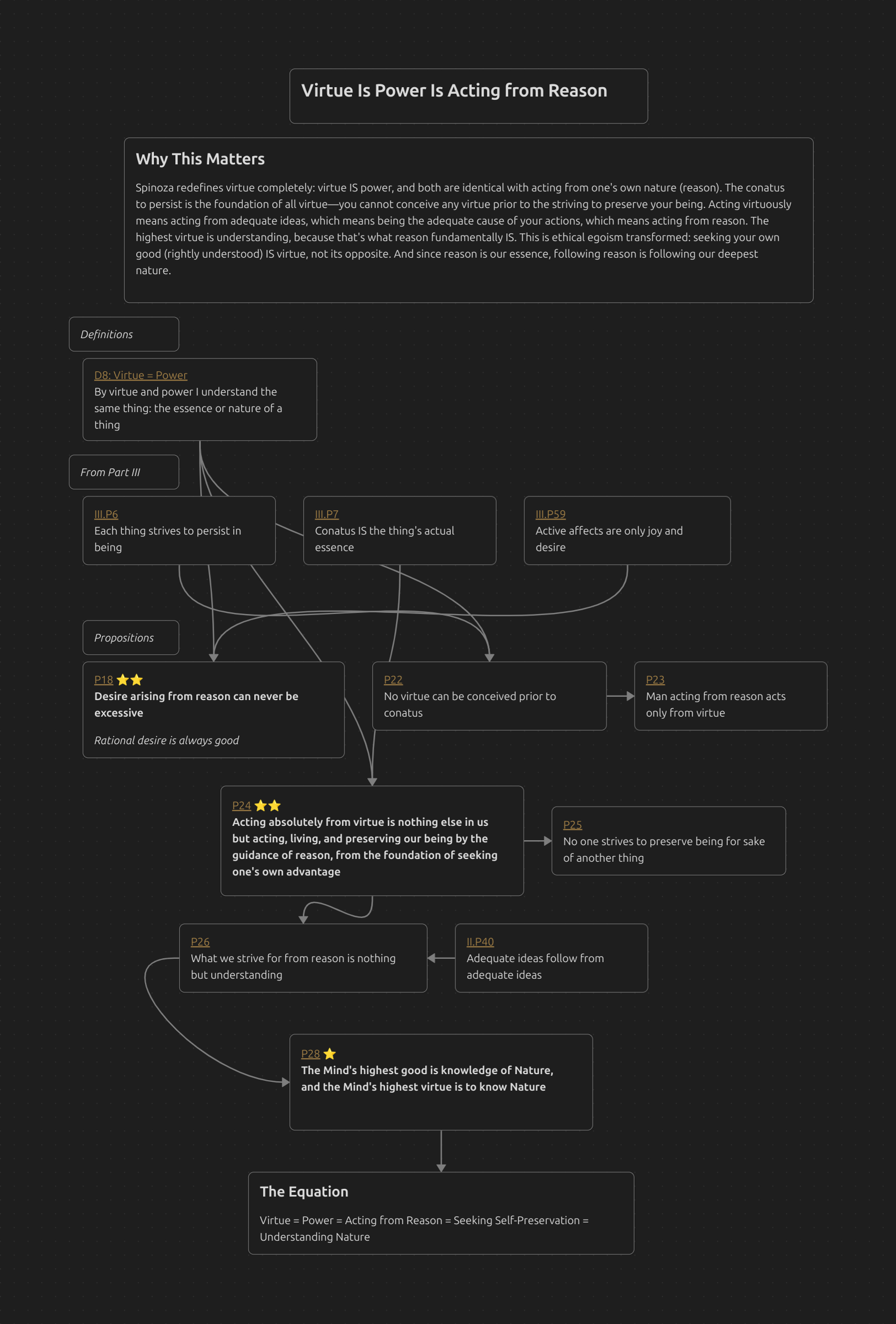
Virtue Is Power Is Acting from Reason
Why This Matters
Spinoza redefines virtue completely: virtue IS power, and both are identical with acting from one’s own nature (reason). The conatus to persist is the foundation of all virtue—you cannot conceive any virtue prior to the striving to preserve your being. Acting virtuously means acting from adequate ideas, which means being the adequate cause of your actions, which means acting from reason. The highest virtue is understanding, because that’s what reason fundamentally IS. This is ethical egoism transformed: seeking your own good (rightly understood) IS virtue, not its opposite. And since reason is our essence, following reason is following our deepest nature.
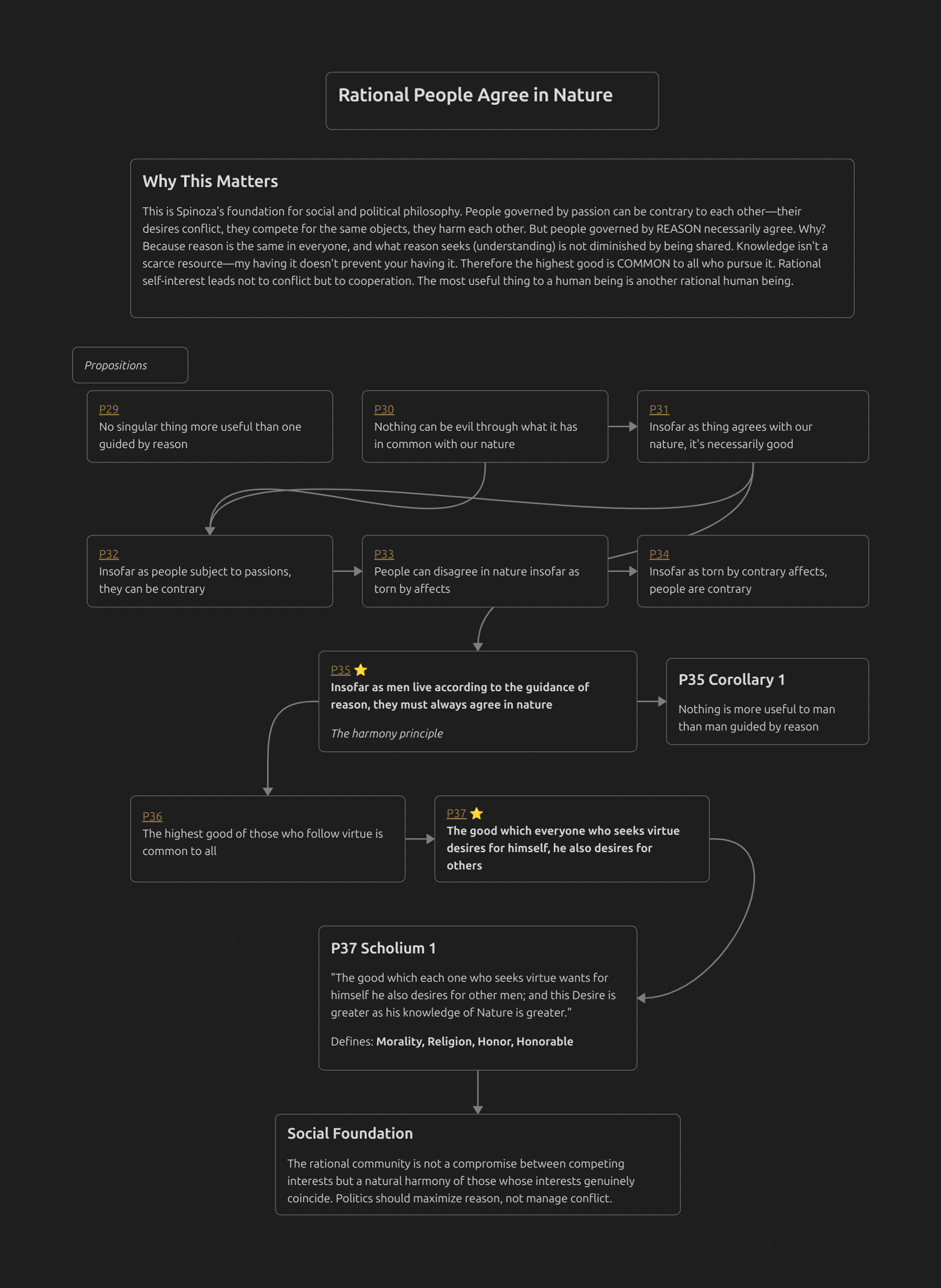
Rational People Agree in Nature
Why This Matters
This is Spinoza’s foundation for social and political philosophy. People governed by passion can be contrary to each other—their desires conflict, they compete for the same objects, they harm each other. But people governed by REASON necessarily agree. Why? Because reason is the same in everyone, and what reason seeks (understanding) is not diminished by being shared. Knowledge isn’t a scarce resource—my having it doesn’t prevent your having it. Therefore the highest good is COMMON to all who pursue it. Rational self-interest leads not to conflict but to cooperation. The most useful thing to a human being is another rational human being.
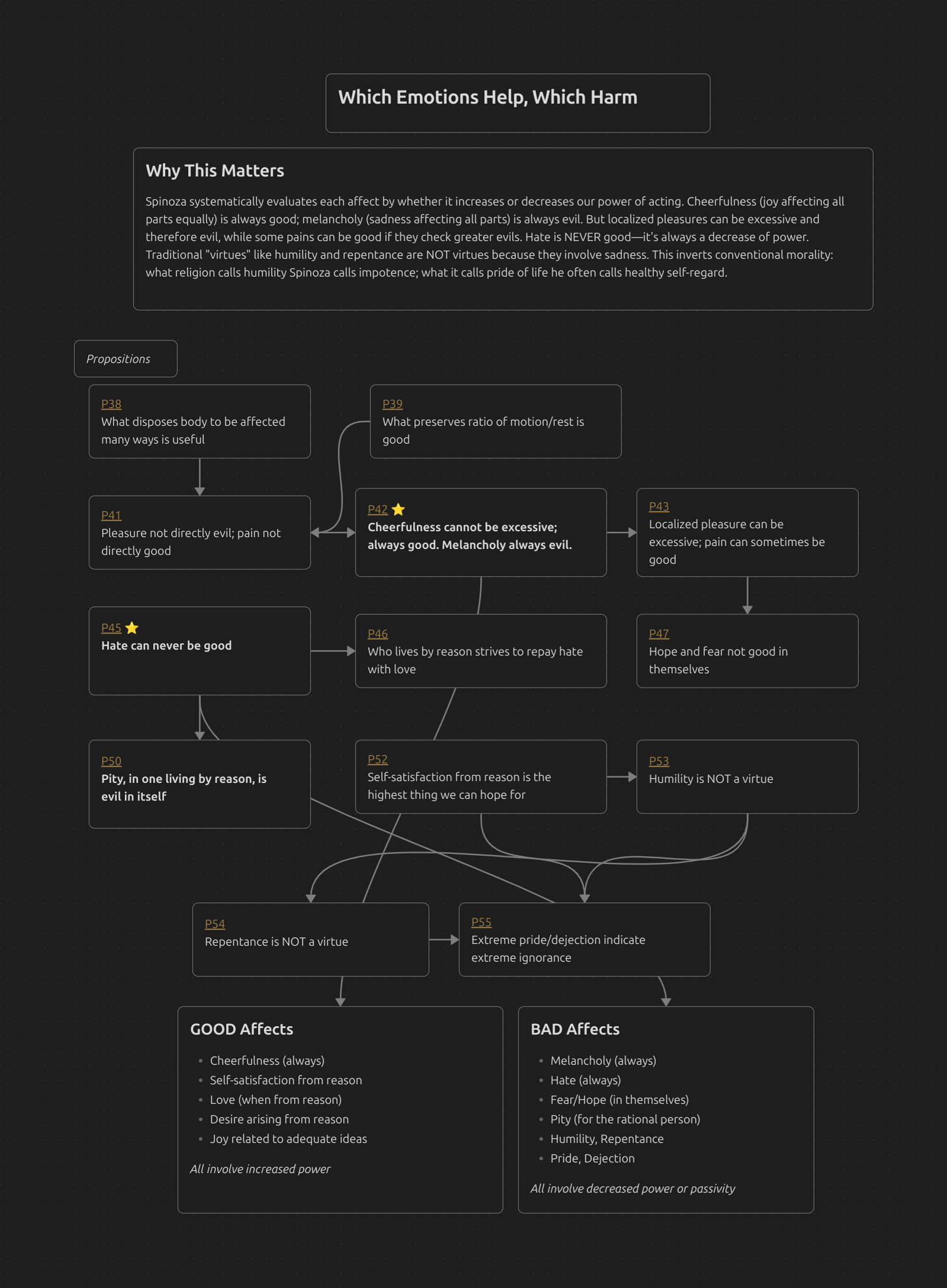
Which Emotions Help, Which Harm
Why This Matters
Spinoza systematically evaluates each affect by whether it increases or decreases our power of acting. Cheerfulness (joy affecting all parts equally) is always good; melancholy (sadness affecting all parts) is always evil. But localized pleasures can be excessive and therefore evil, while some pains can be good if they check greater evils. Hate is NEVER good—it’s always a decrease of power. Traditional “virtues” like humility and repentance are NOT virtues because they involve sadness. This inverts conventional morality: what religion calls humility Spinoza calls impotence; what it calls pride of life he often calls healthy self-regard.
Portrait of the Free Person
Why This Matters
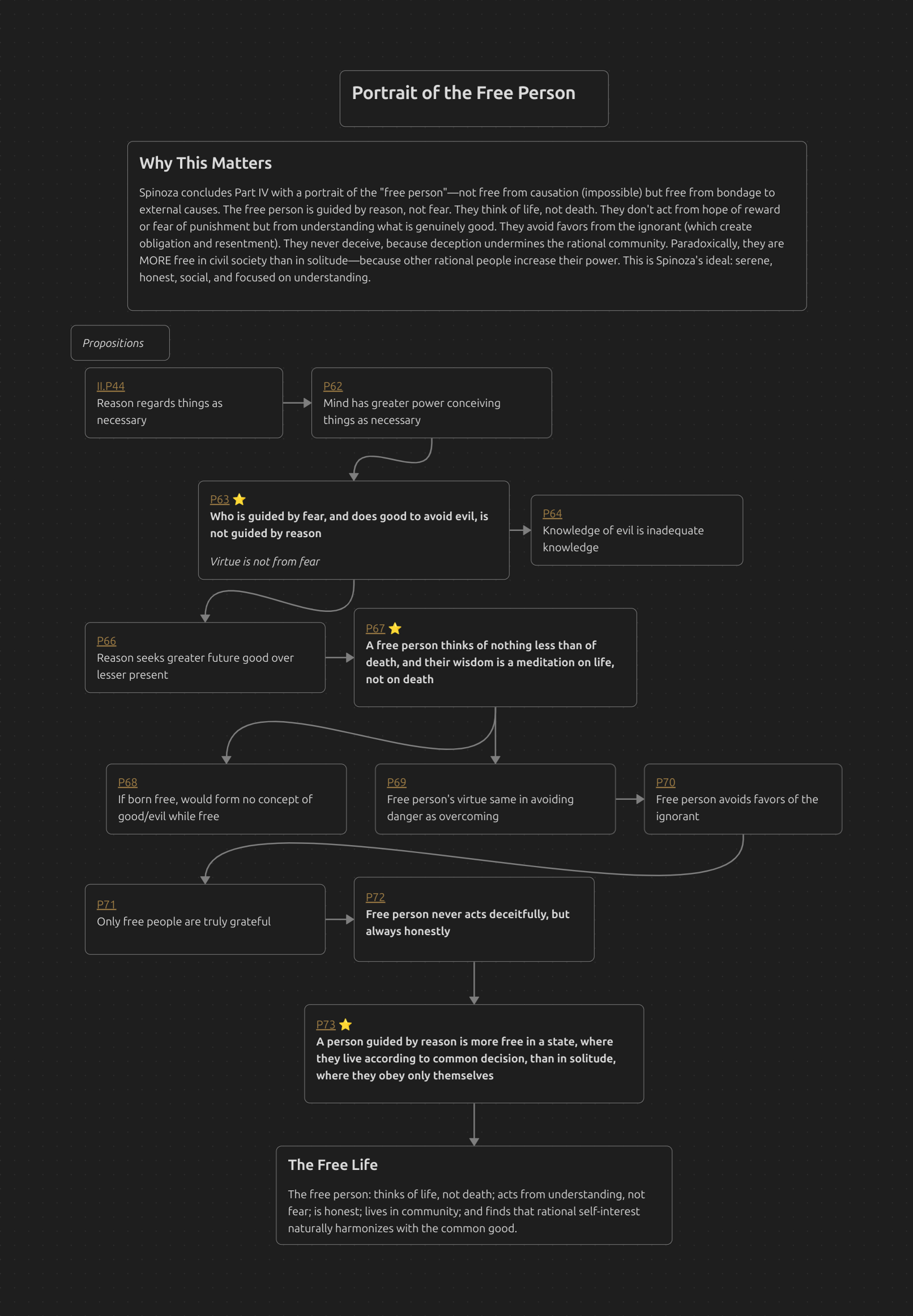
Spinoza concludes Part IV with a portrait of the “free person”—not free from causation (impossible) but free from bondage to external causes. The free person is guided by reason, not fear. They think of life, not death. They don’t act from hope of reward or fear of punishment but from understanding what is genuinely good. They avoid favors from the ignorant (which create obligation and resentment). They never deceive, because deception undermines the rational community. Paradoxically, they are MORE free in civil society than in solitude—because other rational people increase their power. This is Spinoza’s ideal: serene, honest, social, and focused on understanding.
Appendix: How to Live Well
Why This Matters
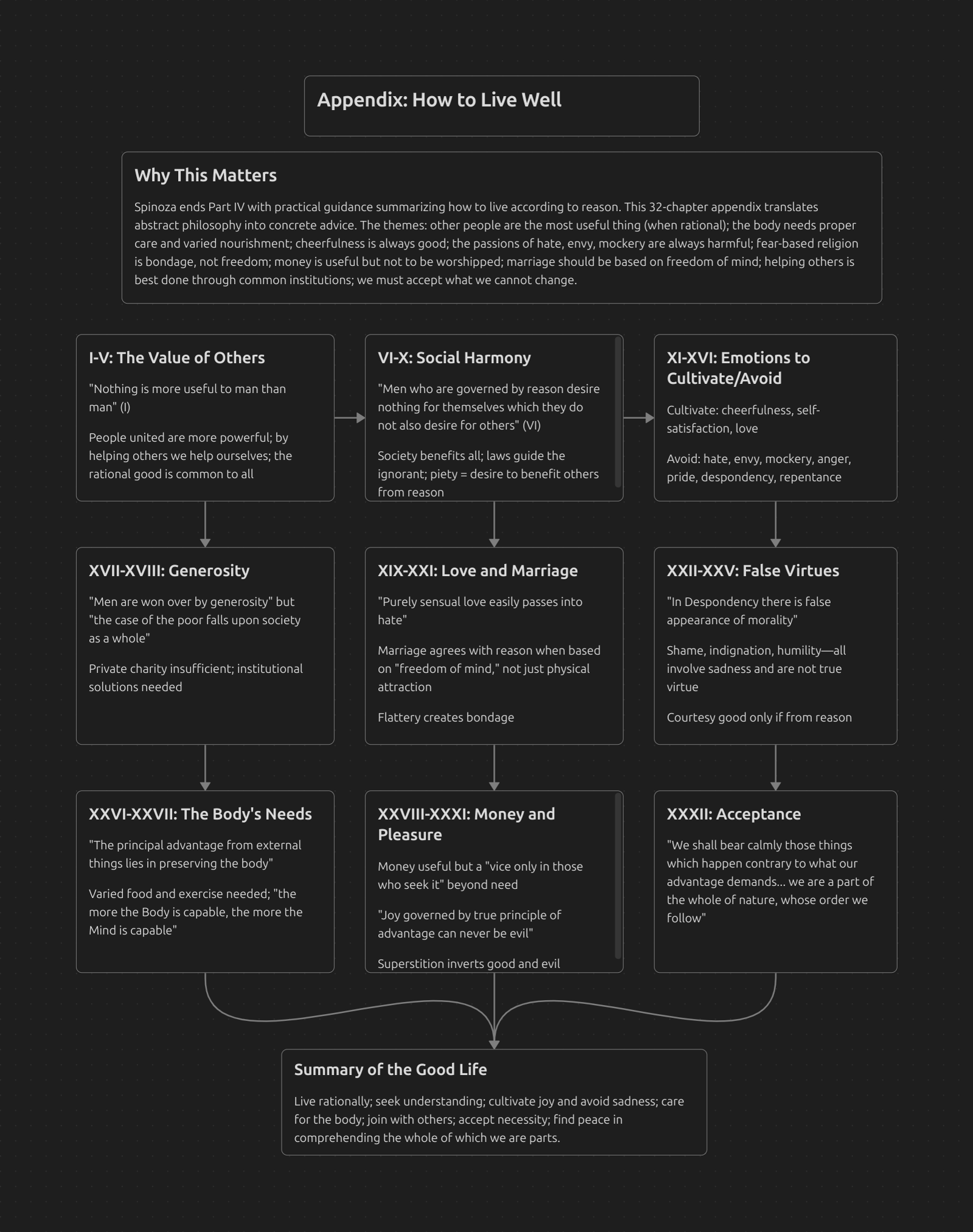
Spinoza ends Part IV with practical guidance summarizing how to live according to reason. This 32-chapter appendix translates abstract philosophy into concrete advice. The themes: other people are the most useful thing (when rational); the body needs proper care and varied nourishment; cheerfulness is always good; the passions of hate, envy, mockery are always harmful; fear-based religion is bondage, not mental freedom; money is useful but not to be worshipped; marriage should be based on mental freedom of mind; helping others is best done through common institutions; we must accept what we cannot change.
Link to original
Part 5 Important Concepts
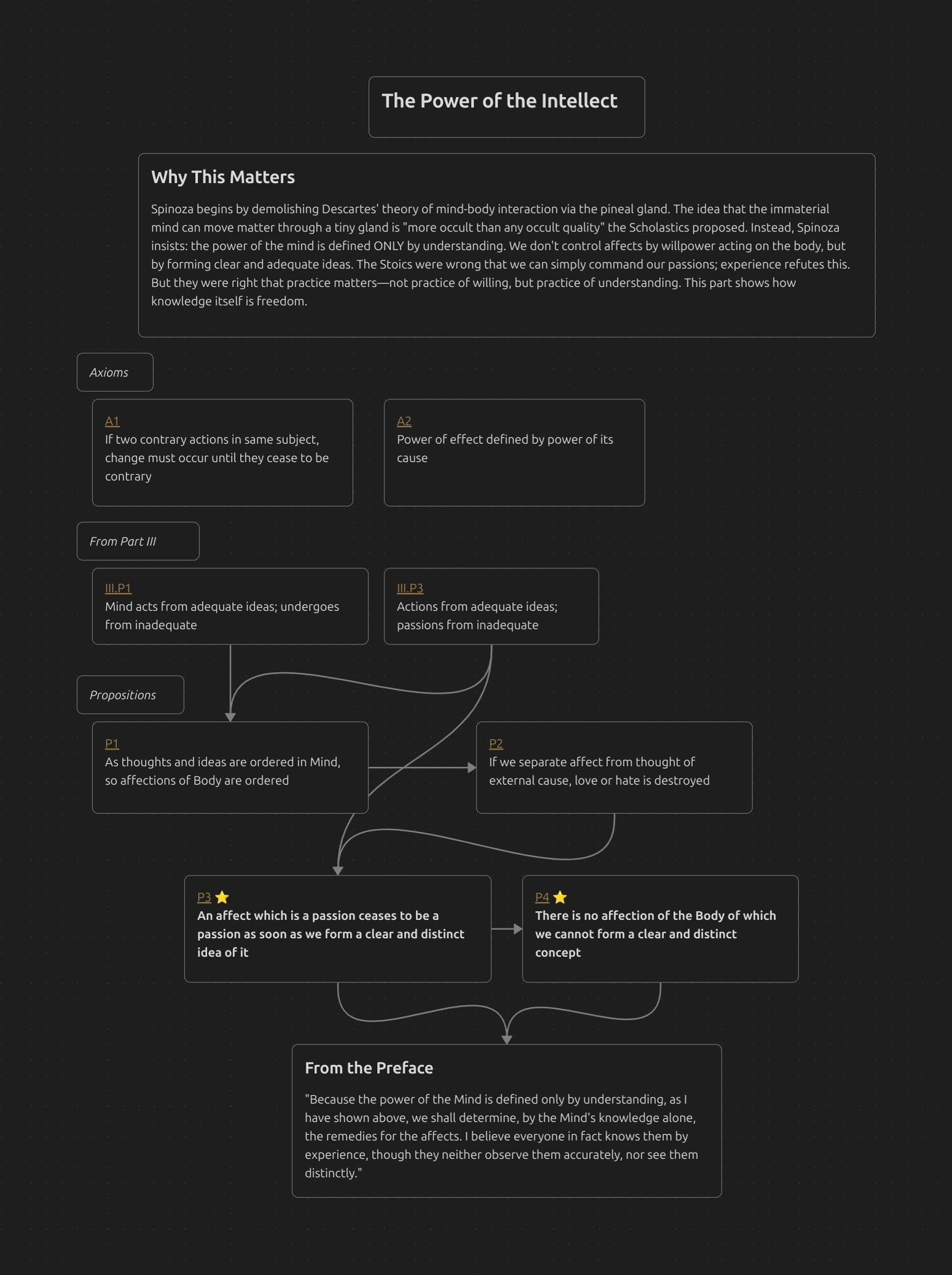
The Power of the Intellect
Why This Matters
Spinoza begins by demolishing Descartes’ theory of mind-body interaction via the pineal gland. The idea that the immaterial mind can move matter through a tiny gland is “more occult than any occult quality” the Scholastics proposed. Instead, Spinoza insists: the power of the mind is defined ONLY by understanding. We don’t control affects by willpower acting on the body, but by forming clear and adequate ideas. The Stoics were wrong that we can simply command our passions; experience refutes this. But they were right that practice matters—not practice of willing, but practice of understanding. This part shows how knowledge itself is mental freedom.
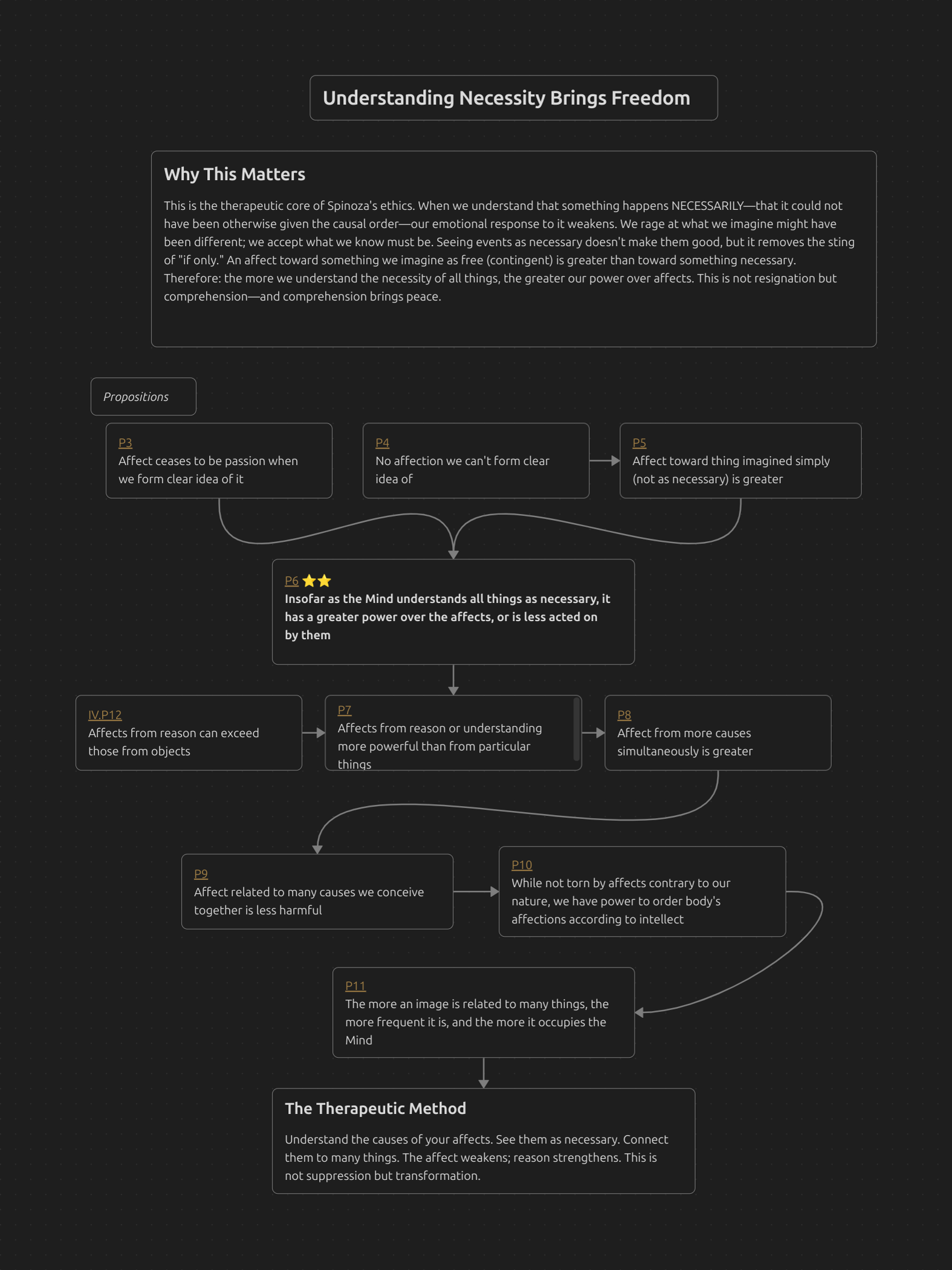
Understanding Necessity Brings Mental freedom
Why This Matters
This is the therapeutic core of Spinoza’s ethics. When we understand that something happens NECESSARILY—that it could not have been otherwise given the causal order—our emotional response to it weakens. We rage at what we imagine might have been different; we accept what we know must be. Seeing events as necessary doesn’t make them good, but it removes the sting of “if only.” An affect toward something we imagine as free (contingent) is greater than toward something necessary. Therefore: the more we understand the necessity of all things, the greater our power over affects. This is not resignation but comprehension—and comprehension brings peace.
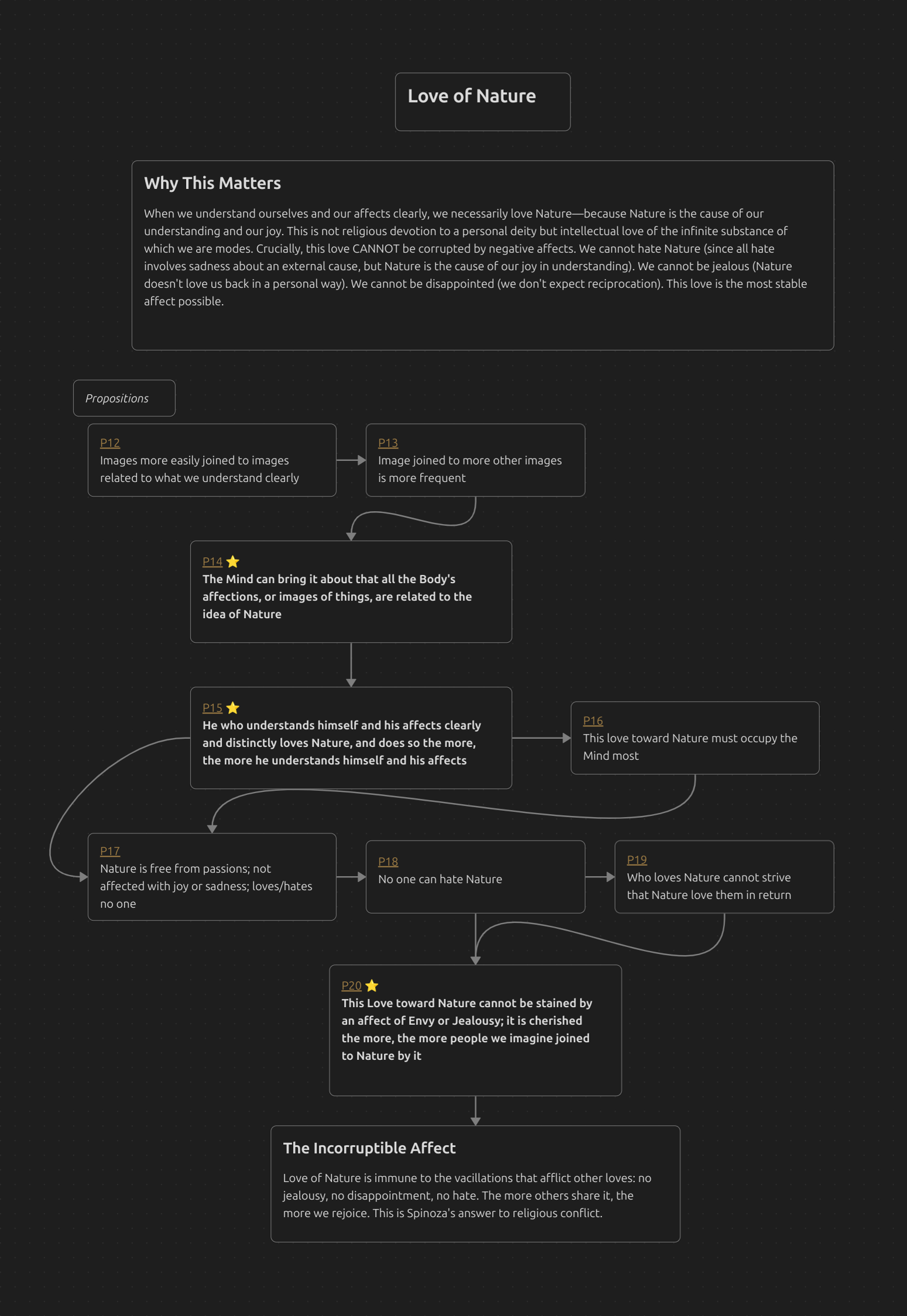
Love of Nature
Why This Matters
When we understand ourselves and our affects clearly, we necessarily love Nature—because Nature is the cause of our understanding and our joy. This is not religious devotion to a personal deity but intellectual love of the infinite substance of which we are modes. Crucially, this love CANNOT be corrupted by negative affects. We cannot hate Nature (since all hate involves sadness about an external cause, but Nature is the cause of our joy in understanding). We cannot be jealous (Nature doesn’t love us back in a personal way). We cannot be disappointed (we don’t expect reciprocation). This love is the most stable affect possible.
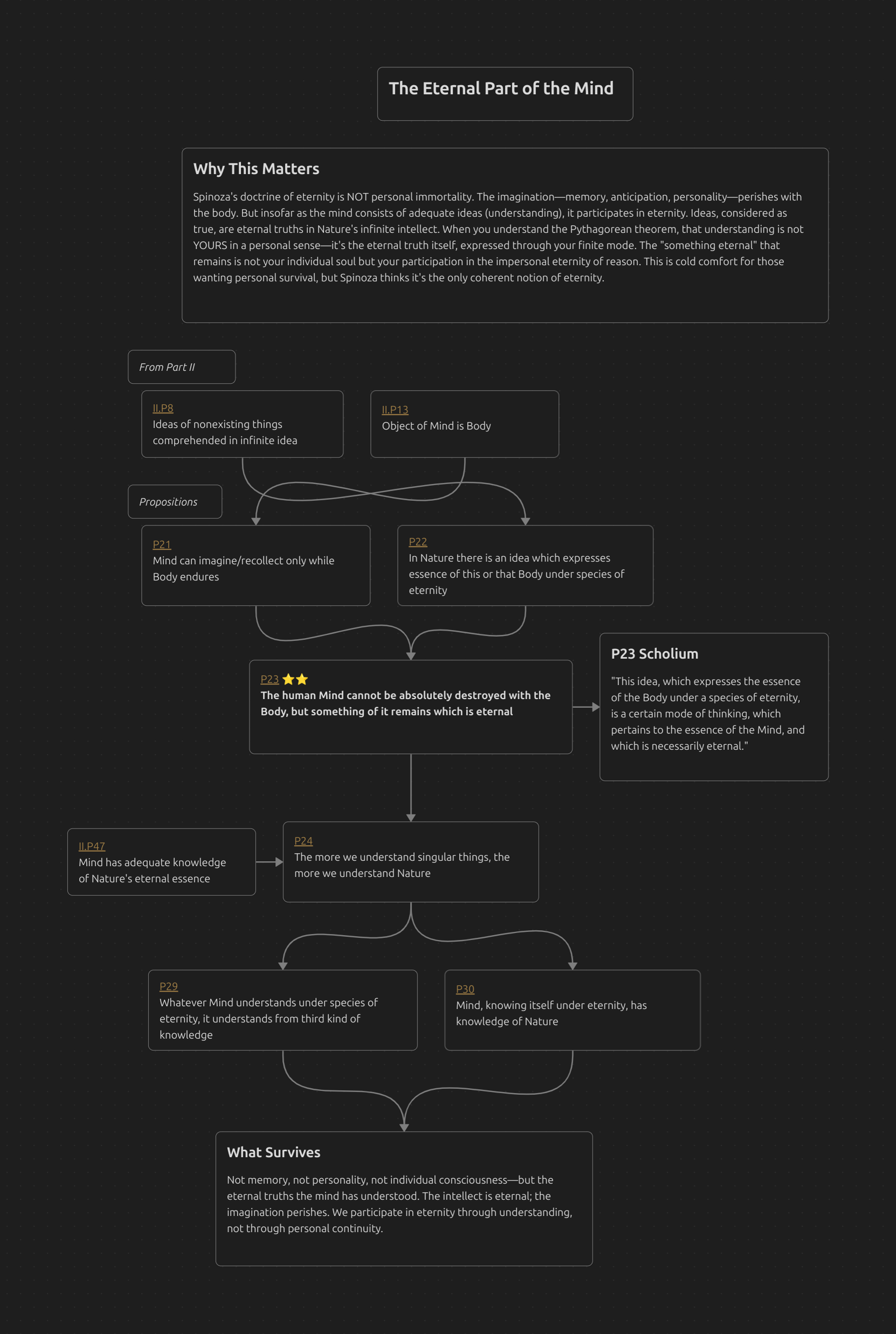
The Eternal Part of the Mind
Why This Matters
Spinoza’s doctrine of eternity is NOT personal immortality. The imagination—memory, anticipation, personality—perishes with the body. But insofar as the mind consists of adequate ideas (understanding), it participates in eternity. Ideas, considered as true, are eternal truths in Nature’s infinite intellect. When you understand the Pythagorean theorem, that understanding is not YOURS in a personal sense—it’s the eternal truth itself, expressed through your finite mode. The “something eternal” that remains is not your individual soul but your participation in the impersonal eternity of reason. This is cold comfort for those wanting personal survival, but Spinoza thinks it’s the only coherent notion of eternity.
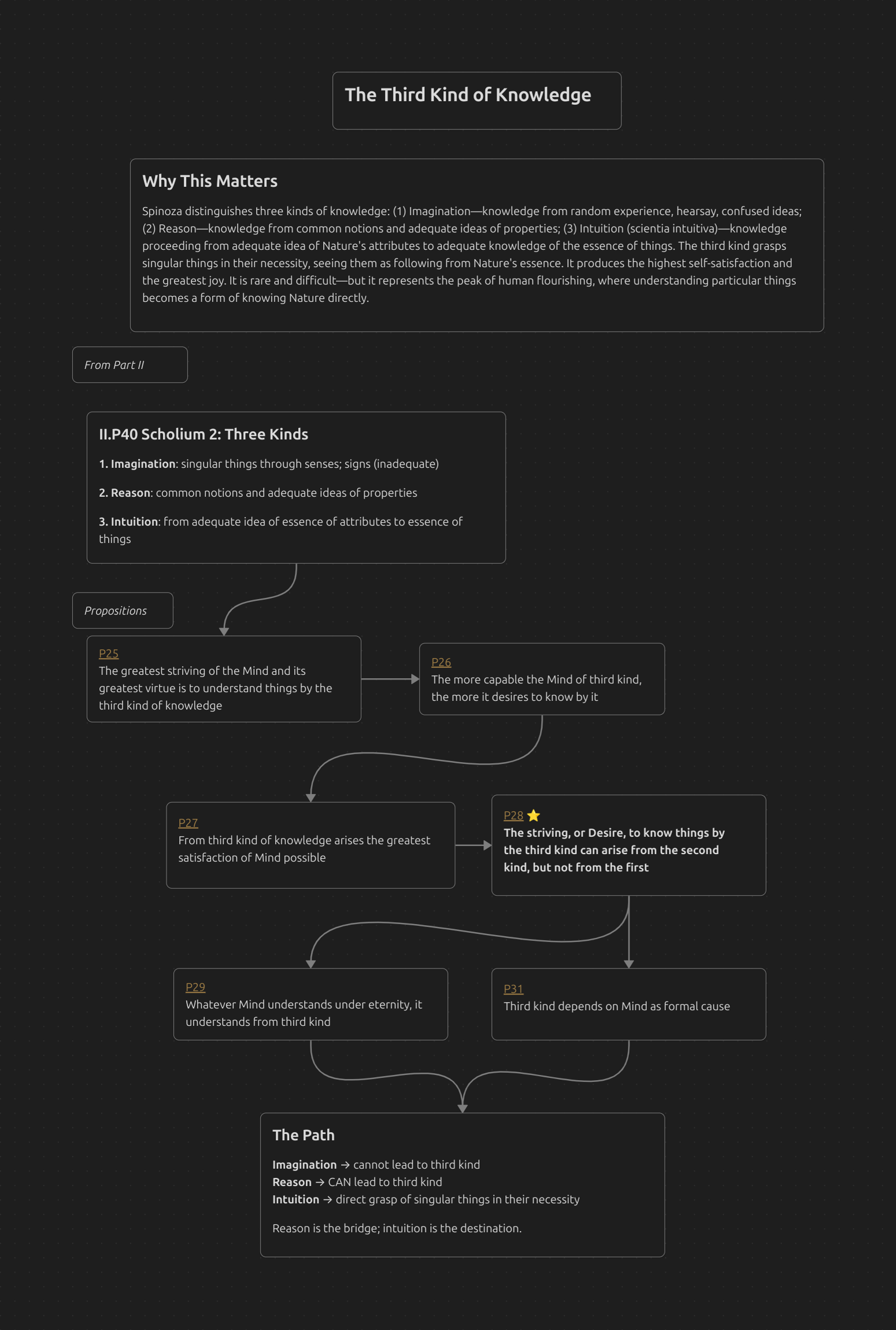
The third kind of knowledge
Why This Matters
Spinoza distinguishes three kinds of knowledge: (1) Imagination—knowledge from random experience, hearsay, confused ideas; (2) Reason—knowledge from common notions and adequate ideas of properties; (3) Intuition (scientia intuitiva)—knowledge proceeding from Adequate idea of Nature’s attributes to adequate knowledge of the essence of things. The third kind grasps singular things in their necessity, seeing them as following from Nature’s essence. It produces the highest self-satisfaction and the greatest joy. It is rare and difficult—but it represents the peak of human intellectual joy, where understanding particular things becomes a form of knowing Nature directly.
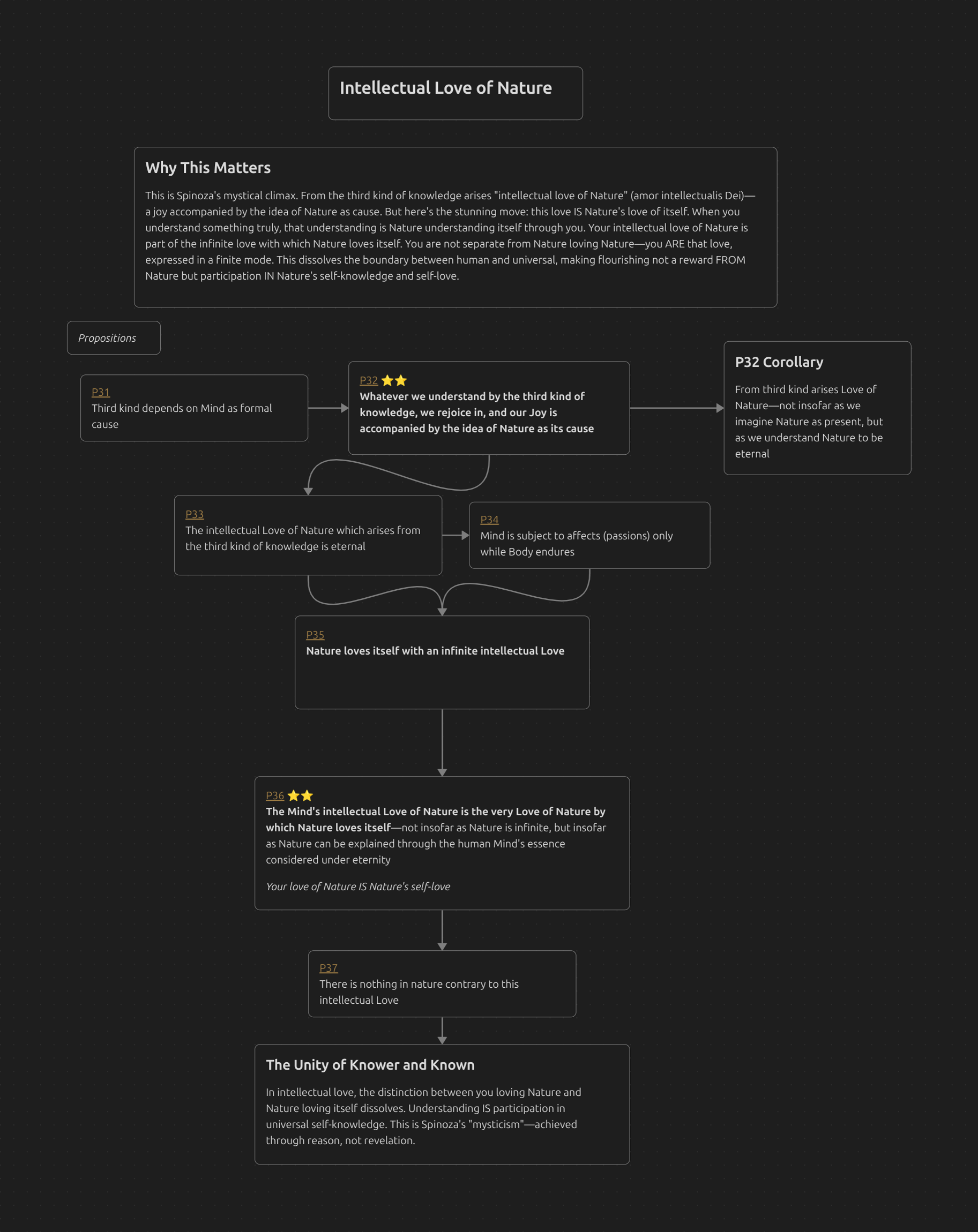
Intellectual Love of Natureof Nature
Why This Matters
This is Spinoza’s mystical climax. From the third kind of knowledge arises “intellectual love of Nature” (amor intellectualis Dei)—a joy accompanied by the idea of Nature as cause. But here’s the stunning move: this love IS Nature’s love of itself. When you understand something truly, that understanding is Nature understanding itself through you. Your intellectual love of Nature is part of the infinite love with which Nature loves itself. You are not separate from Nature loving Nature—you ARE that love, expressed in a finite mode. This dissolves the boundary between human and divine, making intellectual joy not a reward FROM Nature but participation IN Nature’s self-knowledge and self-love.
Intellectual joy Is Not the Reward of Virtue, But Virtue Itself
Why This Matters
The Ethics ends with its most famous proposition: intellectual joy is not a reward for virtue but IS virtue itself. We don’t restrain our lusts in order to be happy later—we ARE happy when we understand, and that happiness gives us power over lusts. This inverts the religious picture where morality is a burden rewarded after death. For Spinoza, understanding IS joy, virtue IS power, and intellectual joy IS the activity of knowing Nature. The wise person “never ceases to be, but always possesses true peace of mind.” The way is hard—“all things excellent are as difficult as they are rare”—but it is the only path to genuine mental freedom and peace.
Link to original